Department of Nursing, College of Nursing, Tzu Chi University of Science and Technology, Hualien, Taiwan.
Department of Family Physician and Geriatrician, Mennonite Christian Hospital, Hualien, Taiwan.
BMC Geriatr. 2023 Nov 16;23(1):749. doi: 10.1186/s12877-023-04478-w.
With the rapid aging of the population structure, and the suicide ideation rate also increasing year by year, the ratio of people over 65 to the total number of deaths is increasing yearly. The study provides a reference for researchers interested in older adults' care to explore SI further affecting older adults in the future and provide a reference for qualitative research methods or interventional measures.
The objective of this study is to explore the influence of mental health status, life satisfaction, and depression status on suicidal ideation (SI) among hospitalized older adults.
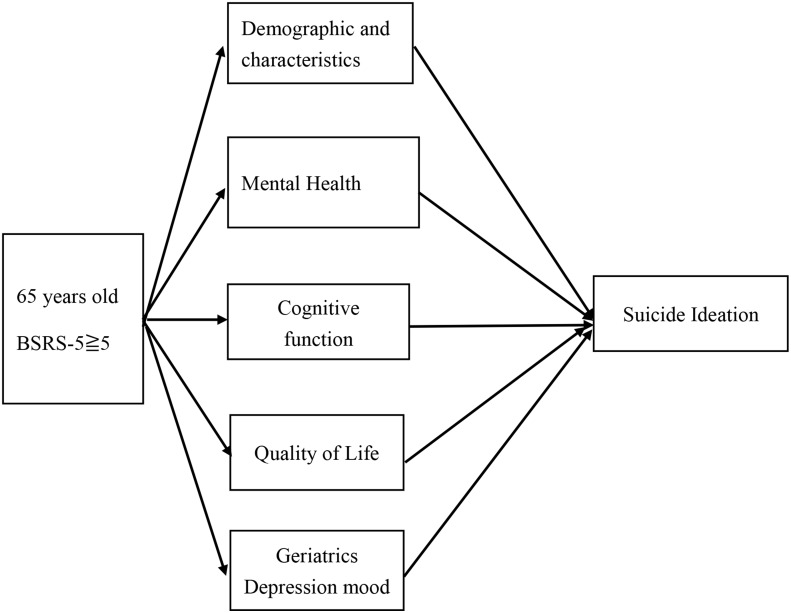
In a cross-sectional correlation study, taking inpatients over 65 years old in a regional teaching hospital in eastern Taiwan, and the BSRS-5 ≧ 5 points of the screening cases, a total of 228 older adults agree to conduct data analysis in this study. Mainly explore the influence of personal characteristics, mental health status, life satisfaction, and depressed mood on SI among the hospitalized older adults. The basic attributes of the cases used in the data, mental health status, cognitive function, quality of life, depression, and suicide ideation, the data obtained were statistically analyzed with SPSS 20/Windows, and the descriptive statistics were average, standard deviation, percentage, median, etc. In the part of inference statistics, independent sample t-test, single-factor analysis of variance, Pearson performance difference correlation, and logistic regression analysis were used to detect important predictors of SI.
Research results in (1) 89.5% of hospitalized older adults have a tendency to depression. 2.26.3% of the older adults had SI. (2) Here are significant differences in the scores of SI among hospitalized older adults in different economic status groups and marital status groups. (3) The age, marital status, and quality of life of the hospitalized older adults were negatively correlated with SI; economic status, self-conscious health, mental health, and depression were positively correlated with SI. (4) The results of the mental health status and SI is (r = .345, p < .001), higher the score on the BSRS-5 scale, the higher the SI. The correlation between the depression scale score (SDS-SF) and SI was (r = .150, p < .05), the higher the depression scale score, the higher the SI.
The results of the study found that there was a statistically significant correlation between SI in older adults and age, marital status, economic status, mental health, quality of life, and depression, and also showed that they might interact with each other; the older adults in BSRS-5, GDS-SF, quality of life scale scores have statistically significant differences as essential predictors of SI. The results of this study suggest that medical staff can use the BSRS-5 scale to quickly screen and evaluate the mental health status of older adults, hoping to detect early and provide preventive measures, thereby improving the quality of life of older adults.
随着人口结构的快速老龄化,以及自杀意念率逐年上升,65 岁以上人群在总死亡人数中的比例逐年上升。该研究为关注老年人护理的研究人员提供了参考,以探讨 SI 对未来老年人的进一步影响,并为定性研究方法或干预措施提供参考。
本研究旨在探讨心理健康状况、生活满意度和抑郁状况对住院老年人自杀意念(SI)的影响。
采用横断面相关性研究方法,选取台湾东部某地区教学医院的 65 岁以上住院患者,并对筛查病例中的 BSRS-5≥5 分进行研究,共有 228 名老年人同意进行数据分析。主要探讨个人特征、心理健康状况、生活满意度和抑郁情绪对住院老年人 SI 的影响。病例的基本属性、心理健康状况、认知功能、生活质量、抑郁和自杀意念均采用 SPSS 20/Windows 进行数据分析,采用平均值、标准差、百分比、中位数等进行描述性统计。在推断统计部分,采用独立样本 t 检验、单因素方差分析、Pearson 绩效差异相关和逻辑回归分析来检测 SI 的重要预测因子。
(1)89.5%的住院老年人有抑郁倾向。2.26.3%的老年人有 SI。(2)不同经济状况组和婚姻状况组住院老年人 SI 得分存在显著差异。(3)老年人的年龄、婚姻状况和生活质量与 SI 呈负相关;经济状况、自我意识健康、心理健康和抑郁与 SI 呈正相关。(4)心理健康状况和 SI 的结果为(r=0.345,p<0.001),BSRS-5 量表得分越高,SI 越高。抑郁量表评分(SDS-SF)与 SI 的相关性为(r=0.150,p<0.05),抑郁量表评分越高,SI 越高。
研究结果发现,老年人 SI 与年龄、婚姻状况、经济状况、心理健康、生活质量和抑郁呈显著相关,且可能相互作用;BSRS-5、GDS-SF、生活质量量表评分较高的老年人作为 SI 的重要预测因子有统计学意义。本研究结果提示医务人员可利用 BSRS-5 量表快速筛查和评估老年人的心理健康状况,希望能早期发现并采取预防措施,从而提高老年人的生活质量。
