University of Texas at Austin Dell Medical School, Austin.
Audie L. Murphy Veterans Affairs Medical Center, San Antonio, Texas.
JAMA Netw Open. 2023 Nov 1;6(11):e2344448. doi: 10.1001/jamanetworkopen.2023.44448.
Housing status is an important health determinant, yet little is known about unstable housing among individuals receiving dialysis.
To determine factors associated with unstable housing among US veterans receiving dialysis and to estimate the association of unstable housing with risk of death.
DESIGN, SETTING, AND PARTICIPANTS: This retrospective cohort study used data from the US Veterans Health Administration (VHA) and the US Renal Data System for patients who initiated dialysis between October 1, 2012, and December 31, 2018. Veterans were included if they used VHA outpatient services and completed 1 or more unstable housing screenings within a 3-year period before starting dialysis. Data analysis was conducted from January 24 to June 16, 2023.
Unstable housing was defined as self-report of not having stable housing within the past 2 months or having concerns about stable housing in the next 2 months.
The main outcome was all-cause mortality. Characteristics associated with unstable housing at the time of dialysis initiation were examined. The multivariate Fine and Gray cumulative incidence model was used, treating transplant as a competing risk and age as an effect modifier, to examine the risk of death associated with unstable housing.
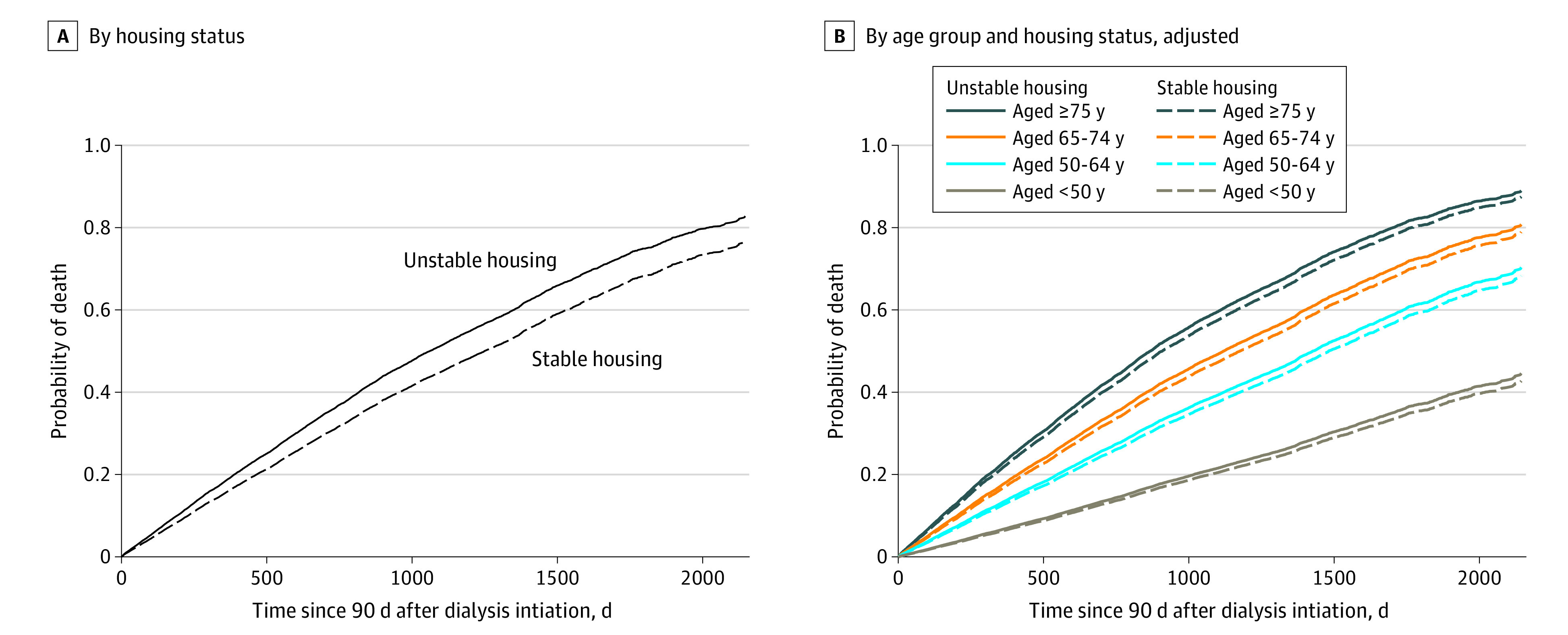
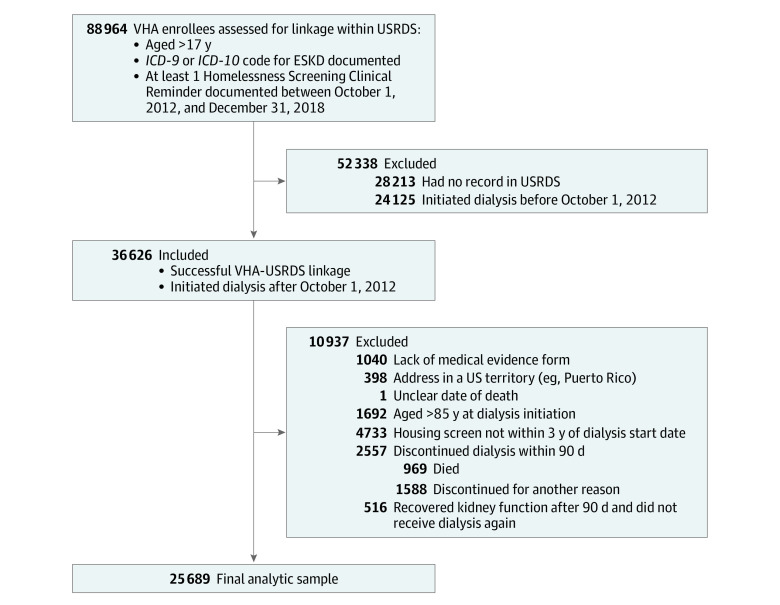
This study included 25 689 veterans, with a median age of 68 (IQR, 62-74) years. Most participants were men (98%), and more than half (52%) were White. There were 771 veterans (3%) with a positive screen for unstable housing within a 3-year period before starting dialysis. Compared with veterans with stable housing, those with unstable housing were younger (mean [SD] age, 61 [8] vs 68 [10] years), were more likely to be Black (45% vs 32%) or Hispanic (9% vs 7%), and were more likely to start dialysis with a central venous catheter (77% vs 66%), receive in-center hemodialysis (96% vs 91%), and have non-Medicare insurance (53% vs 28%). Factors associated with unstable housing included Hispanic ethnicity, non-arteriovenous fistula vascular access, lack of predialysis nephrology care, and non-Medicare insurance. Veterans with unstable housing had higher all-cause mortality (adjusted hazard ratio [AHR], 1.20 [95% CI, 1.04 to 1.37] for a median age of 68 years), and risks increased with age (P = .01 for interaction). In age-stratified analyses, unstable housing was associated with higher mortality among veterans aged 75 to 85 years (AHR, 1.64 [95% CI, 1.18 to 2.28]), but associations were not observed for other age groups.
In this cohort study of veterans receiving dialysis, unstable housing experienced before starting dialysis was associated with increased risk of all-cause mortality, and risks increased with age. Further efforts are needed to understand the experiences of older adults with unstable housing and to estimate the scope of unstable housing among all individuals receiving dialysis.
住房状况是一个重要的健康决定因素,但人们对接受透析的个体中不稳定住房的了解甚少。
确定美国退伍军人接受透析时不稳定住房的相关因素,并估计不稳定住房与死亡风险的关联。
设计、设置和参与者:本回顾性队列研究使用了美国退伍军人事务部(VA)和美国肾脏数据系统的数据,这些数据来自于 2012 年 10 月 1 日至 2018 年 12 月 31 日期间开始透析的患者。如果退伍军人在开始透析前的 3 年内使用 VA 门诊服务并完成了 1 次或多次不稳定住房筛查,则将其纳入研究。数据分析于 2023 年 1 月 24 日至 6 月 16 日进行。
不稳定住房的定义为过去 2 个月内自报没有稳定住房,或在未来 2 个月内对稳定住房有顾虑。
主要结果是全因死亡率。研究了在开始透析时与不稳定住房相关的特征。使用多变量 Fine 和 Gray 累积发病率模型,将移植作为竞争风险,并将年龄作为效应修饰剂,以检查不稳定住房与死亡风险的关联。
这项研究包括了 25689 名退伍军人,他们的中位年龄为 68(IQR,62-74)岁。大多数参与者是男性(98%),超过一半(52%)是白人。在开始透析前的 3 年内,有 771 名退伍军人(3%)的不稳定住房筛查呈阳性。与有稳定住房的退伍军人相比,不稳定住房的退伍军人年龄更小(平均[SD]年龄,61[8]岁 vs 68[10]岁),更可能是黑人(45% vs 32%)或西班牙裔(9% vs 7%),更可能开始透析时使用中心静脉导管(77% vs 66%),接受中心血液透析(96% vs 91%),并且拥有非医疗保险(53% vs 28%)。与不稳定住房相关的因素包括西班牙裔、非动静脉瘘血管通路、缺乏透析前肾病护理和非医疗保险。不稳定住房的退伍军人全因死亡率更高(中位年龄为 68 岁时,调整后的危险比[AHR]为 1.20[95%CI,1.04 至 1.37]),并且随着年龄的增加风险增加(P=0.01 用于交互作用)。在年龄分层分析中,不稳定住房与 75 至 85 岁退伍军人的死亡率较高相关(AHR,1.64[95%CI,1.18 至 2.28]),但在其他年龄组中未观察到相关性。
在这项接受透析的退伍军人队列研究中,开始透析前经历的不稳定住房与全因死亡率增加相关,并且风险随着年龄的增加而增加。需要进一步努力了解不稳定住房的老年人的体验,并估计所有接受透析的个体中不稳定住房的范围。