Department of Ocean Science, Hong Kong University of Science and Technology, Hong Kong, China.
Center for Ocean Research in Hong Kong and Macau, Hong Kong University of Science and Technology, Hong Kong, China.
Environ Microbiol Rep. 2024 Feb;16(1):e13216. doi: 10.1111/1758-2229.13216. Epub 2023 Nov 21.
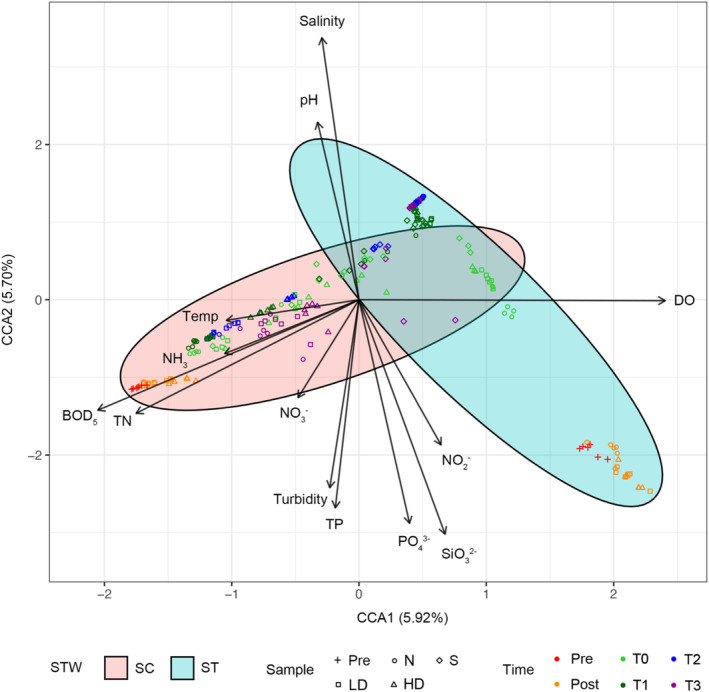
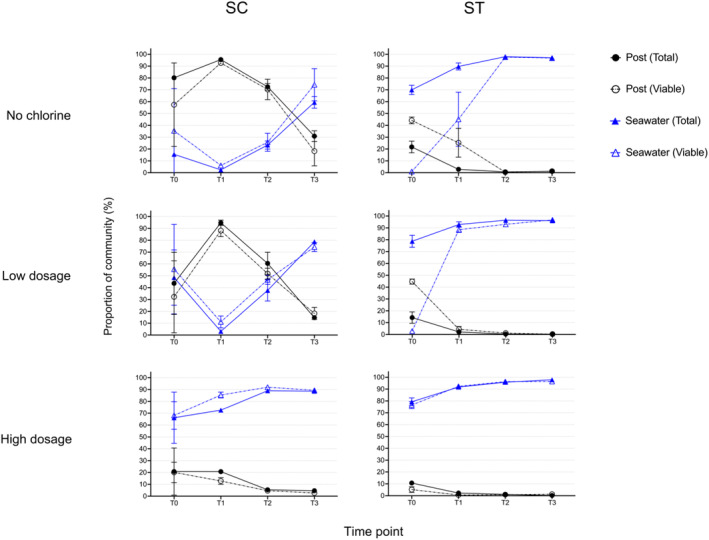
Chlorination is a commonly used disinfection method in sewage treatment process. However, resistant bacteria may survive chlorination and enter the receiving aquatic environment upon effluent discharge. There has been limited research on the effects of chlorination on bacterial survival in seawater. To address this knowledge gap, microcosm experiments were conducted to simulate the discharge of chlorinated effluents into coastal seawater. The results revealed that bacterial communities in seawater-based effluents survived better in seawater than those in freshwater-based effluents. High chlorine dosages could significantly reduce the viable bacterial populations and their chance of regrowth in seawater. Additionally, faecal indicator bacteria (FIB) that entered the viable but non-culturable (VBNC) state under chlorination tended to persist in the VBNC state without resuscitation during seawater incubation. Because of the prevalence of VBNC indicator bacteria, qPCR quantification of FIB was more effective than conventional culture-based methods in tracing viable pathogenic chlorine-resistant bacteria, although the correlation strength varied depending on the type of effluent. This study sheds light on how chlorine dosages and the intrinsic properties of effluents affect bacterial survival in seawater and highlights the potential and limitations of using FIB in monitoring the health risks associated with the discharge of chlorinated effluents.
氯化消毒是污水处理过程中常用的消毒方法。然而,耐氯菌可能在氯化后存活,并在污水排放后进入受纳水生环境。关于氯化消毒对海水细菌存活的影响,研究有限。为了弥补这一知识空白,进行了微宇宙实验来模拟氯化污水排入沿海海水的情况。结果表明,海水中的细菌群落比淡水中的细菌群落更能在海水中存活。高氯剂量可显著减少海水中的活菌数量及其在海水中的再生机会。此外,在氯化作用下进入活但非可培养(VBNC)状态的粪便指示菌(FIB)在海水孵育过程中倾向于持续处于 VBNC 状态而不复苏。由于 VBNC 指示菌的普遍存在,qPCR 定量 FIB 比传统的基于培养的方法更有效地追踪活的致病性耐氯细菌,尽管相关性强度取决于污水的类型。本研究揭示了氯剂量和污水内在特性如何影响海水细菌的存活,并强调了使用 FIB 监测与氯化污水排放相关的健康风险的潜力和局限性。