Department of Urology, Sun Yat-Sen Memorial Hospital, Sun Yat-Sen University, Guangdong Provincial Key Laboratory of Malignant Tumor Epigenetics and Gene Regulation, Guangdong Provincial Clinical Research Center for Urological Diseases, Guangzhou, Guangdong 510120, China.
Department of Neurology, Sun Yat-Sen Memorial Hospital, Sun Yat-Sen University, Guangzhou, Guangdong 510120, China.
Chin Med J (Engl). 2024 May 5;137(9):1095-1104. doi: 10.1097/CM9.0000000000002866. Epub 2023 Nov 23.
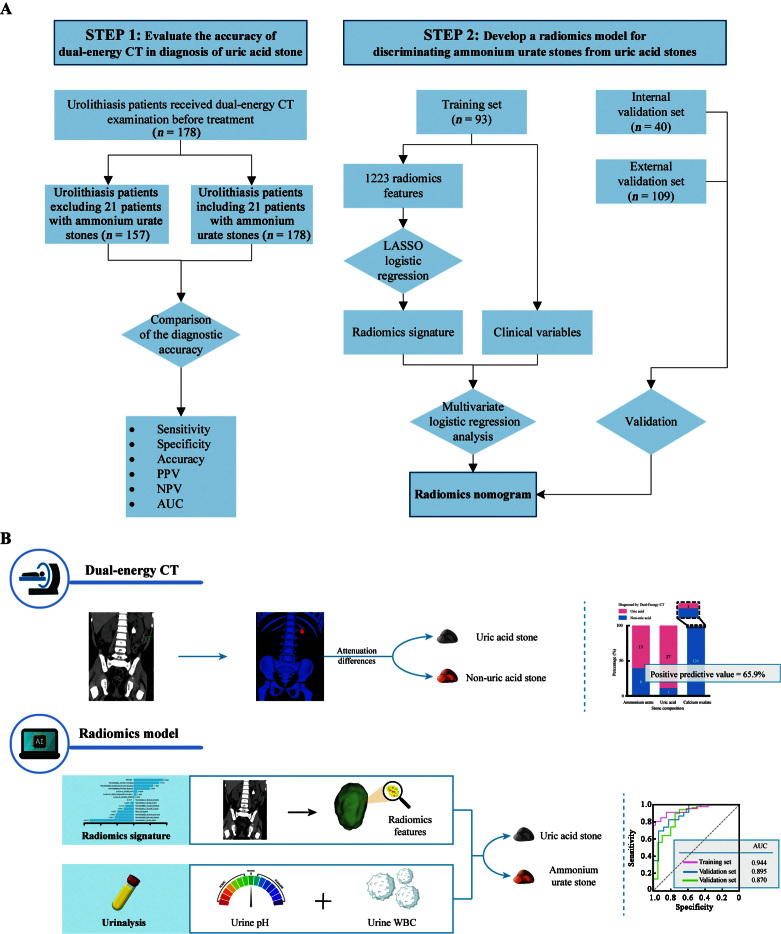
Dual-energy computed tomography (DECT) is purported to accurately distinguish uric acid stones from non-uric acid stones. However, whether DECT can accurately discriminate ammonium urate stones from uric acid stones remains unknown. Therefore, we aimed to explore whether they can be accurately identified by DECT and to develop a radiomics model to assist in distinguishing them.
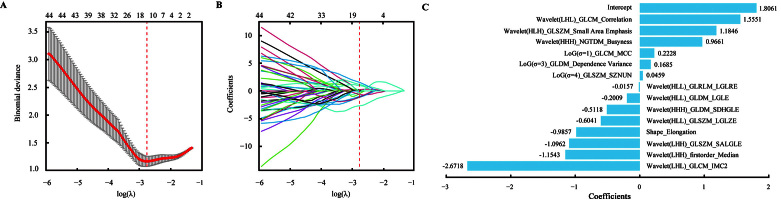
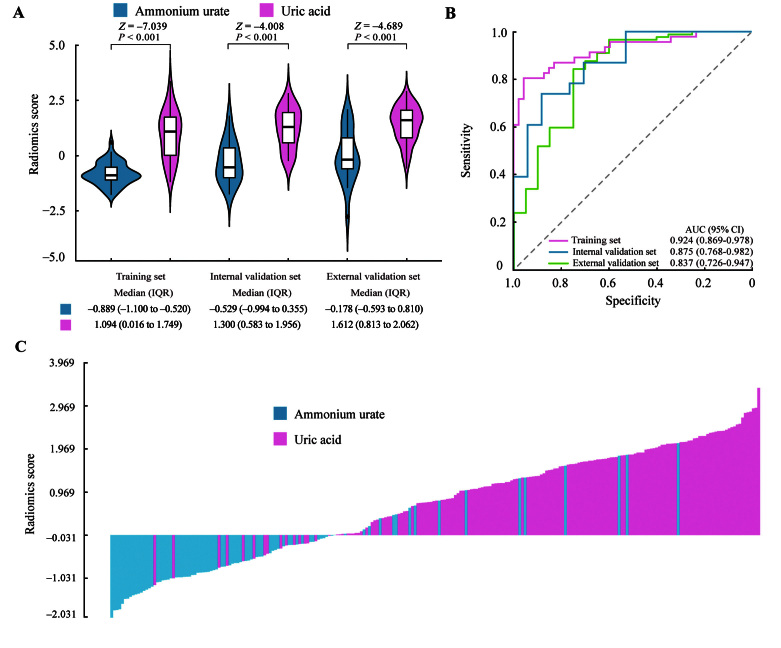
This research included two steps. For the first purpose to evaluate the accuracy of DECT in the diagnosis of uric acid stones, 178 urolithiasis patients who underwent preoperative DECT between September 2016 and December 2019 were enrolled. For model construction, 93, 40, and 109 eligible urolithiasis patients treated between February 2013 and October 2022 were assigned to the training, internal validation, and external validation sets, respectively. Radiomics features were extracted from non-contrast CT images, and the least absolute shrinkage and selection operator (LASSO) algorithm was used to develop a radiomics signature. Then, a radiomics model incorporating the radiomics signature and clinical predictors was constructed. The performance of the model (discrimination, calibration, and clinical usefulness) was evaluated.
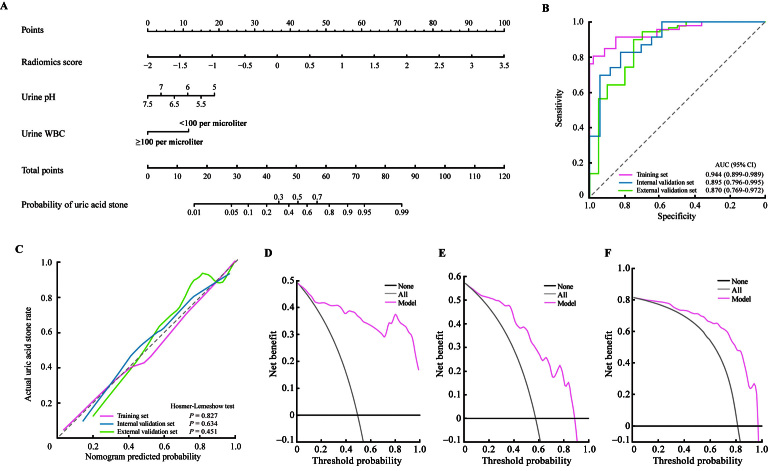
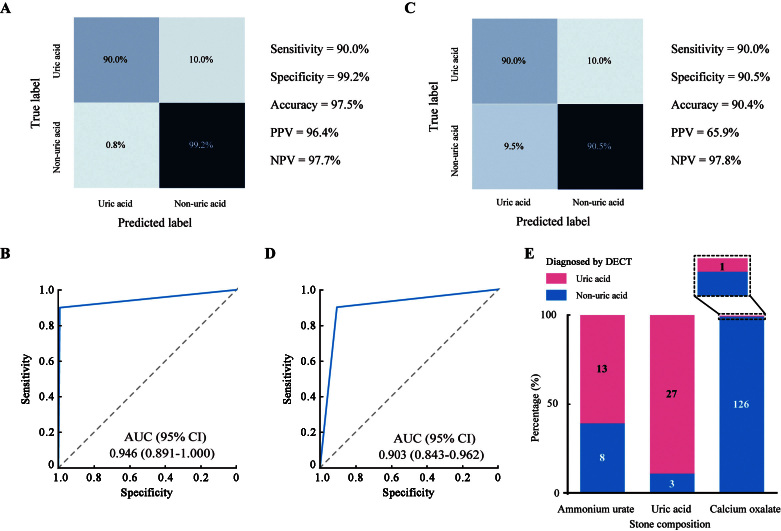
When patients with ammonium urate stones were included in the analysis, the accuracy of DECT in the diagnosis of uric acid stones was significantly decreased. Sixty-two percent of ammonium urate stones were mistakenly diagnosed as uric acid stones by DECT. A radiomics model incorporating the radiomics signature, urine pH value, and urine white blood cell count was constructed. The model achieved good calibration and discrimination {area under the receiver operating characteristic curve (AUC; 95% confidence interval [CI]), 0.944 (0.899-0.989)}, which was internally and externally validated with AUCs of 0.895 (95% CI, 0.796-0.995) and 0.870 (95% CI, 0.769-0.972), respectively. Decision curve analysis revealed the clinical usefulness of the model.
DECT cannot accurately differentiate ammonium urate stones from uric acid stones. Our proposed radiomics model can serve as a complementary diagnostic tool for distinguishing them in vivo .
双能 CT(DECT)被认为可以准确地区分尿酸结石和非尿酸结石。然而,DECT 是否能准确区分尿酸铵结石和尿酸结石尚不清楚。因此,我们旨在探讨 DECT 是否能准确识别它们,并开发一种放射组学模型来辅助区分它们。
本研究分为两个步骤。第一,为了评估 DECT 对尿酸结石诊断的准确性,我们纳入了 178 例 2016 年 9 月至 2019 年 12 月间接受术前 DECT 的尿路结石患者。为了构建模型,我们分别从 2013 年 2 月至 2022 年 10 月间治疗的 93、40 和 109 例符合条件的尿路结石患者中,将其纳入训练集、内部验证集和外部验证集。从非增强 CT 图像中提取放射组学特征,并使用最小绝对收缩和选择算子(LASSO)算法开发放射组学特征。然后,构建了一个纳入放射组学特征和临床预测因子的放射组学模型。评估模型的性能(区分度、校准度和临床实用性)。
当将尿酸铵结石患者纳入分析时,DECT 对尿酸结石的诊断准确性显著下降。62%的尿酸铵结石被 DECT 错误诊断为尿酸结石。我们构建了一个纳入放射组学特征、尿液 pH 值和尿液白细胞计数的放射组学模型。该模型具有良好的校准度和区分度{受试者工作特征曲线下面积(AUC;95%置信区间[CI]),0.944(0.899-0.989)},内部和外部验证的 AUC 分别为 0.895(95%CI,0.796-0.995)和 0.870(95%CI,0.769-0.972)。决策曲线分析显示了该模型的临床实用性。
DECT 不能准确地区分尿酸铵结石和尿酸结石。我们提出的放射组学模型可作为一种体内鉴别它们的辅助诊断工具。