Escuela de Ingenierías Eléctrica Electrónica y de Telecomunicaciones, Universidad Industrial de Santander, Bucaramanga, Colombia.
Faculty of Medicine and Health Technology, Tampere University, Tampere, Finland.
Sci Rep. 2023 Nov 23;13(1):20545. doi: 10.1038/s41598-023-46921-3.
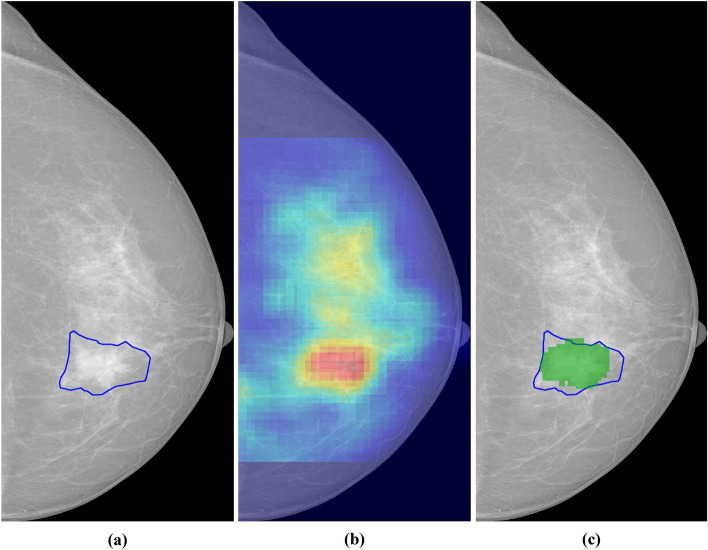
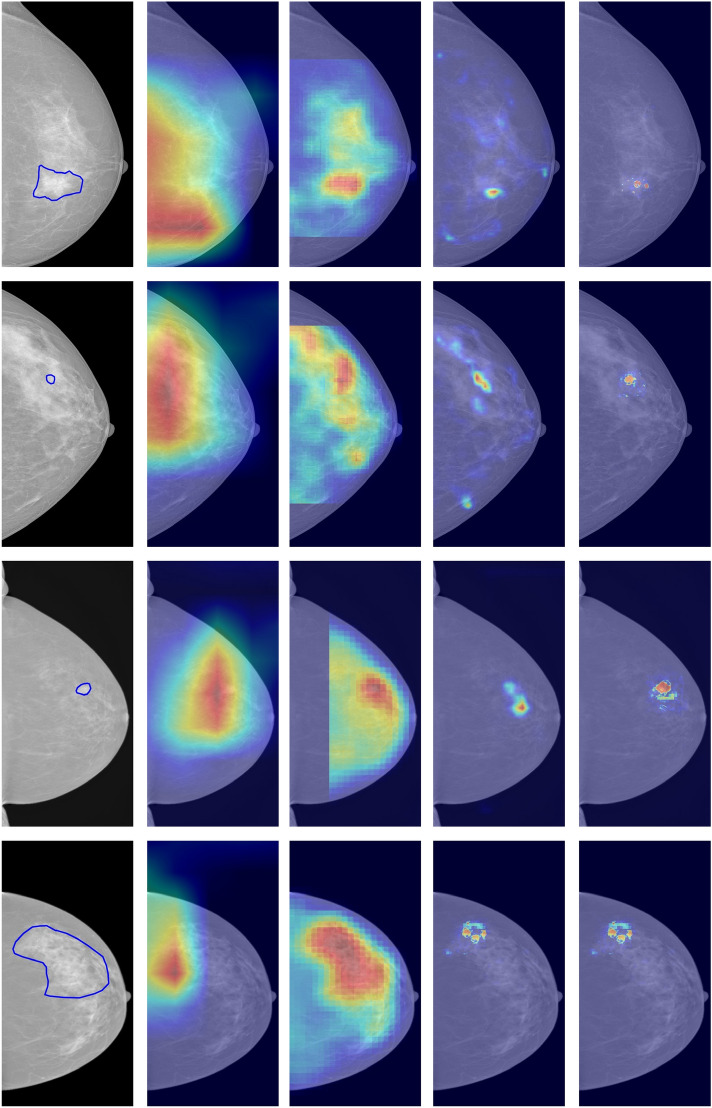
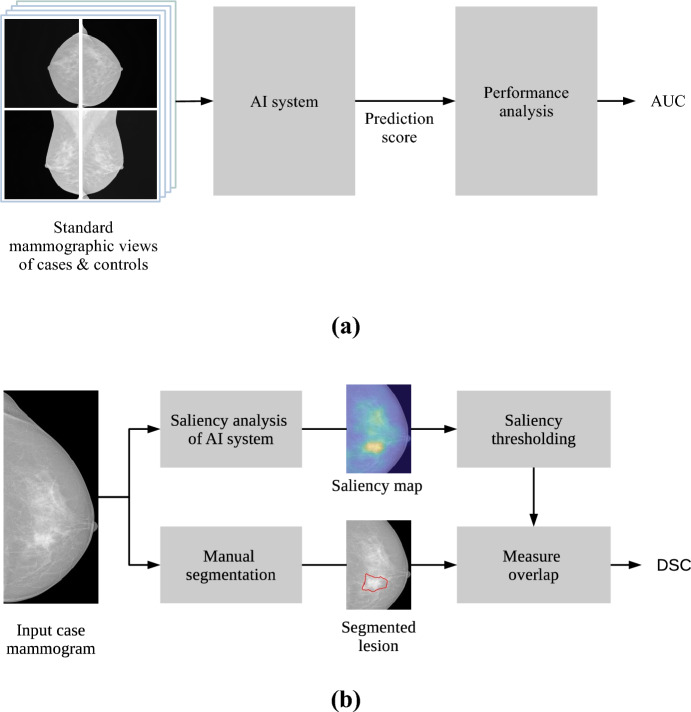
The analysis of mammograms using artificial intelligence (AI) has shown great potential for assisting breast cancer screening. We use saliency maps to study the role of breast lesions in the decision-making process of AI systems for breast cancer detection in screening mammograms. We retrospectively collected mammograms from 191 women with screen-detected breast cancer and 191 healthy controls matched by age and mammographic system. Two radiologists manually segmented the breast lesions in the mammograms from CC and MLO views. We estimated the detection performance of four deep learning-based AI systems using the area under the ROC curve (AUC) with a 95% confidence interval (CI). We used automatic thresholding on saliency maps from the AI systems to identify the areas of interest on the mammograms. Finally, we measured the overlap between these areas of interest and the segmented breast lesions using Dice's similarity coefficient (DSC). The detection performance of the AI systems ranged from low to moderate (AUCs from 0.525 to 0.694). The overlap between the areas of interest and the breast lesions was low for all the studied methods (median DSC from 4.2% to 38.0%). The AI system with the highest cancer detection performance (AUC = 0.694, CI 0.662-0.726) showed the lowest overlap (DSC = 4.2%) with breast lesions. The areas of interest found by saliency analysis of the AI systems showed poor overlap with breast lesions. These results suggest that AI systems with the highest performance do not solely rely on localized breast lesions for their decision-making in cancer detection; rather, they incorporate information from large image regions. This work contributes to the understanding of the role of breast lesions in cancer detection using AI.
使用人工智能(AI)分析乳房 X 光片在乳腺癌筛查中显示出很大的辅助作用。我们使用显著图来研究在用于筛查性乳房 X 光片中乳腺癌检测的 AI 系统的决策过程中,乳房病变的作用。我们回顾性地收集了 191 名经筛检发现患有乳腺癌的女性和 191 名年龄和乳房 X 光系统匹配的健康对照者的乳房 X 光片。两位放射科医生分别手动在 CC 和 MLO 视图的乳房 X 光片中对乳房病变进行了分割。我们使用接受者操作特征曲线(ROC)下面积(AUC)及其 95%置信区间(CI)来估计四个基于深度学习的 AI 系统的检测性能。我们使用 AI 系统的显著图自动阈值确定乳房 X 光片上的感兴趣区域。最后,我们使用 Dice 相似系数(DSC)测量这些感兴趣区域与分割的乳房病变之间的重叠。AI 系统的检测性能从低到中不等(AUC 从 0.525 到 0.694)。对于所有研究的方法,感兴趣区域与乳房病变之间的重叠都很低(中位数 DSC 从 4.2%到 38.0%)。癌症检测性能最高的 AI 系统(AUC=0.694,CI 0.662-0.726)与乳房病变的重叠最低(DSC=4.2%)。AI 系统的显著分析找到的感兴趣区域与乳房病变的重叠度很差。这些结果表明,性能最高的 AI 系统的决策不仅仅依赖于局部的乳房病变来进行癌症检测;相反,它们还整合了来自大图像区域的信息。这项工作有助于理解 AI 用于癌症检测中乳房病变的作用。