Key Laboratory of Agriculture Animal Genetics, Breeding and Reproduction of the Ministry of Education, College of Animal Science, Huazhong Agricultural University, Wuhan, Hubei, P. R. China.
College of Animal Science and Technology, Shandong Agricultural University, Taian, Shandong, P. R. China.
Clin Transl Med. 2023 Nov;13(11):e1441. doi: 10.1002/ctm2.1441.
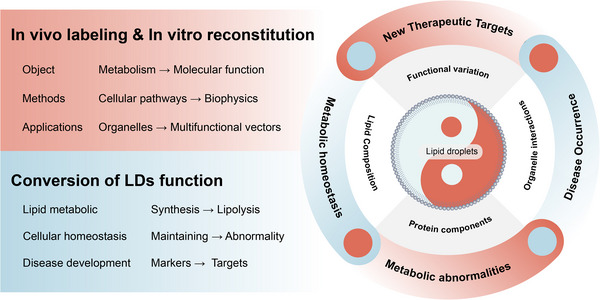
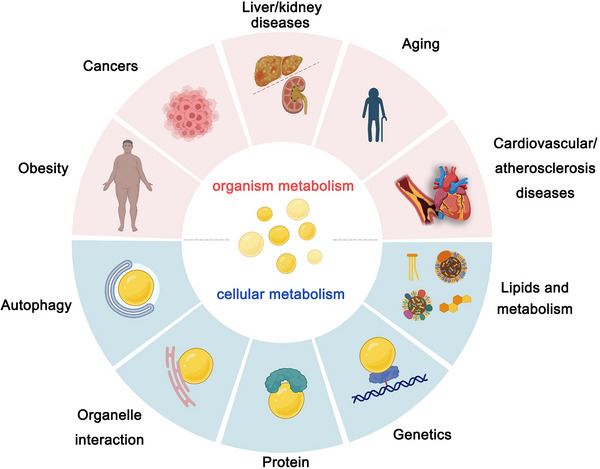
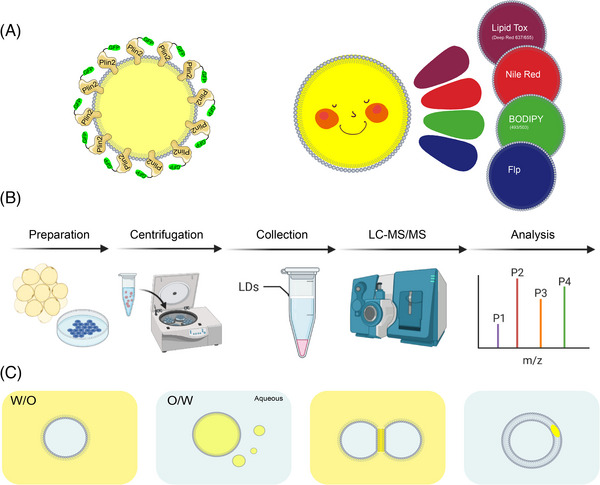
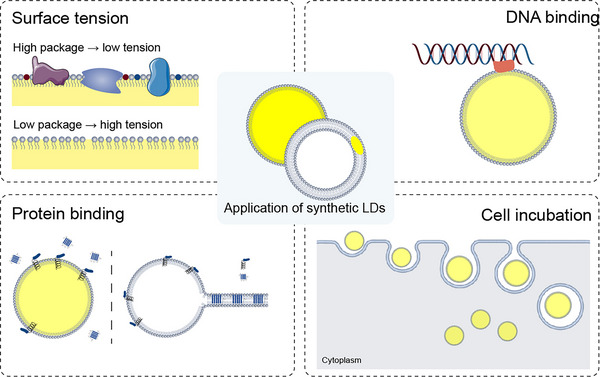
The study and synthesis of membrane organelles are becoming increasingly important, not only as simplified cellular models for corresponding molecular and metabolic studies but also for applications in synthetic biology of artificial cells and drug delivery vehicles. Lipid droplets (LDs) are central organelles in cellular lipid metabolism and are involved in almost all metabolic processes. Multiple studies have also demonstrated a high correlation between LDs and metabolic diseases. During these processes, LDs reveal a highly dynamic character, with their lipid fraction, protein composition and subcellular localisation constantly changing in response to metabolic demands. However, the molecular mechanisms underlying these functions have not been fully understood due to the limitations of cell biology approaches. Fortunately, developments in synthetic biology have provided a huge breakthrough for metabolism research, and methods for in vitro synthesis of LDs have been successfully established, with great advances in protein binding, lipid function, membrane dynamics and enzymatic reactions.
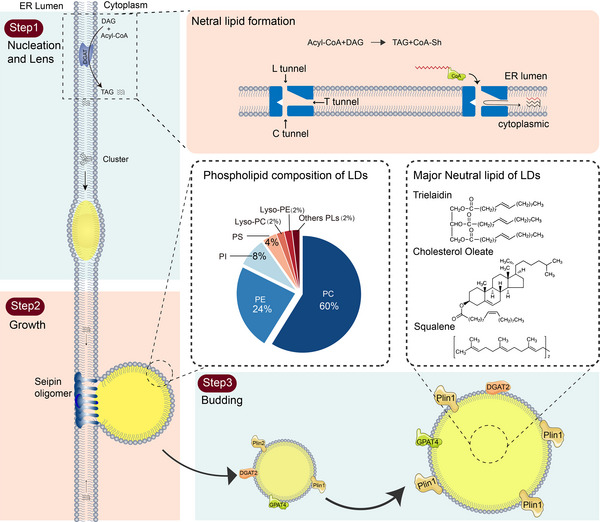
In this review, we provide a comprehensive overview of the assembly and function of endogenous LDs, from the generation of lipid molecules to how they are assembled into LDs in the endoplasmic reticulum. In particular, we highlight two major classes of synthetic LD models for fabrication techniques and their recent advances in biology and explore their roles and challenges in achieving real applications of artificial LDs in the future.
膜细胞器的研究和合成变得越来越重要,不仅作为相应的分子和代谢研究的简化细胞模型,而且还应用于人工细胞和药物输送载体的合成生物学。脂滴(LDs)是细胞脂质代谢的核心细胞器,几乎参与所有代谢过程。多项研究还表明,LDs 与代谢疾病之间存在高度相关性。在这些过程中,LDs 呈现出高度动态的特征,其脂质部分、蛋白质组成和亚细胞定位不断变化以响应代谢需求。然而,由于细胞生物学方法的局限性,这些功能的分子机制尚未完全理解。幸运的是,合成生物学的发展为代谢研究提供了巨大的突破,并且成功建立了体外合成 LDs 的方法,在蛋白质结合、脂质功能、膜动力学和酶反应方面取得了重大进展。
在这篇综述中,我们全面概述了内源性 LDs 的组装和功能,从脂质分子的产生到它们在内质网中如何组装成 LDs。特别是,我们强调了两种主要类型的合成 LD 模型的制造技术及其在生物学中的最新进展,并探讨了它们在未来实现人工 LDs 的实际应用中的作用和挑战。