Miao Tianshun, Zhou Bo, Liu Juan, Guo Xueqi, Liu Qiong, Xie Huidong, Chen Xiongchao, Chen Ming-Kai, Wu Jing, Carson Richard E, Liu Chi
Department of Radiology and Biomedical Imaging, Yale University, New Haven, CT 06511, USA.
Department of Biomedical Engineering, Yale University, New Haven, CT 06511, USA.
IEEE Trans Radiat Plasma Med Sci. 2023 May;7(5):465-472. doi: 10.1109/trpms.2023.3243576. Epub 2023 Feb 22.
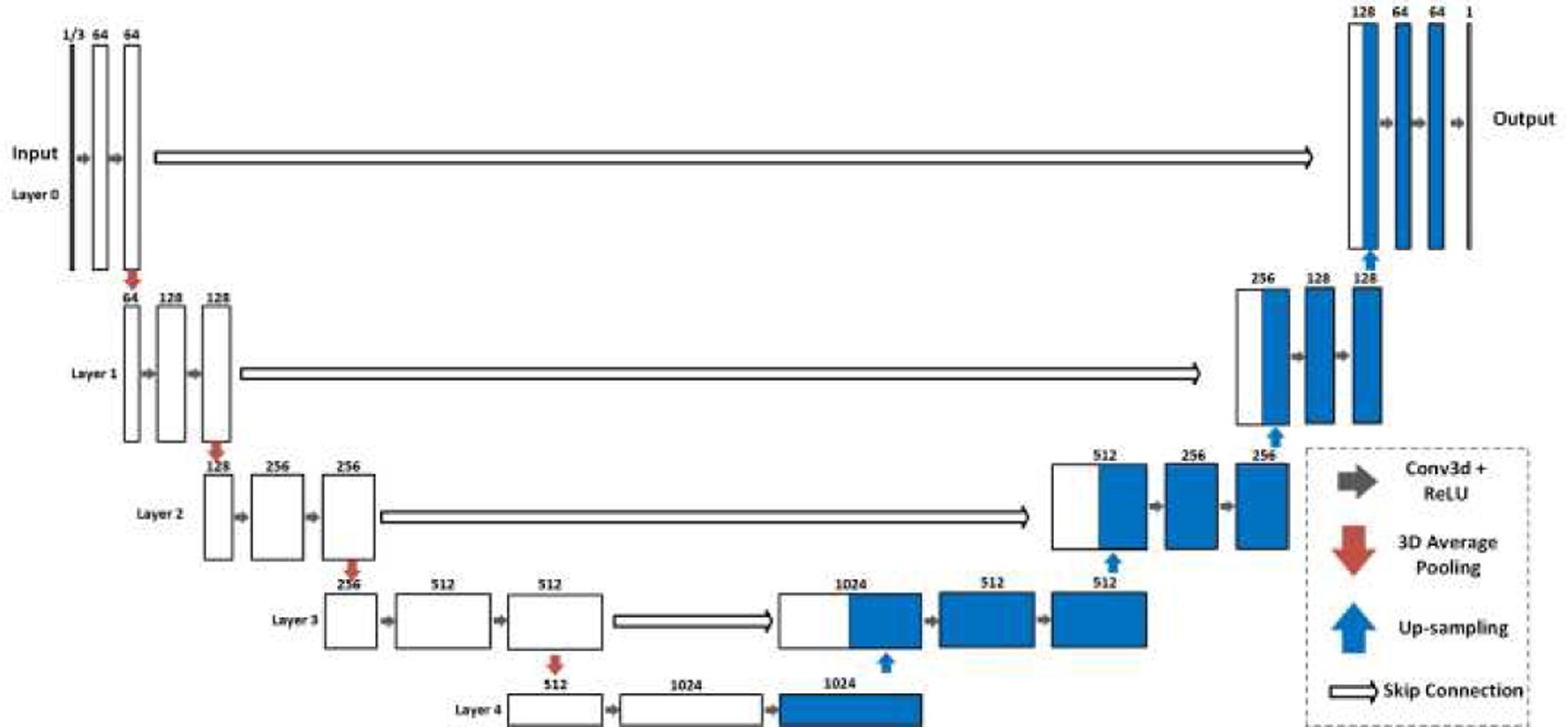
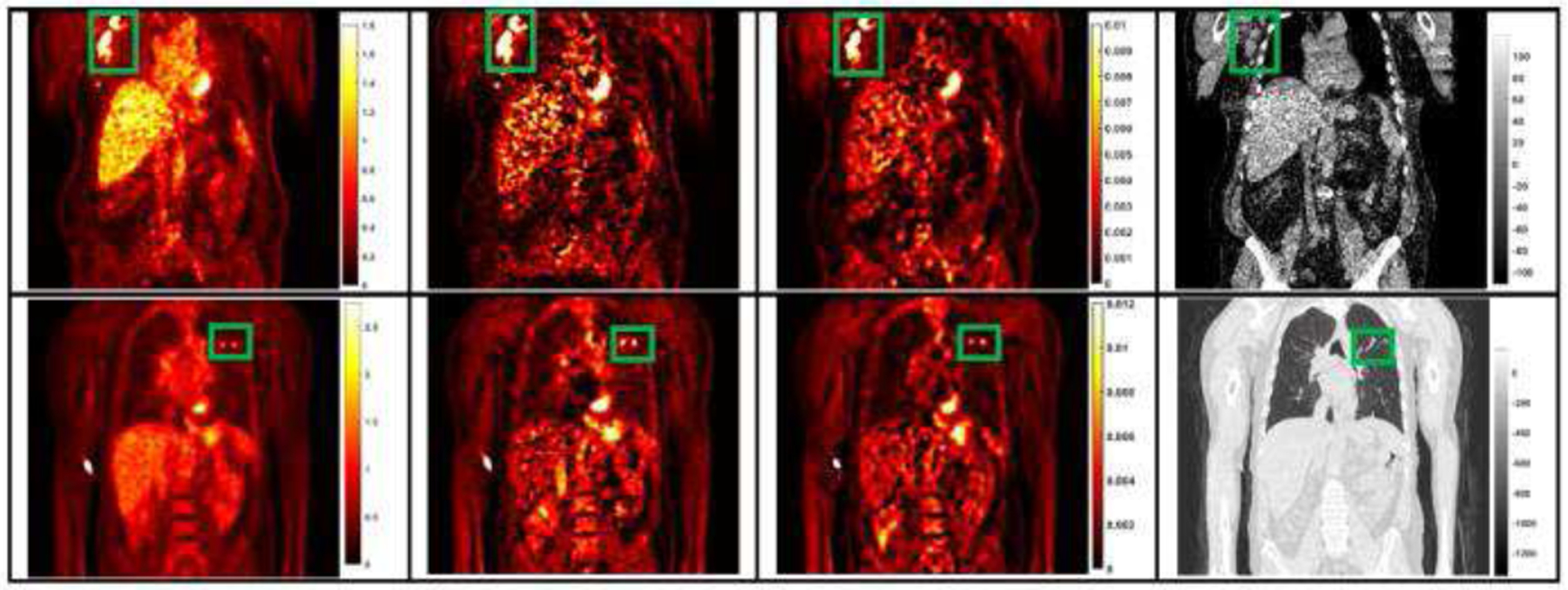
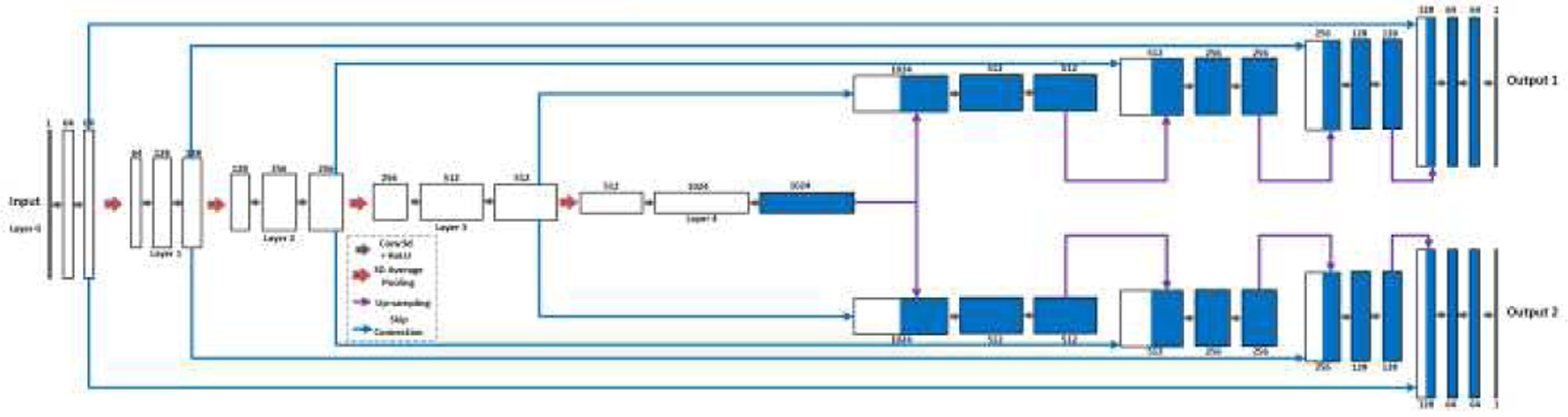
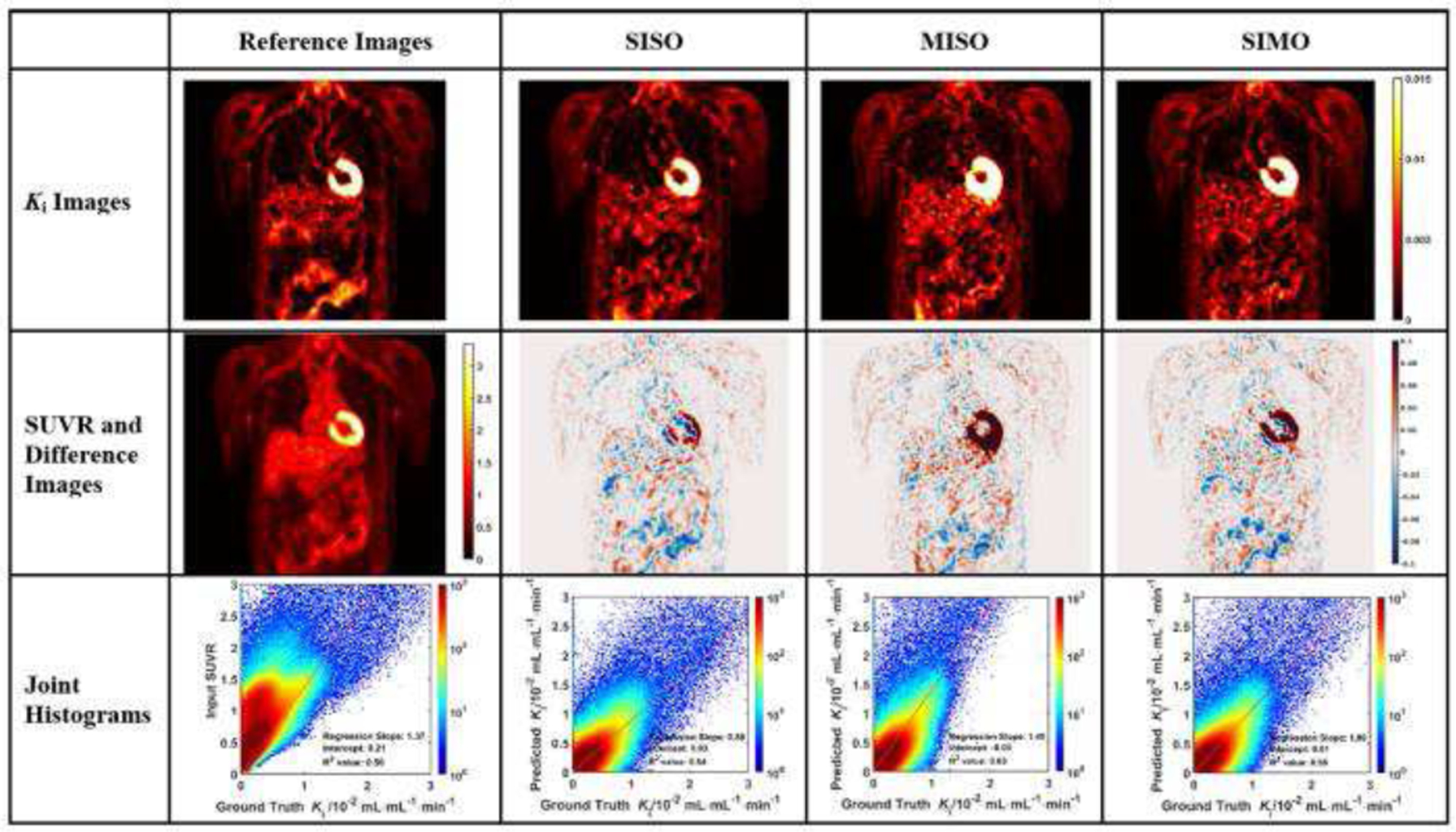
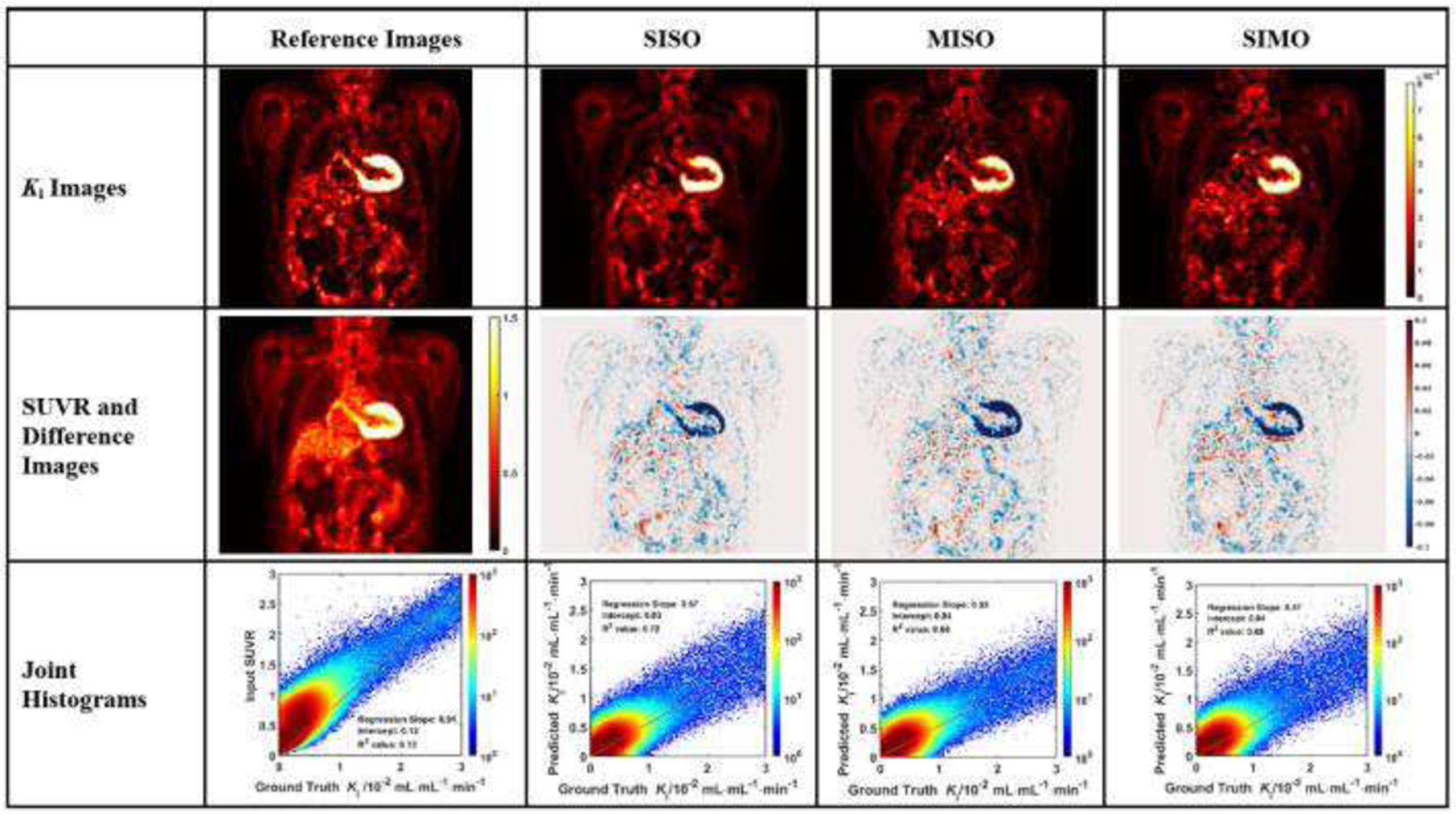
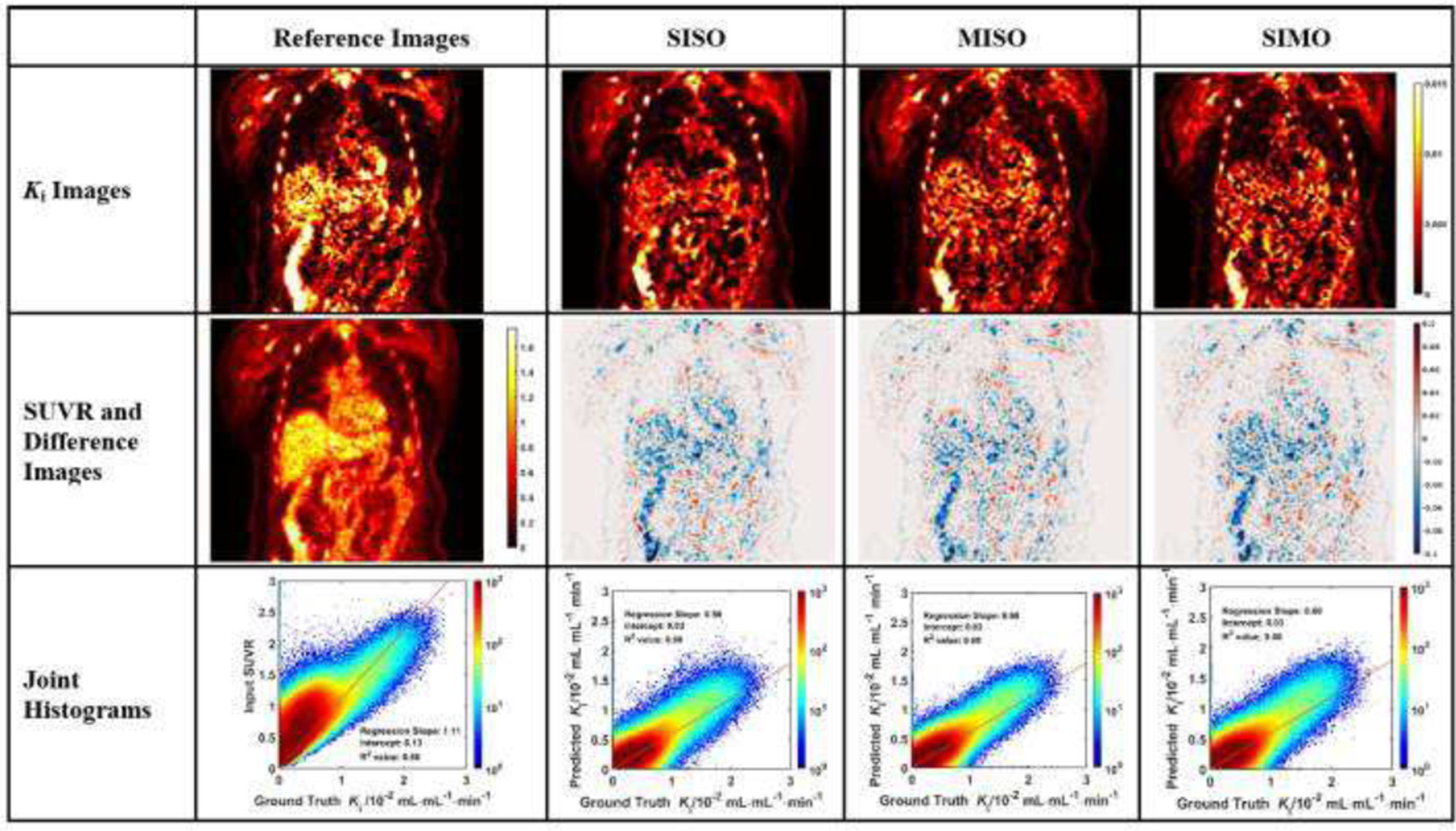
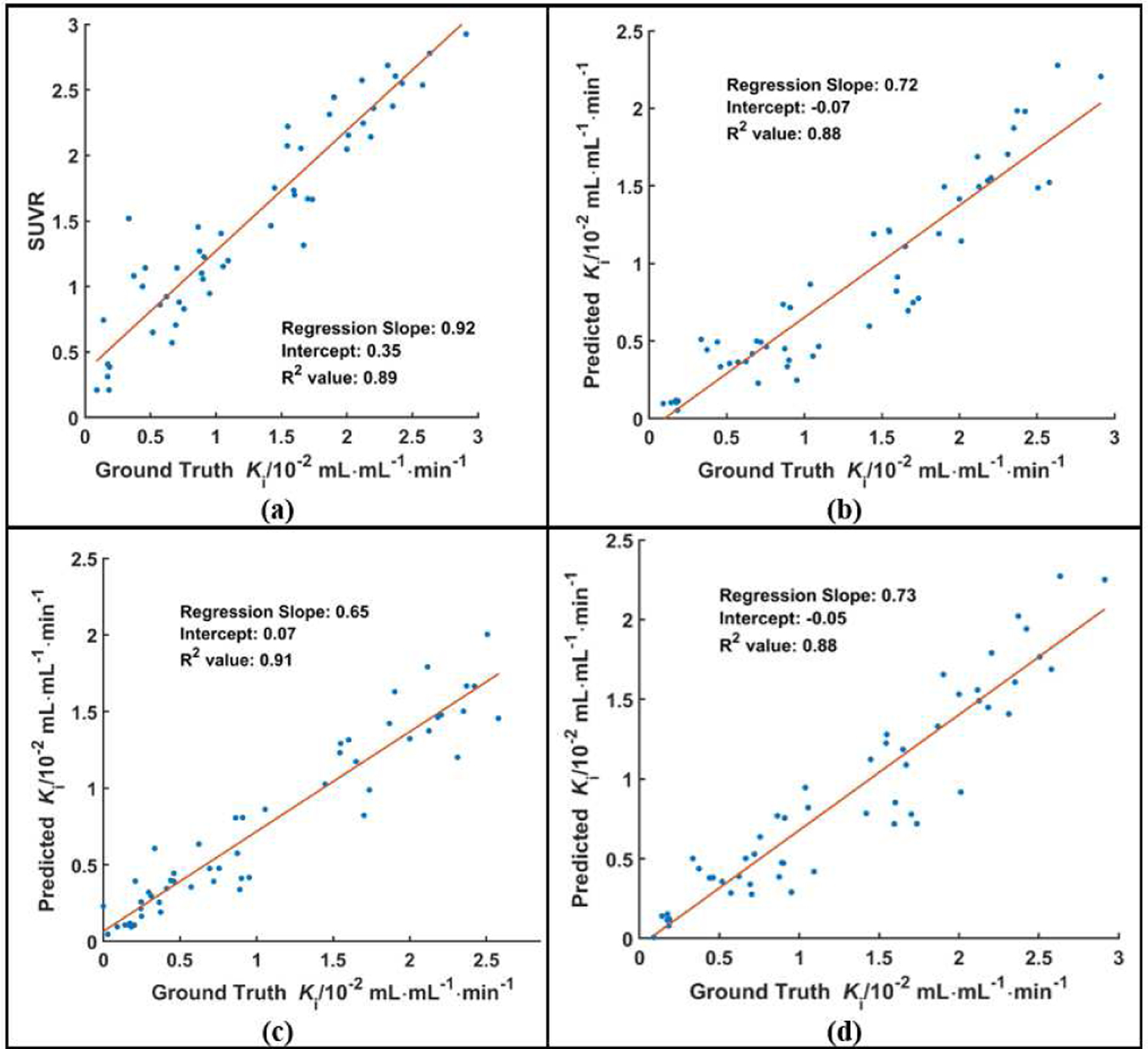
FDG parametric images show great advantage over static SUV images, due to the higher contrast and better accuracy in tracer uptake rate estimation. In this study, we explored the feasibility of generating synthetic images from static SUV ratio (SUVR) images using three configurations of U-Nets with different sets of input and output image patches, which were the U-Nets with single input and single output (), multiple inputs and single output (), and single input and multiple outputs (). SUVR images were generated by averaging three 5-min dynamic SUV frames starting at 60 minutes post-injection, and then normalized by the mean SUV values in the blood pool. The corresponding ground truth images were derived using Patlak graphical analysis with input functions from measurement of arterial blood samples. Even though the synthetic values were not quantitatively accurate compared with ground truth, the linear regression analysis of joint histograms in the voxels of body regions showed that the mean values were higher between U-Net prediction and ground truth (0.596, 0.580, 0.576 in , and ), than that between SUVR and ground truth (0.571). In terms of similarity metrics, the synthetic images were closer to the ground truth images (mean = 0.729, 0.704, 0.704 in , and ) than the input SUVR images (mean = 0.691). Therefore, it is feasible to use deep learning networks to estimate surrogate map of parametric images from static SUVR images.
由于在示踪剂摄取率估计方面具有更高的对比度和更好的准确性,FDG参数图像相对于静态SUV图像显示出巨大优势。在本研究中,我们探讨了使用具有不同输入和输出图像块集的三种U-Net配置从静态SUV比率(SUVR)图像生成合成图像的可行性,这三种配置分别是单输入单输出U-Net、多输入单输出U-Net和单输入多输出U-Net。SUVR图像通过对注射后60分钟开始的三个5分钟动态SUV帧求平均生成,然后用血池中的平均SUV值进行归一化。相应的真实图像通过Patlak图形分析并使用来自动脉血样本测量的输入函数得出。尽管与真实情况相比,合成值在定量上并不准确,但对身体区域体素中联合直方图的线性回归分析表明,U-Net预测与真实情况之间的平均相关系数(分别为0.596、0.580、0.576)高于SUVR与真实情况之间的平均相关系数(0.571)。就相似性指标而言,合成图像比输入的SUVR图像(平均相关系数 = 0.691)更接近真实图像(分别为0.729、0.704、0.704)。因此,使用深度学习网络从静态SUVR图像估计参数图像的替代图是可行的。