Nübel Jonathan, Buhre Charlotte, Hoffmeister Meike, Oess Stefanie, Labrenz Oliver, Jost Kerstin, Hauptmann Michael, Schön Julika, Fritz Georg, Butter Christian, Haase-Fielitz Anja
Department of Cardiology, University Hospital Heart Centre Brandenburg, Brandenburg Medical School Theodor Fontane, 16321 Bernau, Germany.
Faculty of Health Sciences (FGW), Joint Faculty of the University of Potsdam, The Brandenburg Medical School Theodor Fontane and the Brandenburg Technical University Cottbus-Senftenberg, 16816 Cottbus, Germany.
J Cardiovasc Dev Dis. 2023 Oct 25;10(11):441. doi: 10.3390/jcdd10110441.
Although transfemoral aortic valve replacement (TAVR) is a safe treatment for elderly patients with severe aortic valve stenosis, postoperative microembolism has been described. In this secondary endpoint analysis of the POST-TAVR trial, we aimed to investigate whether changes in neuron-specific enolase (NSE)-a biomarker of neuronal damage-are associated with changes in memory function or postoperative delirium (POD).
This was a prospective single-center study enrolling patients undergoing elective TAVR. Serum NSE was measured before and 24 h after TAVR. POD was diagnosed using CAM-ICU testing. Memory function was assessed before TAVR and before hospital discharge using the "Consortium to Establish a Registry for Alzheimer's Disease" (CERAD) word list and the digit span task (DST) implemented in "∆elta-App".
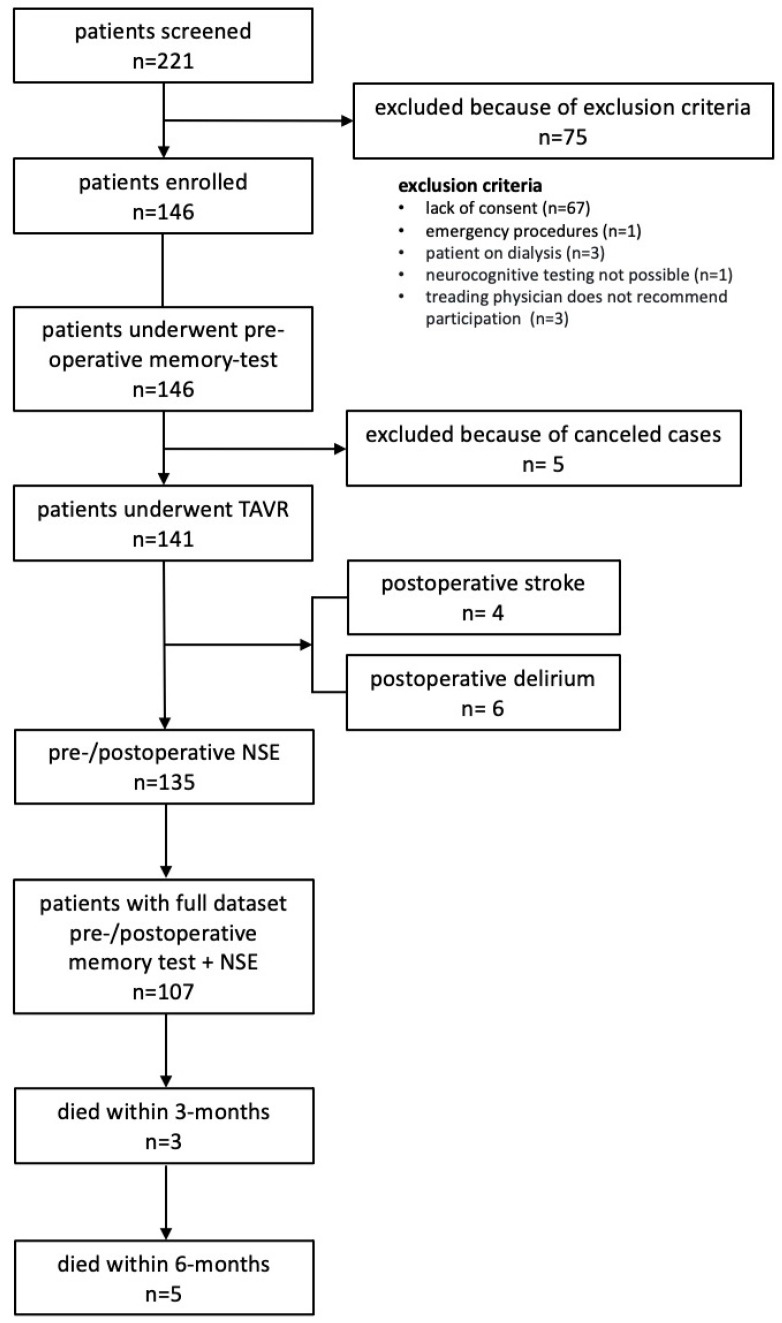
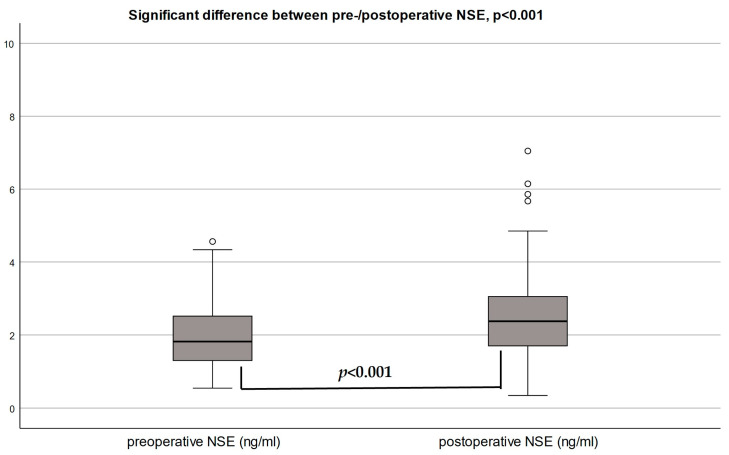
Subjects' median age was 82 years (25th to 75th percentile: 77.5-85.0), 42.6% of subjects were women. CERAD scores significantly increased from pre- to post-TAVR, with < 0.001. POD occurred in 4.4% (6/135) of subjects at median 2 days after TAVR. After TAVR, NSE increased from a median of 1.85 ng/mL (1.30-2.53) to 2.37 ng/mL (1.69-3.07), < 0.001. The median increase in NSE was 40.4% (13.1-138.0) in patients with POD versus 17.3% (3.3-43.4) in those without POD ( = 0.17).
Memory function improved after TAVR, likely due to learning effects, with no association to change in NSE. Patients with POD appear to have significantly higher postoperative levels of NSE compared to patients without POD after TAVR. This finding suggests that neuronal damage, as indicated by NSE elevation, may not significantly impair assessed memory function after TAVR.
尽管经股动脉主动脉瓣置换术(TAVR)是治疗老年重度主动脉瓣狭窄患者的一种安全方法,但术后微栓塞现象已被报道。在这项TAVR术后试验的次要终点分析中,我们旨在研究神经元特异性烯醇化酶(NSE)——一种神经元损伤的生物标志物——的变化是否与记忆功能或术后谵妄(POD)的变化相关。
这是一项前瞻性单中心研究,纳入接受择期TAVR的患者。在TAVR术前和术后24小时测量血清NSE。使用CAM-ICU测试诊断POD。在TAVR术前和出院前使用“阿尔茨海默病注册协会”(CERAD)单词表和“∆elta-应用程序”中实施的数字广度任务(DST)评估记忆功能。
受试者的中位年龄为82岁(第25至75百分位数:77.5 - 85.0),42.6%的受试者为女性。CERAD评分从TAVR术前到术后显著增加,P < 0.001。4.4%(6/135)的受试者在TAVR术后中位2天发生POD。TAVR术后,NSE从中位值1.85 ng/mL(1.30 - 2.53)增加到2.37 ng/mL(1.69 - 3.07),P < 0.001。发生POD的患者NSE的中位增幅为40.4%(13.1 - 138.0),而未发生POD的患者为17.3%(3.3 - 43.4)(P = 0.17)。
TAVR术后记忆功能有所改善,可能是由于学习效应,与NSE的变化无关。与TAVR术后未发生POD的患者相比,发生POD的患者术后NSE水平明显更高。这一发现表明,NSE升高所表明的神经元损伤可能不会显著损害TAVR术后评估的记忆功能。