Department of Pharmaceutical Chemistry, College of Pharmacy, King Saud University, P.O. Box 2457, Riyadh 11451, Saudi Arabia.
Molecules. 2023 Nov 8;28(22):7476. doi: 10.3390/molecules28227476.
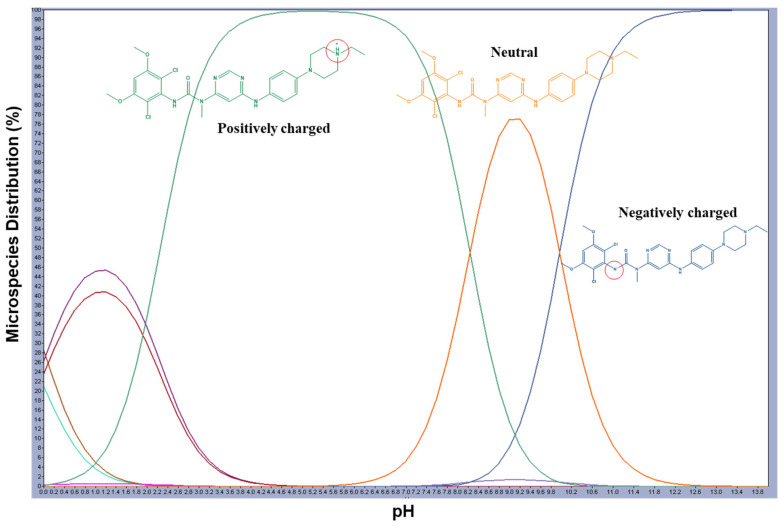
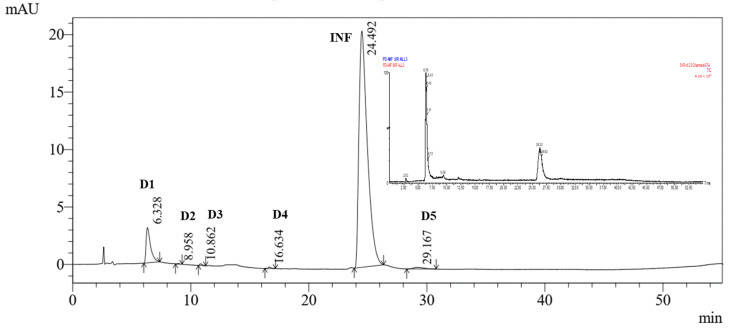
Infigratinib, a protein kinase inhibitor employed in the therapeutic management of cholangiocarcinoma, was subjected to various stress conditions, including hydrolytic (acidic and alkaline), oxidative, photolytic, and thermal stress, in accordance with the rules established by the International Council for Harmonization. A cumulative count of five degradation products was observed. The application of the Quality by Design principle was utilized in the development of a rapid and specific separation method for Infigratinib and its degradation products. The methodology employed in this study was derived from an experimental design approach, which was utilized to examine the critical process parameters associated with chromatographic systems. The reversed-phase high-performance liquid chromatography technique, employing a C18 column and a mobile phase composed of a gradient mixture of 25 mM ammonium acetate buffer at pH 6.0 and acetonitrile, successfully facilitated the chromatographic separation. The methodology was expanded to include the utilization of UPLC-quadrupole tandem mass spectrometry in order to conduct a comprehensive analysis of the structural properties and characterize the degradation products. Overall, five degradation products were found in different stress conditions. The method was verified at certain working points, wherein a linearity range (5.0-200.0 µg/mL) was developed and other parameters such as accuracy, repeatability, selectivity, and system suitability were evaluated. Finally, the toxicity and mutagenicity of Infigratinib and its degradation products were predicted using in silico software, namely DEREK Nexus (version 6.2.1) and SARAH Nexus (version 3.2.1). Various toxicity endpoints, including chromosomal damage, were predicted. Additionally, two degradation products were also predicted to be mutagenic.
英菲格拉替尼是一种蛋白激酶抑制剂,用于胆管癌的治疗管理。按照国际协调理事会的规定,它经受了各种应激条件,包括水解(酸和碱)、氧化、光解和热应激。观察到有五种累积降解产物。应用质量源于设计原则开发了一种快速和特定的英菲格拉替尼及其降解产物的分离方法。本研究采用的方法源自实验设计方法,用于研究与色谱系统相关的关键工艺参数。反相高效液相色谱技术,采用 C18 柱和由 pH 6.0 的 25mM 乙酸铵缓冲液和乙腈组成的梯度混合流动相,成功地促进了色谱分离。该方法扩展到包括使用 UPLC-串联四极杆质谱法进行全面的结构特性分析和鉴定降解产物。总的来说,在不同的应激条件下发现了五种降解产物。该方法在某些工作点进行了验证,其中开发了一个线性范围(5.0-200.0μg/ml),并评估了其他参数,如准确性、重复性、选择性和系统适用性。最后,使用 DEREK Nexus(版本 6.2.1)和 SARAH Nexus(版本 3.2.1)等计算机软件对英菲格拉替尼及其降解产物的毒性和致突变性进行了预测。预测了各种毒性终点,包括染色体损伤。此外,还预测了两种降解产物具有致突变性。