Pan Xin, Ye Fang, Ning Peiruo, Zhang Zhiyi, Li Xinyu, Zhang Binghao, Wang Qian, Chen Geng, Gao Wei, Qiu Chen, Wu Zhangsong, Li Jiancheng, Zhu Lizhe, Xia Jiang, Gong Kaizheng, Du Yang
Kobilka Institute of Innovative Drug Discovery, Shenzhen Futian Biomedical Innovation R&D Center, School of Medicine, The Chinese University of Hong Kong, Shenzhen, Guangdong, China.
Department of Cardiology, Central Laboratory, The Affiliated Hospital of Yangzhou University, Yangzhou University, Yangzhou, Jiangsu, China.
Cell Discov. 2023 Nov 28;9(1):118. doi: 10.1038/s41421-023-00610-7.
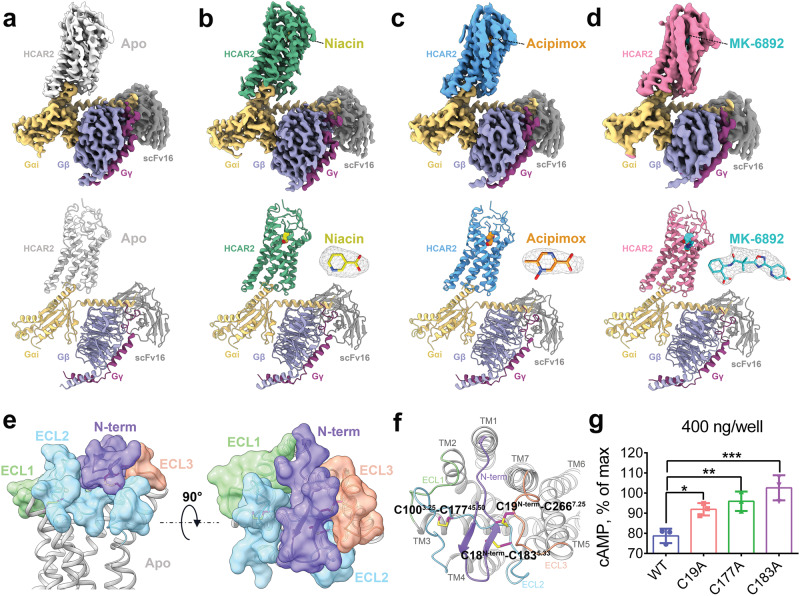
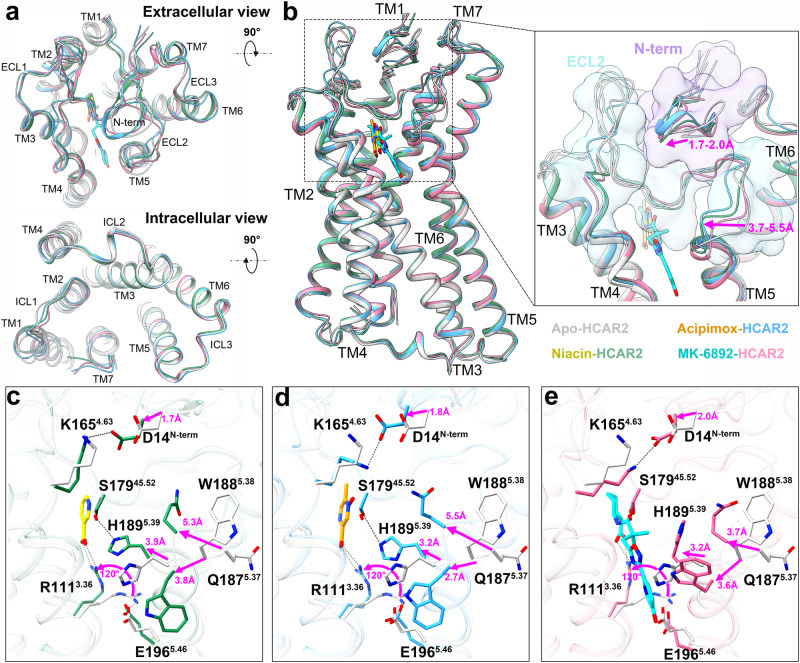
Hydroxycarboxylic acid receptor 2 (HCAR2) belongs to the family of class A G protein-coupled receptors with key roles in regulating lipolysis and free fatty acid formation in humans. It is deeply involved in many pathophysiological processes and serves as an attractive target for the treatment of cardiovascular, neoplastic, autoimmune, neurodegenerative, inflammatory, and metabolic diseases. Here, we report four cryo-EM structures of human HCAR2-Gi1 complexes with or without agonists, including the drugs niacin (2.69 Å) and acipimox (3.23 Å), the highly subtype-specific agonist MK-6892 (3.25 Å), and apo form (3.28 Å). Combined with molecular dynamics simulation and functional analysis, we have revealed the recognition mechanism of HCAR2 for different agonists and summarized the general pharmacophore features of HCAR2 agonists, which are based on three key residues R111, S179, and Y284. Notably, the MK-6892-HCAR2 structure shows an extended binding pocket relative to other agonist-bound HCAR2 complexes. In addition, the key residues that determine the ligand selectivity between the HCAR2 and HCAR3 are also illuminated. Our findings provide structural insights into the ligand recognition, selectivity, activation, and G protein coupling mechanism of HCAR2, which shed light on the design of new HCAR2-targeting drugs for greater efficacy, higher selectivity, and fewer or no side effects.
羟基羧酸受体2(HCAR2)属于A类G蛋白偶联受体家族,在调节人体脂肪分解和游离脂肪酸形成中起关键作用。它深度参与许多病理生理过程,是治疗心血管、肿瘤、自身免疫、神经退行性、炎症和代谢疾病的一个有吸引力的靶点。在此,我们报告了人类HCAR2与Gi1复合物在有或没有激动剂情况下的四种冷冻电镜结构,包括药物烟酸(2.69 Å)和阿西莫司(3.23 Å)、高度亚型特异性激动剂MK-6892(3.25 Å)以及无配体形式(3.28 Å)。结合分子动力学模拟和功能分析,我们揭示了HCAR2对不同激动剂的识别机制,并总结了基于三个关键残基R111、S179和Y284的HCAR2激动剂的一般药效团特征。值得注意的是,与其他激动剂结合的HCAR2复合物相比,MK-6892-HCAR2结构显示出一个扩展的结合口袋。此外,还阐明了决定HCAR2和HCAR3之间配体选择性的关键残基。我们的研究结果为HCAR2的配体识别、选择性、激活和G蛋白偶联机制提供了结构见解,这为设计具有更高疗效、更高选择性且副作用更少或无副作用的新型HCAR2靶向药物提供了思路。