Department of Public Health, Faculty of Medicine, Semmelweis University, Üllői út 26, Budapest, H-1085, Hungary.
Department of Pulmonology, Semmelweis University, Budapest, Hungary.
Geroscience. 2024 Aug;46(4):3801-3818. doi: 10.1007/s11357-023-00957-5. Epub 2023 Nov 28.
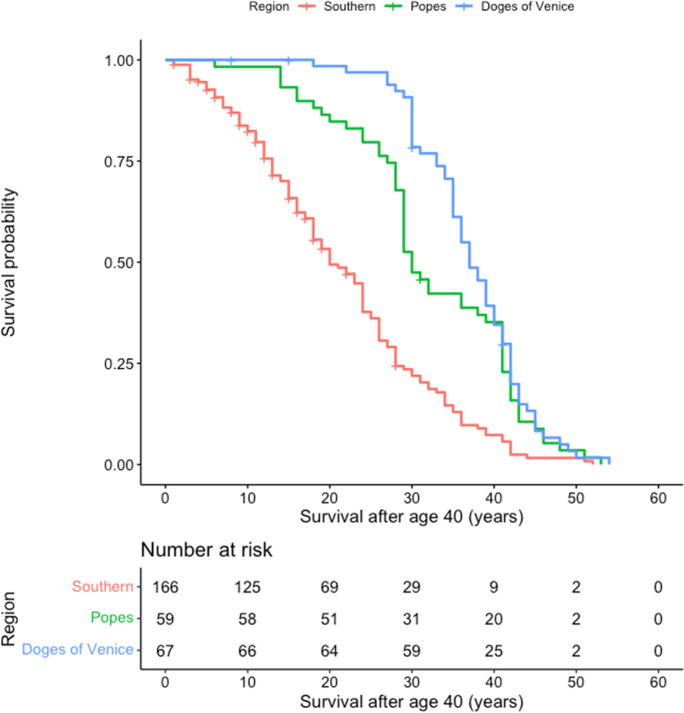
Significant regional variability in lifespan in Europe is influenced by environmental factors and lifestyle behaviors, including diet. This study investigates the impact of geographical region on the lifespan of European rulers spanning from the fourteenth century to the present day. By analyzing historical records and literature, we aim to identify region-specific dietary patterns and lifestyle factors that may have contributed to longer lifespans among rulers. The hypothesis to be tested is that rulers from Southern European countries, where the traditional Mediterranean diet is consumed by the local people, may exhibit longer lifespans compared to rulers from other regions, due to the well-documented health benefits associated with this dietary pattern. We extracted comprehensive information for each ruler, encompassing their sex, birth and death dates, age, age of enthronement, duration of rulership, country, and cause of death (natural vs. non-natural). To determine their nationality, we coded rulers based on their hypothetical present-day residence (2023). Utilizing the EuroVoc Geographical classification, we categorized the countries into four regions: Northern, Western, Southern, Central and Eastern Europe. While Cox regression models did not find significant differences in survival rates among regions, further analysis stratified by time periods revealed intriguing trends. Contrary to our initial predictions, the Northern region displayed better survival rates compared to the Southern region between 1354 and 1499, whereas survival rates were similar across regions from 1500 to 1749. However, after 1750, all regions, except the Southern region, exhibited significantly improved survival rates, suggesting advancements in healthcare and lifestyle factors. These findings underscore the dynamic influence of both region and time period on health and longevity. Interestingly, despite the prevalence of the Mediterranean diet in the Southern region of Europe, rulers from this region did not demonstrate longer lifespans compared to their counterparts in other regions. This suggests that additional lifestyle factors may have played a more prominent role in their longevity. In conclusion, our study sheds light on the intricate relationship between region, time period, and lifespan among European rulers. Although the Mediterranean diet is often associated with health benefits, our findings indicate that it alone may not account for differences in ruler longevity across regions. Further research is warranted to explore the impact of other lifestyle factors on the health and lifespan of European rulers throughout history.
欧洲的寿命存在显著的地域差异,这受到环境因素和生活方式行为的影响,包括饮食。本研究调查了地域对 14 世纪至今欧洲统治者寿命的影响。通过分析历史记录和文献,我们旨在确定特定地区的饮食模式和生活方式因素,这些因素可能有助于统治者长寿。我们要检验的假设是,与来自其他地区的统治者相比,来自南欧国家的统治者,由于当地居民食用传统的地中海饮食,可能寿命更长,因为这种饮食模式与众所周知的健康益处有关。我们为每个统治者提取了全面的信息,包括他们的性别、出生日期和死亡日期、年龄、登基年龄、统治时间、国家和死亡原因(自然死亡与非自然死亡)。为了确定他们的国籍,我们根据统治者的假设当前居住地(2023 年)对他们进行了编码。我们利用 EuroVoc 地理分类,将国家分为四个地区:北欧、西欧、南欧、中欧和东欧。虽然 Cox 回归模型没有发现各地区生存率存在显著差异,但进一步按时间段分层分析揭示了有趣的趋势。与我们最初的预测相反,1354 年至 1499 年间,北欧地区的生存率高于南欧地区,而 1500 年至 1749 年间,各地区的生存率相似。然而,1750 年后,除南欧地区外,所有地区的生存率都显著提高,这表明医疗保健和生活方式因素的进步。这些发现强调了地域和时间段对健康和长寿的动态影响。有趣的是,尽管地中海饮食在欧洲南部地区很普遍,但与其他地区的统治者相比,该地区的统治者并没有表现出更长的寿命。这表明其他生活方式因素可能在他们的长寿中发挥了更为重要的作用。总之,本研究揭示了欧洲统治者的地域、时间和寿命之间复杂的关系。尽管地中海饮食通常与健康益处相关,但我们的研究结果表明,它本身并不能解释各地区统治者寿命的差异。需要进一步研究来探索其他生活方式因素对欧洲统治者在整个历史时期的健康和寿命的影响。