Wilkins Oscar G, Chien Max Z Y J, Wlaschin Josette J, Pisliakova Maria, Thompson David, Digby Holly, Simkin Rebecca L, Diaz Juan Antinao, Mehta Puja R, Keuss Matthew J, Zanovello Matteo, Brown Anna-Leigh, Harley Peter, Darbey Annalucia, Karda Rajvinder, Fisher Elizabeth M C, Cunningham Tom J, Le Pichon Claire E, Ule Jernej, Fratta Pietro
UCL Queen Square Motor Neuron Disease Centre, Department of Neuromuscular Diseases, UCL Queen Square Institute of Neurology, UCL; London, WC1N 3BG, UK.
The Francis Crick Institute; London, NW1 1AT, UK.
bioRxiv. 2023 Nov 15:2023.11.15.565967. doi: 10.1101/2023.11.15.565967.
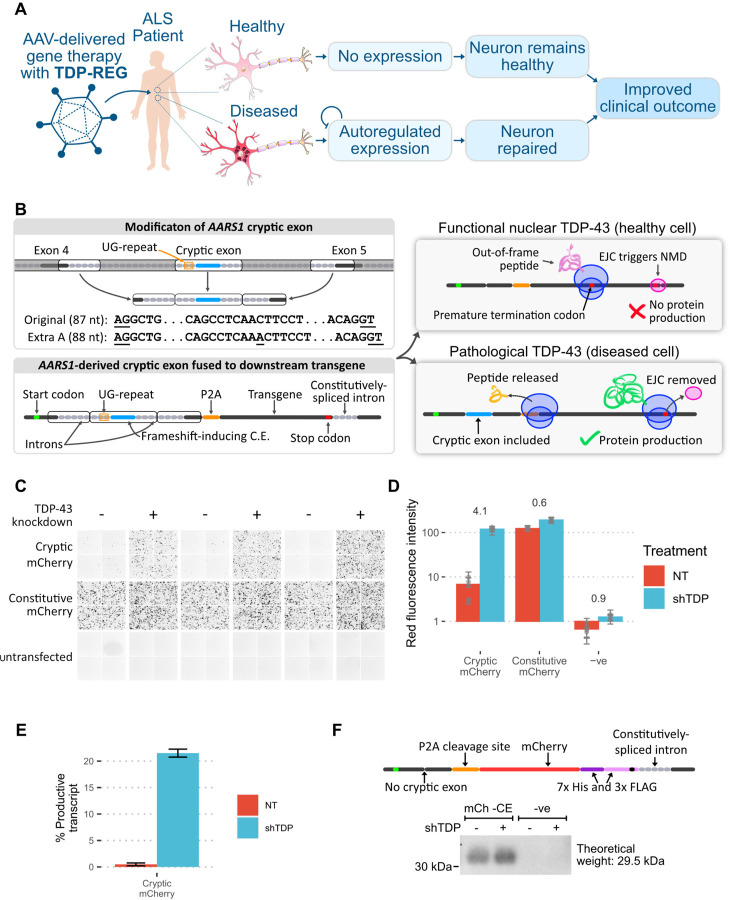
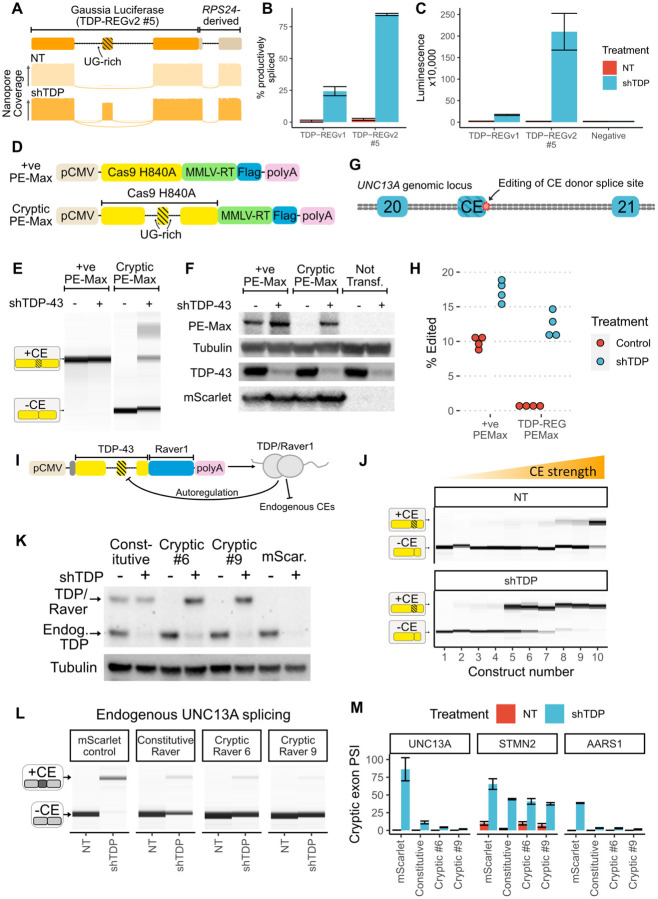
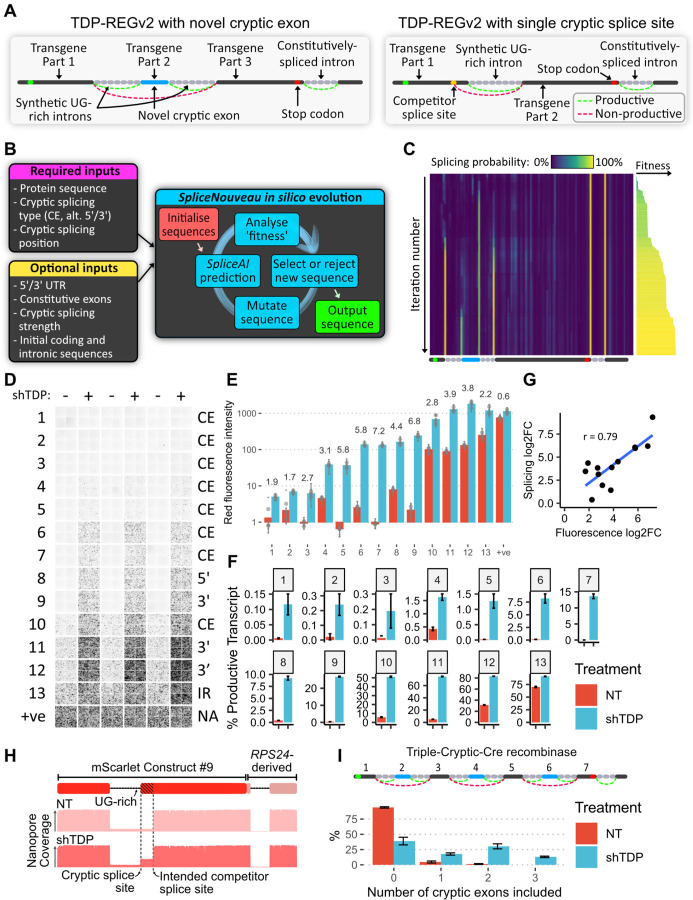
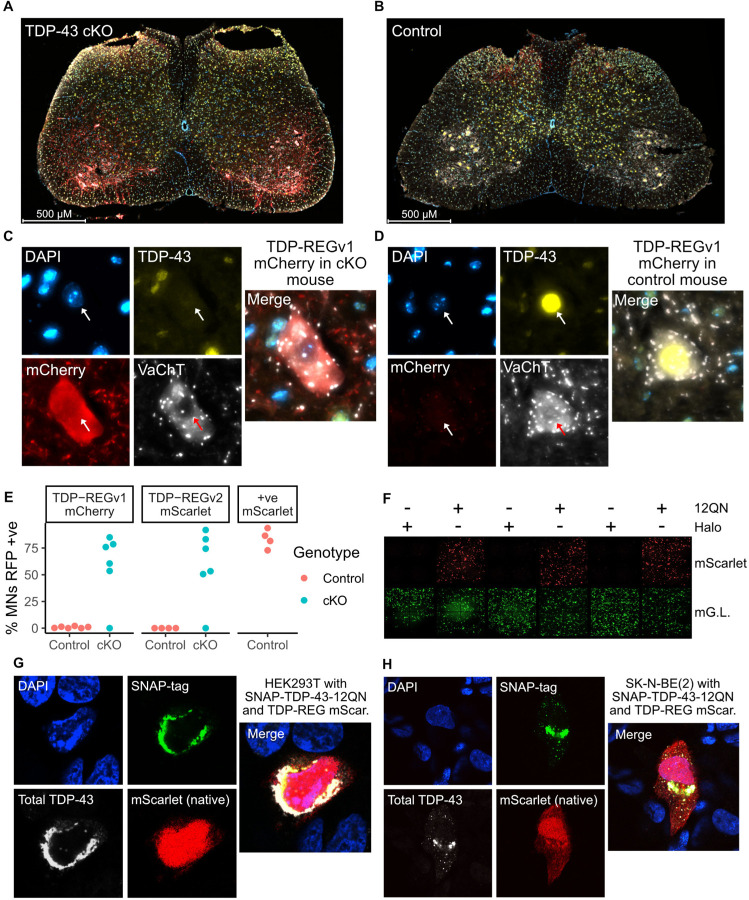
A system enabling the expression of therapeutic proteins specifically in diseased cells would be transformative, providing greatly increased safety and the possibility of pre-emptive treatment. Here we describe "TDP-REG", a precision medicine approach primarily for amyotrophic lateral sclerosis (ALS) and frontotemporal dementia (FTD), which exploits the cryptic splicing events that occur in cells with TDP-43 loss-of-function (TDP-LOF) in order to drive expression specifically in diseased cells. In addition to modifying existing cryptic exons for this purpose, we develop a deep-learning-powered algorithm for generating customisable cryptic splicing events, which can be embedded within virtually any coding sequence. By placing part of a coding sequence within a novel cryptic exon, we tightly couple protein expression to TDP-LOF. Protein expression is activated by TDP-LOF and , including TDP-LOF induced by cytoplasmic TDP-43 aggregation. In addition to generating a variety of fluorescent and luminescent reporters, we use this system to perform TDP-LOF-dependent genomic prime editing to ablate the cryptic donor splice site. Furthermore, we design a panel of tightly gated, autoregulating vectors encoding a TDP-43/Raver1 fusion protein, which rescue key pathological cryptic splicing events. In summary, we combine deep-learning and rational design to create sophisticated splicing sensors, resulting in a platform that provides far safer therapeutics for neurodegeneration, potentially even enabling preemptive treatment of at-risk individuals.
一种能够在患病细胞中特异性表达治疗性蛋白质的系统将具有变革性,可大大提高安全性并提供抢先治疗的可能性。在此,我们描述了“TDP-REG”,这是一种主要针对肌萎缩侧索硬化症(ALS)和额颞叶痴呆(FTD)的精准医学方法,它利用在具有TDP-43功能丧失(TDP-LOF)的细胞中发生的隐蔽剪接事件,以便在患病细胞中特异性驱动表达。除了为此目的修饰现有的隐蔽外显子,我们还开发了一种由深度学习驱动的算法来生成可定制的隐蔽剪接事件,这些事件几乎可以嵌入任何编码序列中。通过将编码序列的一部分置于一个新的隐蔽外显子内,我们将蛋白质表达与TDP-LOF紧密耦合。蛋白质表达由TDP-LOF激活,包括由细胞质TDP-43聚集诱导的TDP-LOF。除了生成各种荧光和发光报告基因外,我们还使用该系统进行依赖TDP-LOF的基因组碱基编辑以消除隐蔽供体剪接位点。此外,我们设计了一组紧密调控、自动调节的载体,编码TDP-43/Raver1融合蛋白,可挽救关键的病理性隐蔽剪接事件。总之,我们将深度学习与合理设计相结合,创建了复杂的剪接传感器,从而形成了一个为神经退行性疾病提供更安全治疗方法的平台,甚至有可能对高危个体进行抢先治疗。