Whyte-Fagundes P, Vance A, Carroll A, Figueroa F, Manukyan C, Baraban S C
Epilepsy Research Laboratory and Weill Institute for Neuroscience, Department of Neurological Surgery, University of California San Francisco, San Francisco, CA, USA.
Behavioral Neurosciences, Northeastern University, Boston, MA, USA.
bioRxiv. 2023 Nov 15:2023.11.11.566723. doi: 10.1101/2023.11.11.566723.
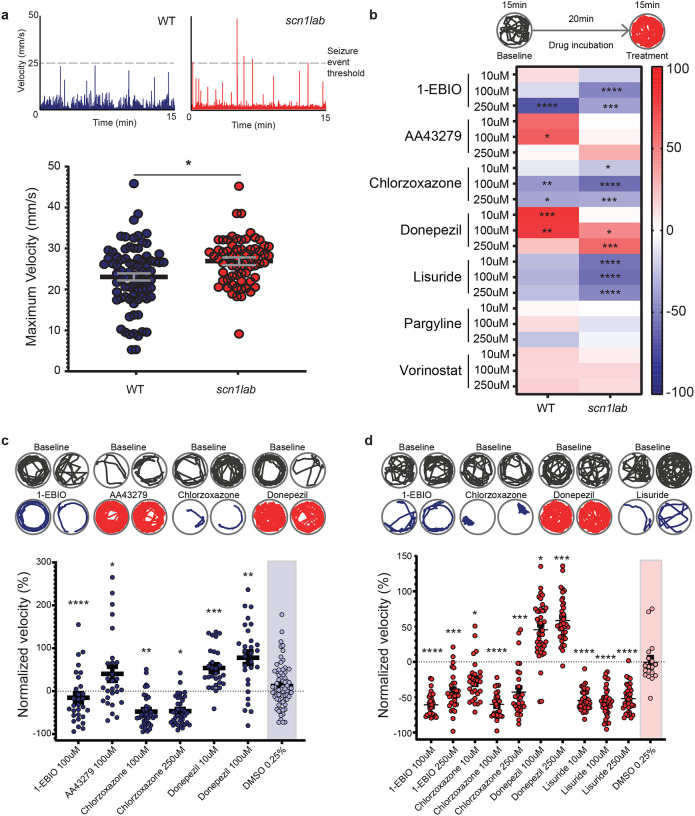
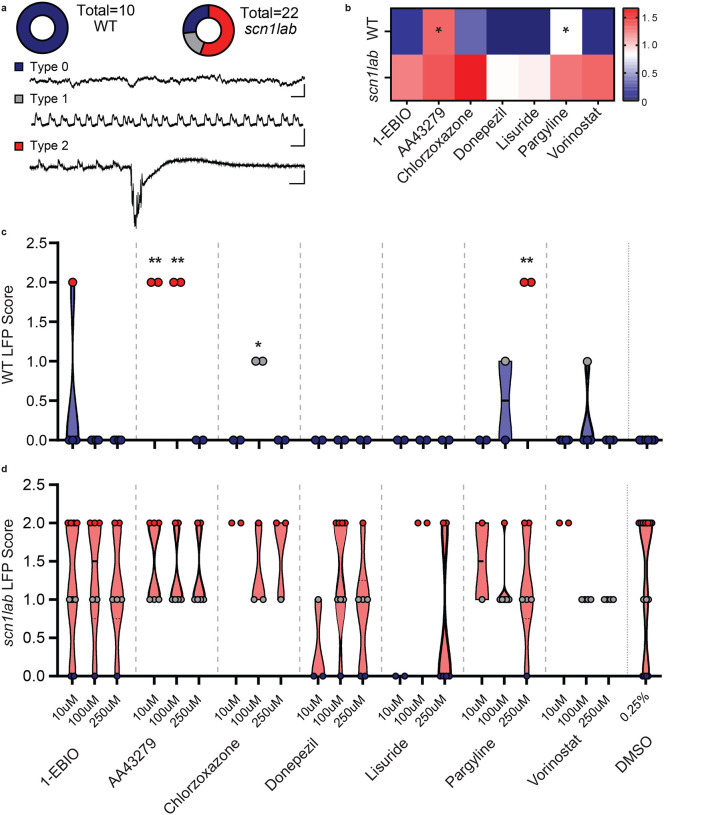
Dravet syndrome (DS) is a severe genetic epilepsy primarily caused by mutations in a voltage-activated sodium channel gene (SCN1A). Patients face life-threatening seizures that are largely resistant to available anti-seizure medications (ASM). Preclinical DS animal models are a valuable tool to identify candidate ASMs for these patients. Among these, mutant zebrafish exhibiting spontaneous seizure-like activity are particularly amenable to large-scale drug screening. Prior screening in a mutant zebrafish line generated using N-ethyl-Nnitrosourea (ENU) identified valproate, stiripentol, and fenfluramine e.g., Federal Drug Administration (FDA) approved drugs with clinical application in the DS population. Successful phenotypic screening in mutant zebrafish consists of two stages: (i) a locomotion-based assay measuring high-velocity convulsive swim behavior and (ii) an electrophysiology-based assay, using local field potential (LFP) recordings, to quantify electrographic seizure-like events. Using this strategy more than 3000 drug candidates have been screened in zebrafish mutants. Here, we curated a list of nine additional anti-seizure drug candidates recently identified in preclinical models: 1-EBIO, AA43279, chlorzoxazone, donepezil, lisuride, mifepristone, pargyline, soticlestat and vorinostat. First-stage locomotion-based assays in mutant zebrafish identified only 1-EBIO, chlorzoxazone and lisuride. However, second-stage LFP recording assays did not show significant suppression of spontaneous electrographic seizure activity for any of the nine anti-seizure drug candidates. Surprisingly, soticlestat induced frank electrographic seizure-like discharges in wild-type control zebrafish. Taken together, our results failed to replicate clear anti-seizure efficacy for these drug candidates highlighting a necessity for strict scientific standards in preclinical identification of ASMs.
德雷维特综合征(DS)是一种严重的遗传性癫痫,主要由电压门控钠通道基因(SCN1A)突变引起。患者面临危及生命的癫痫发作,而现有的抗癫痫药物(ASM)对此大多无效。临床前DS动物模型是为这些患者识别候选ASM的宝贵工具。其中,表现出自发性癫痫样活动的突变斑马鱼特别适合大规模药物筛选。先前在使用N-乙基-N-亚硝基脲(ENU)生成的突变斑马鱼品系中进行的筛选确定了丙戊酸盐、司替戊醇和芬氟拉明等,例如美国食品药品监督管理局(FDA)批准的在DS人群中有临床应用的药物。在突变斑马鱼中成功进行表型筛选包括两个阶段:(i)基于运动的测定,测量高速惊厥性游泳行为;(ii)基于电生理学的测定,使用局部场电位(LFP)记录来量化电描记图癫痫样事件。使用这种策略,已经在斑马鱼突变体中筛选了3000多种候选药物。在这里,我们整理了一份最近在临床前模型中确定的另外九种抗癫痫药物候选物的清单:1-EBIO、AA43279、氯唑沙宗、多奈哌齐、利舒脲、米非司酮、帕吉林、索替司他和伏立诺他。在突变斑马鱼中进行的第一阶段基于运动的测定仅确定了1-EBIO、氯唑沙宗和利舒脲。然而,第二阶段的LFP记录测定并未显示这九种抗癫痫药物候选物中的任何一种对自发性电描记图癫痫活动有显著抑制作用。令人惊讶的是,索替司他在野生型对照斑马鱼中诱发了明显的电描记图癫痫样放电。综上所述,我们的结果未能重现这些候选药物明确的抗癫痫疗效,突出了在临床前ASM鉴定中严格科学标准的必要性。