Ezcurra Iranzu, Puente Ángela, Cuadrado Antonio, Tamayo Ibai, Iruzubieta Paula, Arias-Loste María Teresa, González Francisco José, Pellón Raúl, Sánchez Sara, Crespo Juan, Acebo Mercedes, López-Hoyos Marcos, Pérez Rocío, Cuesta Amalia, Antón Ángela, Echavarría Víctor, Fábrega Emilio, Crespo Javier, Fortea Jose Ignacio
Gastroenterology and Hepatology Department, Clinical and Translational Research in Digestive Diseases, Valdecilla Research Institute (IDIVAL), Marqués de Valdecilla University Hospital, Santander, Spain.
Navarrabiomed, Health Research Institute, Pamplona, Spain.
United European Gastroenterol J. 2023 Dec;11(10):1010-1020. doi: 10.1002/ueg2.12500. Epub 2023 Nov 28.
Preliminary evidence suggests that inherited hypercoagulable disorders can lead to an increased risk of significant liver fibrosis.
We aimed to investigate the prevalence of significant fibrosis in patients with inherited thrombophilia, assessed by using liver stiffness (LS), and to compare this prevalence to that found in a large population-based cohort from the same region.
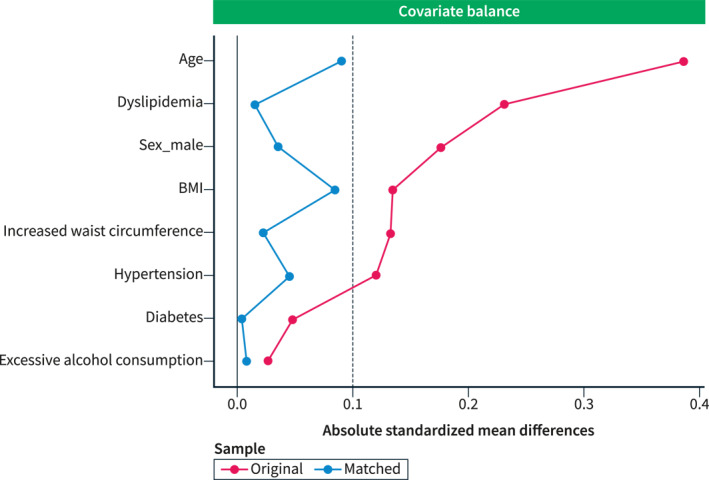
This was a single-center, cross-sectional study. A complete laboratory analysis for liver disease, LS by transient elastography and an abdominal ultrasound were performed in patients with inherited thrombophilia diagnosed between May 2013-February 2017. These patients were propensity score matched (ratio 1:4) with a population-based cohort from the same region (PREVHEP-ETHON study; NCT02749864; N = 5988).
Of 241 patients with inherited thrombophilia, eight patients (3.3%) had significant fibrosis (LS ≥8 kPa). All of them had risk factors for liver disease and met diagnostic criteria for different liver diseases. After matching 221 patients with thrombophilia with 884 patients of the PREVHEP-ETHON cohort, the prevalence of significant fibrosis was similar between both cohorts (1.8% vs. 3.6%, p = 0.488). Multivariate analysis showed that age and liver disease risk factors, but not belonging to the thrombophilia cohort, were associated with the presence of significant fibrosis. The magnitude of the increased risk of significant fibrosis in patients with risk factors for liver disease was also similar in both cohorts.
Our findings do not provide evidence supporting an association between inherited thrombophilia and an increased risk of significant liver fibrosis, independent of the presence of liver-related causes of fibrosis.
初步证据表明,遗传性高凝性疾病可导致显著肝纤维化风险增加。
我们旨在研究遗传性易栓症患者中通过肝脏硬度(LS)评估的显著纤维化的患病率,并将该患病率与来自同一地区的大型人群队列中的患病率进行比较。
这是一项单中心横断面研究。对2013年5月至2017年2月期间诊断为遗传性易栓症的患者进行了肝病的完整实验室分析、通过瞬时弹性成像测定的LS以及腹部超声检查。这些患者与来自同一地区的人群队列(PREVHEP - ETHON研究;NCT02749864;N = 5988)进行倾向得分匹配(比例1:4)。
在241例遗传性易栓症患者中,8例(3.3%)有显著纤维化(LS≥8 kPa)。他们均有肝病危险因素且符合不同肝病的诊断标准。将221例易栓症患者与PREVHEP - ETHON队列的884例患者匹配后,两个队列中显著纤维化的患病率相似(1.8%对3.6%,p = 0.488)。多变量分析显示,年龄和肝病危险因素而非属于易栓症队列与显著纤维化的存在相关。在有肝病危险因素的患者中,显著纤维化风险增加的幅度在两个队列中也相似。
我们的研究结果没有提供证据支持遗传性易栓症与显著肝纤维化风险增加之间存在关联,这与是否存在与肝脏相关的纤维化病因无关。