Department of Educational Sciences, University of Catania, Catania, Italy.
Department of Biomedical and Biotechnological Sciences, University of Catania, Catania, Italy.
BMC Psychiatry. 2023 Nov 28;23(1):885. doi: 10.1186/s12888-023-05300-y.
The Major Depressive Disorder (MDD) is a mental health disorder that affects millions of people worldwide. It is characterized by persistent feelings of sadness, hopelessness, and a loss of interest in activities that were once enjoyable. MDD is a major public health concern and is the leading cause of disability, morbidity, institutionalization, and excess mortality, conferring high suicide risk. Pharmacological treatment with Selective Serotonin Reuptake Inhibitors (SSRIs) and Serotonin Noradrenaline Reuptake Inhibitors (SNRIs) is often the first choice for their efficacy and tolerability profile. However, a significant percentage of depressive individuals do not achieve remission even after an adequate trial of pharmacotherapy, a condition known as treatment-resistant depression (TRD).
To better understand the complexity of clinical phenotypes in MDD we propose Network Intervention Analysis (NIA) that can help health psychology in the detection of risky behaviors, in the primary and/or secondary prevention, as well as to monitor the treatment and verify its effectiveness. The paper aims to identify the interaction and changes in network nodes and connections of 14 continuous variables with nodes identified as "Treatment" in a cohort of MDD patients recruited for their recent history of partial response to antidepressant drugs. The study analyzed the network of MDD patients at baseline and after 12 weeks of drug treatment.
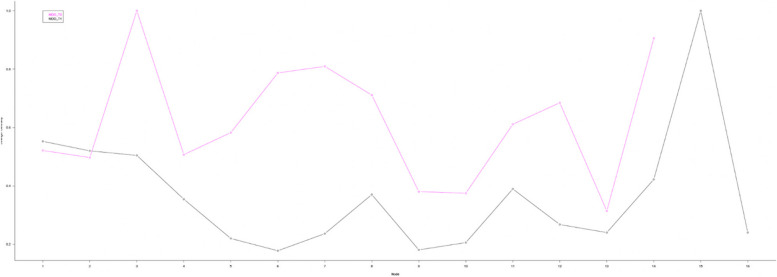
At baseline, the network showed separate dimensions for cognitive and psychosocial-affective symptoms, with cognitive symptoms strongly affecting psychosocial functioning. The MoCA tool was identified as a potential psychometric tool for evaluating cognitive deficits and monitoring treatment response. After drug treatment, the network showed less interconnection between nodes, indicating greater stability, with antidepressants taking a central role in driving the network. Affective symptoms improved at follow-up, with the highest predictability for HDRS and BDI-II nodes being connected to the Antidepressants node.
NIA allows us to understand not only what symptoms enhance after pharmacological treatment, but especially the role it plays within the network and with which nodes it has stronger connections.
重度抑郁症(MDD)是一种影响全球数百万人的心理健康障碍。其特征是持续的悲伤、绝望和对曾经令人愉快的活动失去兴趣。MDD 是一个主要的公共卫生关注点,是导致残疾、发病率、住院和死亡人数增加的主要原因,具有高自杀风险。选择性 5-羟色胺再摄取抑制剂(SSRIs)和 5-羟色胺去甲肾上腺素再摄取抑制剂(SNRIs)的药物治疗通常因其疗效和耐受性而成为首选。然而,即使经过充分的药物治疗试验,仍有相当一部分抑郁患者无法缓解,这种情况称为治疗抵抗性抑郁症(TRD)。
为了更好地理解 MDD 临床表型的复杂性,我们提出了网络干预分析(NIA),它可以帮助健康心理学检测风险行为,进行一级和/或二级预防,以及监测治疗并验证其有效性。本文旨在识别 14 个连续变量的节点之间的相互作用和变化,这些变量的节点被确定为 MDD 患者队列中的“治疗”,这些患者因最近对抗抑郁药物部分反应而被招募。该研究分析了 MDD 患者在基线和药物治疗 12 周后的网络。
在基线时,网络显示出认知和心理社会情感症状的分离维度,认知症状强烈影响心理社会功能。MoCA 工具被确定为评估认知缺陷和监测治疗反应的潜在心理测量工具。药物治疗后,节点之间的网络连接减少,表明稳定性增加,抗抑郁药在驱动网络方面发挥核心作用。在随访时,情感症状得到改善,HDRS 和 BDI-II 节点与抗抑郁药节点的连接具有最高的可预测性。
NIA 使我们不仅能够了解药物治疗后哪些症状得到改善,而且还能了解其在网络中的作用以及与哪些节点具有更强的连接。