Zhang Liping, Zhu Qiaoying, Zhao Qi, Lin Xueping, Song Hui, Liu Hong, Zhu Guiquan, Lu Shun, Cao Bangrong
Department of Clinical Laboratory, Sichuan Provincial Maternity and Child Health Care Hospital, Affiliated Women's and Children's Hospital of Chengdu Medical College, Chengdu Medical College, Chengdu, China.
Department of Biobank, Sichuan Clinical Research Center for Cancer, Sichuan Cancer Hospital & Institute, Sichuan Cancer Center, University of Electronic Science and Technology of China, Chengdu, China.
Cancer Rep (Hoboken). 2024 Jan;7(1):e1939. doi: 10.1002/cnr2.1939. Epub 2023 Nov 28.
Immune cells are crucial components in the tumor microenvironment and have a significant impact on the outcomes of patients.
Here, we aimed to establish a prognostic score based on different types of tumor-infiltrating immune cells for Endometrial Carcinoma (EC).
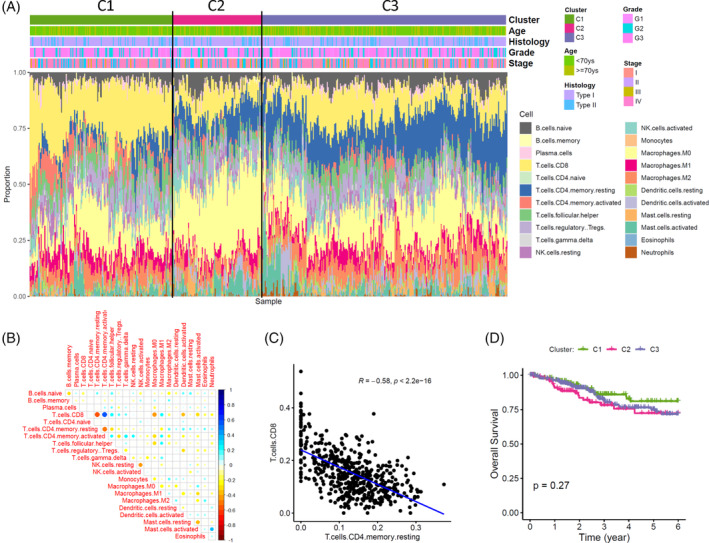
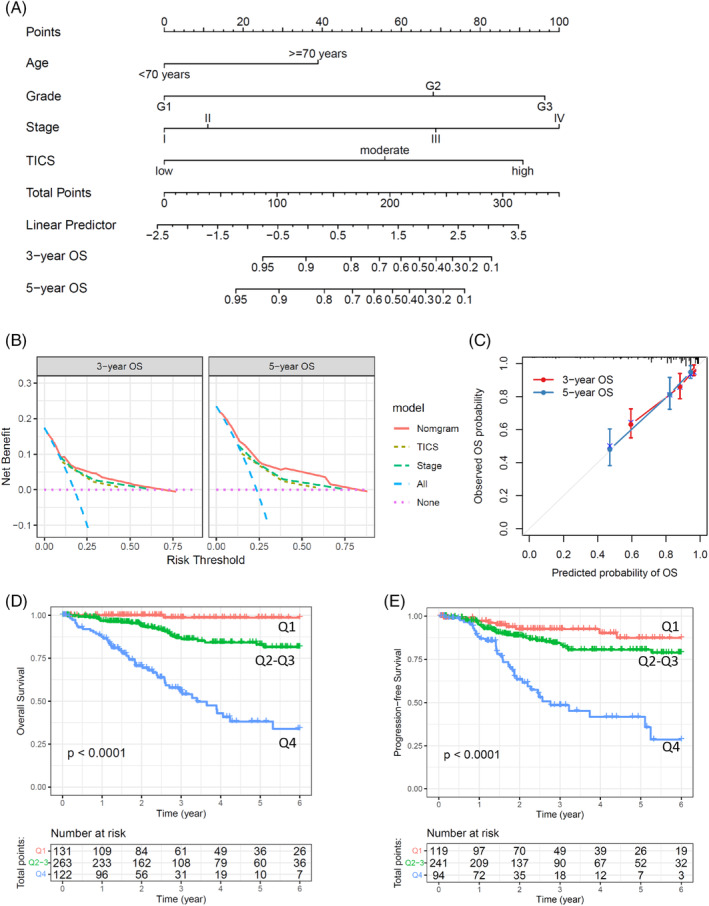
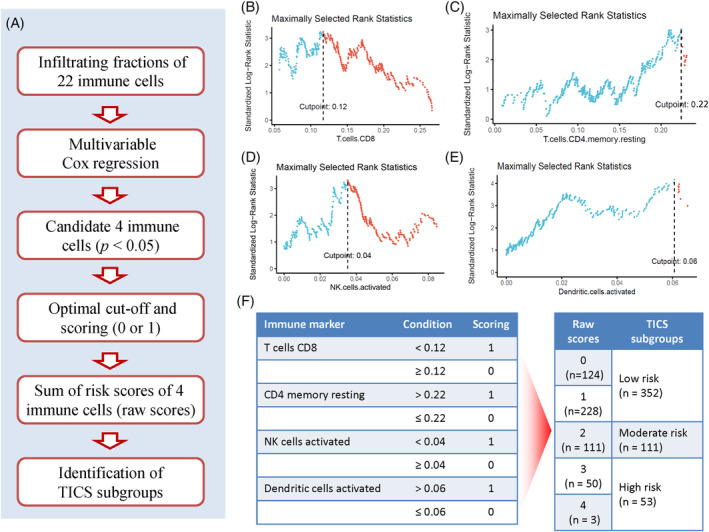
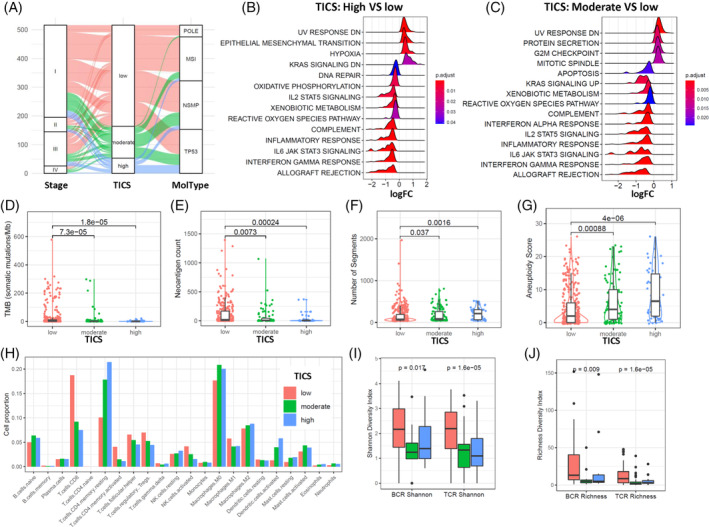
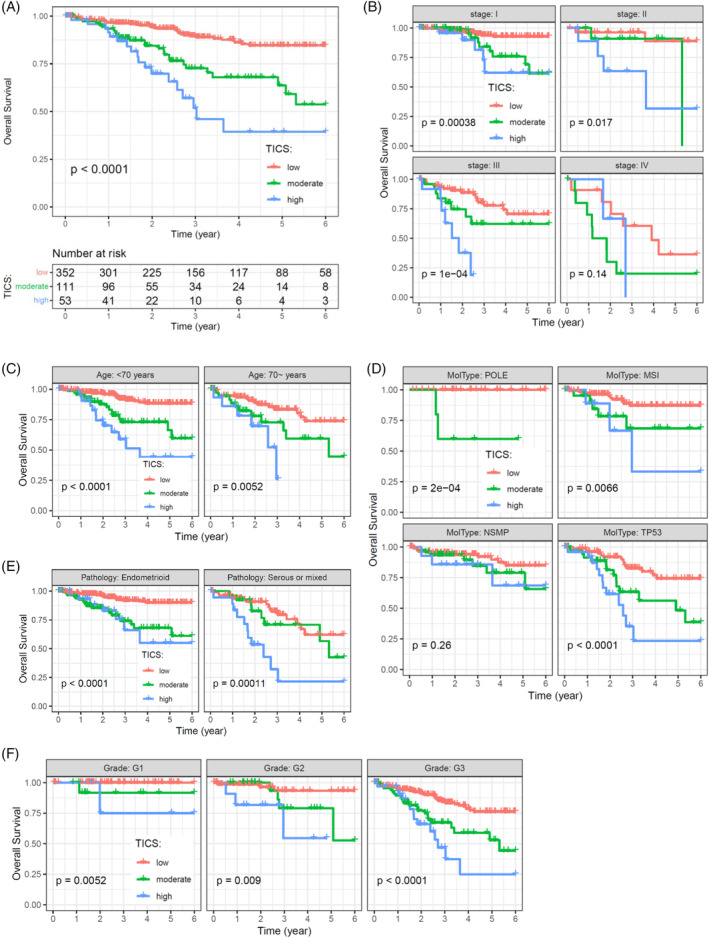
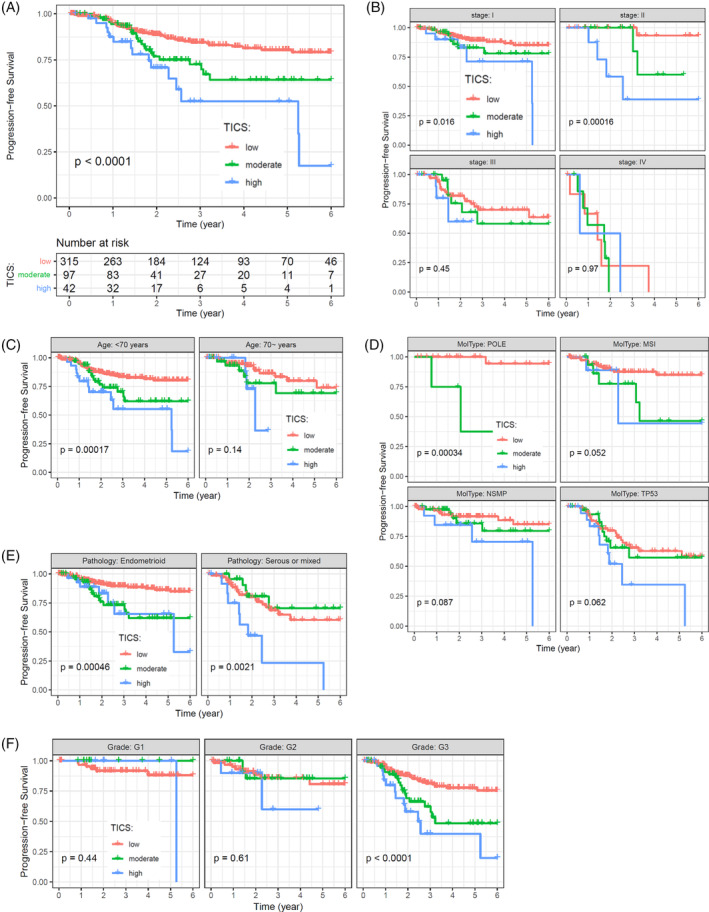
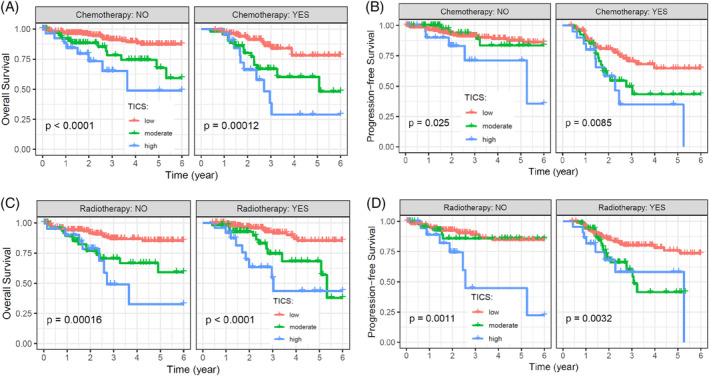
We enrolled and analyzed 516 EC patients from The Cancer Genome Atlas. The relative abundance of 22 immune cells were estimated by using the CIBERSORTx algorithm. Cox regression was performed to identify potential prognostic immune cells, which were used to develop a Tumor-infiltrating Immune Cell Score (TICS). The prognostic and incremental value of TICS for overall survival were compared with traditional prognostic factors using the C-index and decision curves. Clustering analysis using all immune cells identified three immune landscape subtypes, which had weak correlation with survival. A TICS was constructed using CD8T cells, resting memory CD4 T cells, activated NK and activated DCs, and classified patients as low-, moderate- and high-risk subgroups. The low-risk subgroup had higher tumor mutation burden and activation of IL2/STAT5, IL2/STAT3 and IFN-gamma response pathways. Conversely, the high-risk subgroup was associated with DNA copy number variation, hypoxia and EMT process. The TICS subgroups significantly predicted overall survival, which was independent of patient age, tumor stage, grade and molecular classification. Moreover, we developed a nomogram incorporating TICS and clinicopathologic factors, which significantly improved the predictive accuracy compared to the clinicopathologic model alone.
The TICS is an effective and independent prognostic predictor for EC patients and may serve as a useful supplement to clinicopathological factors and molecular subtyping.
免疫细胞是肿瘤微环境的关键组成部分,对患者的预后有重大影响。
在此,我们旨在基于不同类型的肿瘤浸润免疫细胞建立子宫内膜癌(EC)的预后评分。
我们纳入并分析了来自癌症基因组图谱的516例EC患者。使用CIBERSORTx算法估计22种免疫细胞的相对丰度。进行Cox回归以识别潜在的预后免疫细胞,这些细胞用于构建肿瘤浸润免疫细胞评分(TICS)。使用C指数和决策曲线将TICS对总生存的预后和增量价值与传统预后因素进行比较。使用所有免疫细胞进行聚类分析确定了三种免疫景观亚型,它们与生存的相关性较弱。使用CD8 T细胞、静息记忆CD4 T细胞、活化的自然杀伤细胞和活化的树突状细胞构建了TICS,并将患者分为低、中、高风险亚组。低风险亚组具有更高的肿瘤突变负担以及IL2/STAT5、IL2/STAT3和IFN-γ反应途径的激活。相反,高风险亚组与DNA拷贝数变异、缺氧和上皮-间质转化过程相关。TICS亚组显著预测了总生存,且独立于患者年龄、肿瘤分期、分级和分子分类。此外,我们开发了一个包含TICS和临床病理因素的列线图,与单独的临床病理模型相比,显著提高了预测准确性。
TICS是EC患者有效的独立预后预测指标,可作为临床病理因素和分子亚型的有益补充。