Marconi Mathieu, Do Carmo Blanco Noelia, Zimmer Christophe, Guyon Alice
Université Côte d'Azur Neuromod- Mod4NeuCog,, France.
Université Côte d'Azur Plateforme CoCoLab, France.
J Eye Mov Res. 2023 May 16;16(2). doi: 10.16910/jemr.16.2.2. eCollection 2023.
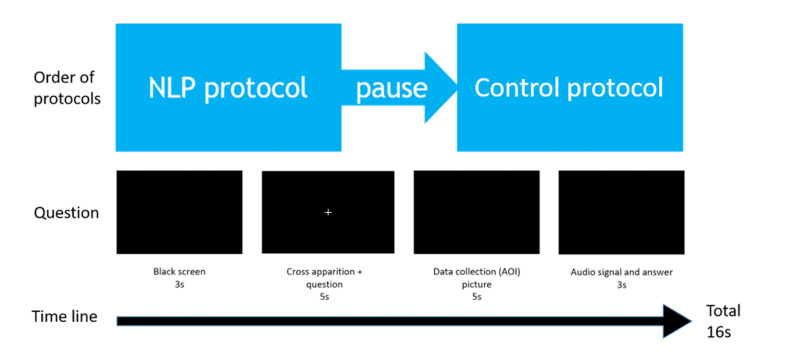
The eyes are in constant movement to optimize the interpretation of the visual scene by the brain. Eye movements are controlled by complex neural networks that interact with the rest of the brain. The direction of our eye movements could thus be influenced by our cognitive activity (imagination, internal dialogue, memory, etc.). A given cognitive activity could then cause the gaze to move in a specific direction (a brief movement that would be instinctive and unconscious). Neuro Linguistic Programming (NLP), which was developed in the 1970s by Richard Bandler and John Grinder (psychologist and linguist respectively), issued a comprehensive theory associating gaze directions with specific mental tasks. According to this theory, depending on the visual path observed, one could go back to the participant's thoughts and cognitive processes. Although NLP is widely used in many disciplines (communication, psychology, psychotherapy, marketing, etc), to date, few scientific studies have examined the validity of this theory. Using eye tracking, this study explores one of the hypotheses of this theory, which is one of the pillars of NLP on visual language. We created a protocol based on a series of questions of different types (supposed to engage different brain areas) and we recorded by eye tracking the gaze movements at the end of each question while the participants were thinking and elaborating on the answer. Our results show that 1) complex questions elicit significantly more eye movements than control questions that necessitate little reflection, 2) the movements are not random but are oriented in selected directions, according to the different question types, 3) the orientations observed are not those predicted by the NLP theory. This pilot experiment paves the way for further investigations to decipher the close links between eye movements and neural network activities in the brain.
眼睛处于持续运动状态,以优化大脑对视觉场景的解读。眼球运动由与大脑其他部分相互作用的复杂神经网络控制。因此,我们眼球运动的方向可能会受到认知活动(想象、内心对话、记忆等)的影响。特定的认知活动可能会导致目光朝特定方向移动(这是一种本能且无意识的短暂移动)。神经语言程序学(NLP)由理查德·班德勒和约翰·格林德(分别为心理学家和语言学家)于20世纪70年代创立,它提出了一种将目光方向与特定心理任务相关联的综合理论。根据该理论,根据观察到的视觉路径,可以追溯到参与者的思维和认知过程。尽管NLP在许多学科(沟通、心理学、心理治疗、市场营销等)中被广泛应用,但迄今为止,很少有科学研究检验该理论的有效性。本研究利用眼动追踪技术,探索了该理论的一个假设,这是NLP关于视觉语言的支柱理论之一。我们基于一系列不同类型的问题(旨在激活不同的脑区)创建了一个实验方案,并在参与者思考并阐述答案时,通过眼动追踪记录每个问题结束时的目光移动情况。我们的结果表明:1)复杂问题引发的眼球运动明显多于几乎无需思考的控制问题;2)这些运动并非随机的,而是根据不同问题类型朝着特定方向进行;3)观察到的方向并非NLP理论所预测的方向。这项初步实验为进一步研究解读眼球运动与大脑神经网络活动之间的紧密联系铺平了道路。