Pearce Alex K, McGuire W Cameron, Elliott Ann R, Goligher Ewan C, Prisk G Kim, Butler James P, Malhotra Atul
Division of Pulmonary, Critical Care, Sleep Medicine, and Physiology, University of California San Diego, La Jolla, CA.
Interdepartmental Division of Critical Care Medicine, University of Toronto, Toronto, ON, Canada.
Crit Care Explor. 2023 Dec 1;5(12):e1014. doi: 10.1097/CCE.0000000000001014. eCollection 2023 Dec.
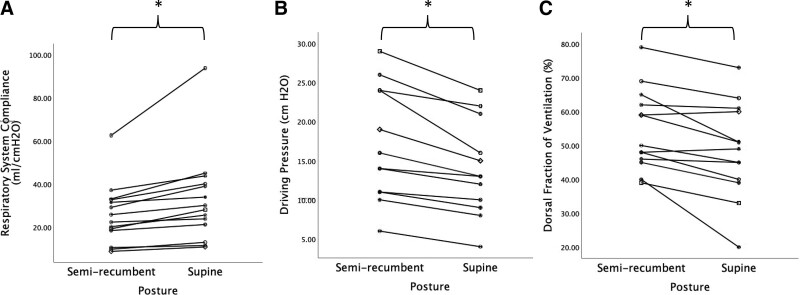
In some patients with acute respiratory distress syndrome (ARDS), a paradoxical improvement in respiratory system compliance (C) has been observed when assuming a supine (head of bed [HOB] 0°) compared with semirecumbent (HOB 35-40°) posture. We sought to test the hypothesis that mechanically ventilated patients with ARDS would have improved C, due to changes in ventilation distribution, when moving from the semirecumbent to supine position. We conducted a prospective, observational ICU study including 14 mechanically ventilated patients with ARDS. For each patient, ventilation distribution (assessed by electrical impedance tomography) and pulmonary mechanics were compared in supine versus semirecumbent postures. Compared with semirecumbent, in the supine posture C increased (33 ± 21 vs. 26 ± 14 mL/cm HO, = 0.005), driving pressure was reduced (14 ± 6 vs. 17 ± 7 cm HO, < 0.001), and dorsal fraction of ventilation was decreased (48.5 ± 14.1% vs. 54.5 ± 12.0%, = 0.003). Posture change from semirecumbent to supine resulted in a favorable physiologic response in terms of improved C and reduced driving pressure-with a corresponding increase in ventral ventilation, possibly related to reduced ventral overdistension.
在一些急性呼吸窘迫综合征(ARDS)患者中,与半卧位(床头抬高[HOB]35 - 40°)相比,仰卧位(床头抬高0°)时观察到呼吸系统顺应性(C)出现反常改善。我们试图验证这样一个假设,即对于接受机械通气的ARDS患者,从半卧位转为仰卧位时,由于通气分布的变化,其C会得到改善。我们进行了一项前瞻性、观察性的重症监护病房(ICU)研究,纳入了14例接受机械通气的ARDS患者。对每位患者,比较了仰卧位与半卧位时的通气分布(通过电阻抗断层扫描评估)和肺力学指标。与半卧位相比,仰卧位时C增加(33±21 vs. 26±14 mL/cm H₂O,P = 0.005),驱动压降低(14±6 vs. 17±7 cm H₂O,P < 0.001),背部通气分数降低(48.5±14.1% vs. 54.5±12.0%,P = 0.003)。从半卧位转为仰卧位的姿势改变在改善C和降低驱动压方面产生了有利的生理反应,同时腹侧通气相应增加,这可能与腹侧过度扩张减轻有关。