Nguyen Mai R, Ma Emily, Wyatt Debra, Knight Katherine L, Osipo Clodia
M.D./Ph.D. Program, Stritch School of Medicine, Loyola University Chicago, Maywood, IL, United States.
Department of Microbiology and Immunology, Stritch School of Medicine, Loyola University Chicago, Maywood, IL, United States.
Front Oncol. 2023 Nov 23;13:1292635. doi: 10.3389/fonc.2023.1292635. eCollection 2023.
Many well-known risk factors for breast cancer are associated with dysbiosis (an aberrant microbiome). However, how bacterial products modulate cancer are poorly understood. In this study, we investigated the effect of an exopolysaccharide (EPS) produced by the commensal bacterium on breast cancer phenotypes. Although is commonly included in probiotic preparations and its EPS protects against inflammatory diseases, it was virtually unknown whether -derived EPS affects cancer.
This work investigated effects of EPS on phenotypes of breast cancer cells as a cancer model. The phenotypes included proliferation, mammosphere formation, cell migration, and tumor growth in two immune compromised mouse models. RNA sequencing was performed on RNA from four breast cancer cells treated with PBS or EPS. IKKβ or STAT1 signaling was assessed using pharmacologic or RNAi-mediated knock down approaches.
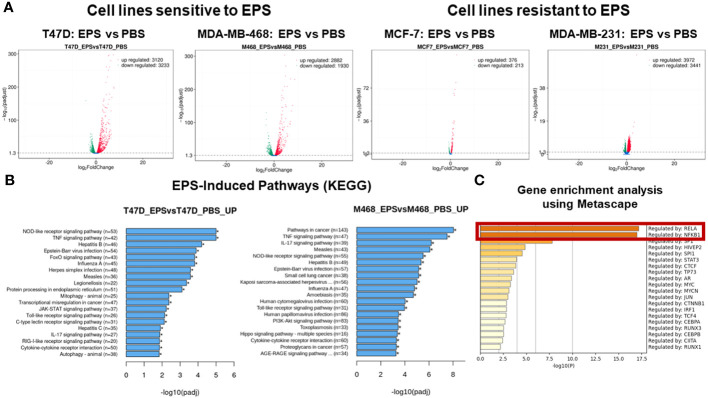
Short-term treatment with EPS inhibited proliferation of certain breast cancer cells (T47D, MDA-MB-468, HCC1428, MDA-MB-453) while having little effect on others (MCF-7, MDA-MB-231, BT549, ZR-75-30). EPS induced G1/G0 cell cycle arrest of T47D cells while increasing apoptosis of MDA-MB-468 cells. EPS also enhanced aggressive phenotypes in T47D cells including cell migration and cancer stem cell survival. Long-term treatment with EPS (months) led to resistance and promoted tumor growth in immunocompromised mice. RNA-sequence analysis showed that EPS increased expression of pro-inflammatory pathways including STAT1 and NF-κB. IKKβ and/or STAT1 signaling was necessary for EPS to modulate phenotypes of EPS sensitive breast cancer cells.
These results demonstrate a multifaceted role for an EPS molecule secreted by the probiotic bacterium on breast cancer cell phenotypes. These results warrant future studies in immune competent mice and different cancer models to fully understand potential benefits and/or side effects of long-term use of probiotics.
许多广为人知的乳腺癌风险因素都与微生物群落失调(异常微生物群)有关。然而,细菌产物如何调节癌症却知之甚少。在本研究中,我们调查了共生细菌产生的一种胞外多糖(EPS)对乳腺癌表型的影响。尽管该细菌通常包含在益生菌制剂中,其EPS可预防炎症性疾病,但实际上尚不清楚该细菌衍生的EPS是否会影响癌症。
本研究以乳腺癌细胞表型作为癌症模型,调查了EPS的作用。这些表型包括增殖、乳腺球形成、细胞迁移以及在两种免疫缺陷小鼠模型中的肿瘤生长情况。对用PBS或EPS处理的四种乳腺癌细胞的RNA进行了RNA测序。使用药理学或RNAi介导的敲低方法评估IKKβ或STAT1信号传导。
短期用EPS处理可抑制某些乳腺癌细胞(T47D、MDA-MB-468、HCC1428、MDA-MB-453)的增殖,而对其他细胞(MCF-7、MDA-MB-231、BT549、ZR-75-30)影响很小。EPS诱导T47D细胞的G1/G0细胞周期停滞,同时增加MDA-MB-468细胞的凋亡。EPS还增强了T47D细胞中的侵袭性表型,包括细胞迁移和癌症干细胞存活。长期用EPS处理(数月)导致免疫缺陷小鼠产生抗性并促进肿瘤生长。RNA序列分析表明,EPS增加了包括STAT1和NF-κB在内的促炎途径的表达。IKKβ和/或STAT1信号传导是EPS调节EPS敏感乳腺癌细胞表型所必需的。
这些结果证明了益生菌细菌分泌的EPS分子对乳腺癌细胞表型具有多方面作用。这些结果值得在免疫健全的小鼠和不同癌症模型中进行进一步研究,以充分了解长期使用益生菌的潜在益处和/或副作用。