Ahn EunSeon, Majumdar Areti, Lee Taraz, Brang David
Department of Psychology, University of Michigan, Ann Arbor, MI 48109.
bioRxiv. 2023 Nov 27:2023.11.27.568892. doi: 10.1101/2023.11.27.568892.
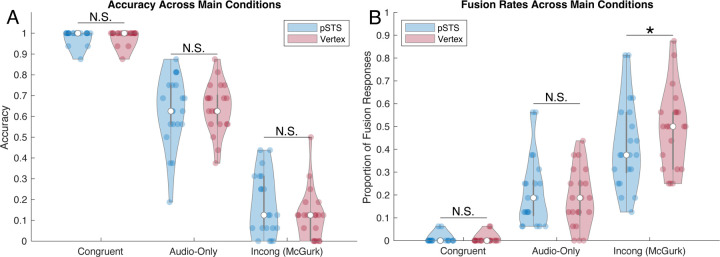
Congruent visual speech improves speech perception accuracy, particularly in noisy environments. Conversely, mismatched visual speech can alter what is heard, leading to an illusory percept known as the McGurk effect. This illusion has been widely used to study audiovisual speech integration, illustrating that auditory and visual cues are combined in the brain to generate a single coherent percept. While prior transcranial magnetic stimulation (TMS) and neuroimaging studies have identified the left posterior superior temporal sulcus (pSTS) as a causal region involved in the generation of the McGurk effect, it remains unclear whether this region is critical only for this illusion or also for the more general benefits of congruent visual speech (e.g., increased accuracy and faster reaction times). Indeed, recent correlative research suggests that the benefits of congruent visual speech and the McGurk effect reflect largely independent mechanisms. To better understand how these different features of audiovisual integration are causally generated by the left pSTS, we used single-pulse TMS to temporarily impair processing while subjects were presented with either incongruent (McGurk) or congruent audiovisual combinations. Consistent with past research, we observed that TMS to the left pSTS significantly reduced the strength of the McGurk effect. Importantly, however, left pSTS stimulation did not affect the positive benefits of congruent audiovisual speech (increased accuracy and faster reaction times), demonstrating a causal dissociation between the two processes. Our results are consistent with models proposing that the pSTS is but one of multiple critical areas supporting audiovisual speech interactions. Moreover, these data add to a growing body of evidence suggesting that the McGurk effect is an imperfect surrogate measure for more general and ecologically valid audiovisual speech behaviors.
一致的视觉语音可提高语音感知准确性,尤其是在嘈杂环境中。相反,不匹配的视觉语音会改变所听到的内容,导致一种被称为麦格克效应的错觉。这种错觉已被广泛用于研究视听语音整合,表明听觉和视觉线索在大脑中结合以产生单一连贯的感知。虽然先前的经颅磁刺激(TMS)和神经成像研究已确定左后颞上沟(pSTS)是参与麦格克效应产生的因果区域,但尚不清楚该区域是否仅对这种错觉至关重要,还是对一致的视觉语音的更普遍益处(例如,提高准确性和更快的反应时间)也至关重要。事实上,最近的相关研究表明,一致的视觉语音的益处和麦格克效应在很大程度上反映了独立的机制。为了更好地理解视听整合的这些不同特征是如何由左pSTS因果性地产生的,我们使用单脉冲TMS在受试者呈现不一致(麦格克)或一致的视听组合时暂时损害其处理能力。与过去的研究一致,我们观察到对左pSTS进行TMS显著降低了麦格克效应的强度。然而,重要的是,左pSTS刺激并未影响一致的视听语音的积极益处(提高准确性和更快的反应时间),这表明这两个过程之间存在因果分离。我们的结果与提出pSTS只是支持视听语音交互的多个关键区域之一的模型一致。此外,这些数据增加了越来越多的证据,表明麦格克效应对于更普遍且生态有效的视听语音行为而言是一种不完美的替代测量方法。