
病例报告:奥沙利铂诱导的特发性非肝硬化门静脉高压症:一例病例报告及文献综述
Case report: Oxaliplatin-induced idiopathic non-cirrhotic portal hypertension: a case report and literature review.
作者信息
Ye Jiayuan, Xie Yilian, Xu Yaojiang, Chen Nan, Tu Yifei
机构信息
Department of Infectious Diseases, Shangyu People's Hospital of Shaoxing, Shaoxing, Zhejiang, China.
Department of Infectious Diseases, The First Affiliated Hospital of Ningbo University, Ningbo, Zhejiang, China.
出版信息
Front Med (Lausanne). 2023 Nov 28;10:1285064. doi: 10.3389/fmed.2023.1285064. eCollection 2023.
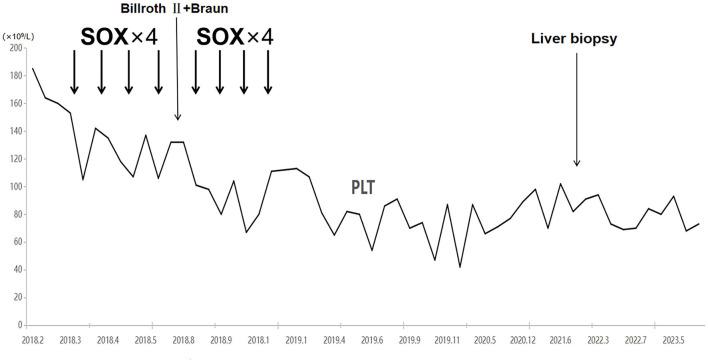
Oxaliplatin has become a widely used agent in neoadjuvant chemotherapy for gastrointestinal tract tumors and is an integral part of the therapeutic approach for managing colorectal cancer recurrences and metastases, resulting in a more favorable prognosis for patients. Nevertheless, oxaliplatin can give rise to idiopathic non-cirrhotic portal hypertension (INCPH). The emergence of INCPH can disrupt tumor chemotherapy and incite persistent adverse reactions in later stages, significantly complicating clinical management. Consequently, we have presented a case report of INCPH induced by oxaliplatin chemotherapy with the aim of advancing the diagnosis and treatment of this condition, with a particular focus on the clinical manifestations. This study has ascertained that the condition is primarily attributed to complications related to portal hypertension, such as gastrointestinal bleeding, splenomegaly, and hypersplenism. The pathological features primarily involve hepatic sinus dilation and congestion, portal obstruction, absence, stenosis, shunting, localized venous and perisinusoidal fibrosis, as well as hepatocellular atrophy. Treatment primarily concentrates on strategies typically employed for cirrhosis. Endoscopic ligation, sclerotherapy, and non-selective beta-blockers (NSBBs) can be selected to prevent and treat variceal hemorrhage. Transjugular intrahepatic portosystemic shunt (TIPS) and liver transplantation can also be chosen for severe cases. Notably, despite the timely discontinuation of oxaliplatin, most patients continue to experience disease progression, ultimately resulting in a poor prognosis due to either tumor advancement or the ongoing progression of portal hypertension. This emphasizes the importance for physicians to be aware of and consider the risk of INCPH when prescribing oxaliplatin.
奥沙利铂已成为胃肠道肿瘤新辅助化疗中广泛使用的药物,是治疗结直肠癌复发和转移的重要组成部分,能为患者带来更有利的预后。然而,奥沙利铂可引发特发性非肝硬化性门静脉高压(INCPH)。INCPH的出现会干扰肿瘤化疗,并在后期引发持续的不良反应,显著增加临床管理的复杂性。因此,我们报告了一例奥沙利铂化疗诱导的INCPH病例,旨在推进对该病症的诊断和治疗,尤其关注其临床表现。本研究确定该病症主要归因于与门静脉高压相关的并发症,如胃肠道出血、脾肿大和脾功能亢进。病理特征主要包括肝窦扩张和充血、门静脉阻塞、缺如、狭窄、分流、局部静脉和窦周纤维化以及肝细胞萎缩。治疗主要集中在通常用于肝硬化的策略上。可选择内镜结扎、硬化疗法和非选择性β受体阻滞剂(NSBBs)来预防和治疗静脉曲张出血。对于严重病例,也可选择经颈静脉肝内门体分流术(TIPS)和肝移植。值得注意的是,尽管及时停用了奥沙利铂,但大多数患者仍会出现疾病进展,最终由于肿瘤进展或门静脉高压的持续发展而导致预后不良。这强调了医生在开具奥沙利铂处方时了解并考虑INCPH风险的重要性。


 Zotero 插件