Department of Advanced Bioscience, Graduate School of Agriculture, Kindai University, Nara, Japan.
School of Life Science and Technology, Tokyo Institute of Technology, Yokohama, Japan.
Nat Ecol Evol. 2024 Jan;8(1):111-120. doi: 10.1038/s41559-023-02258-8. Epub 2023 Dec 13.
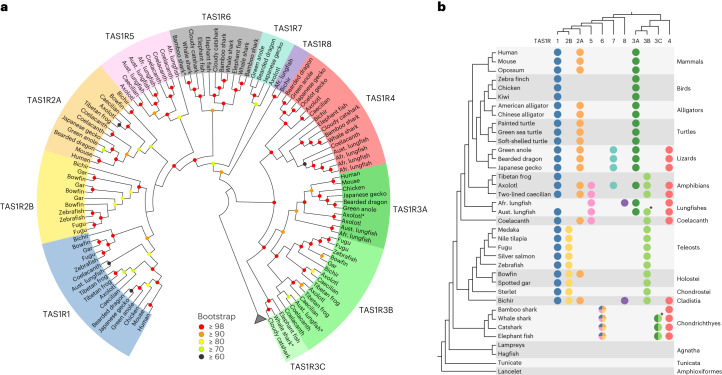
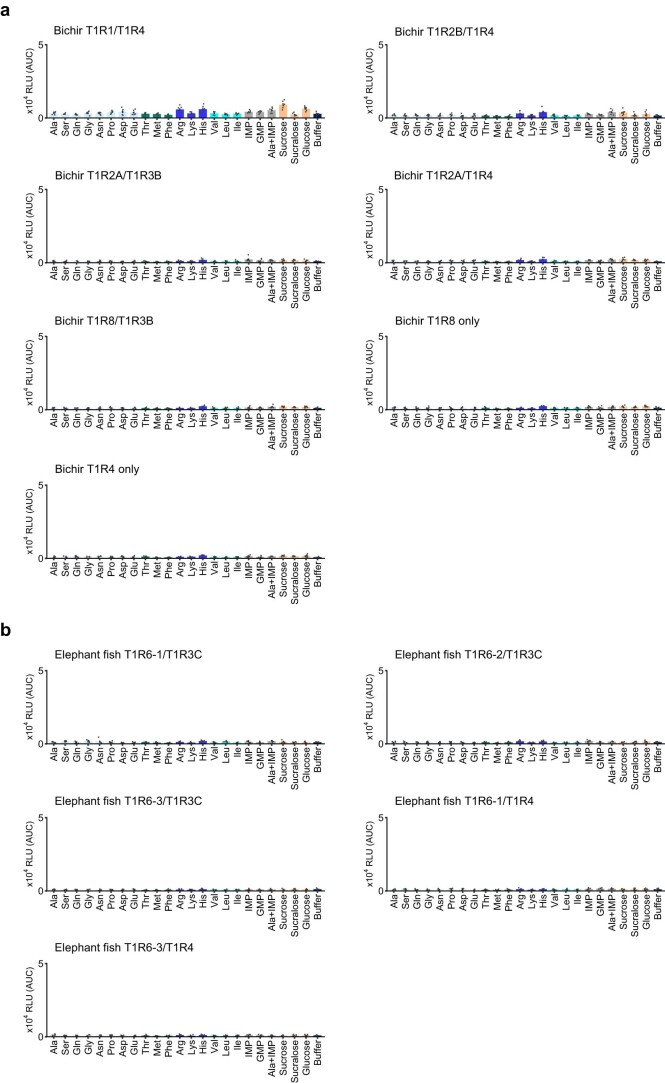
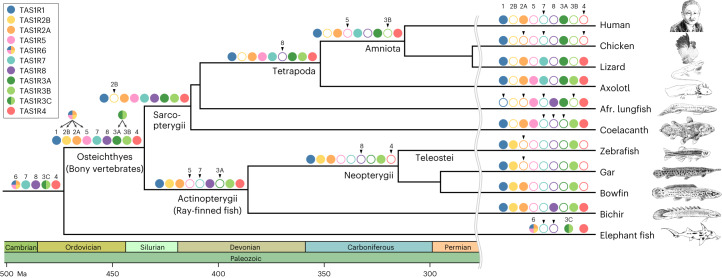
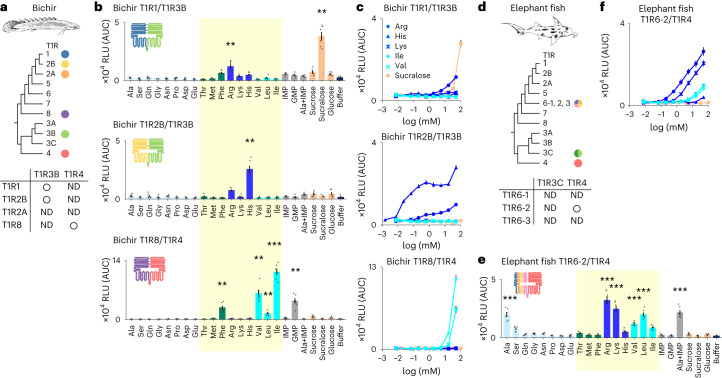
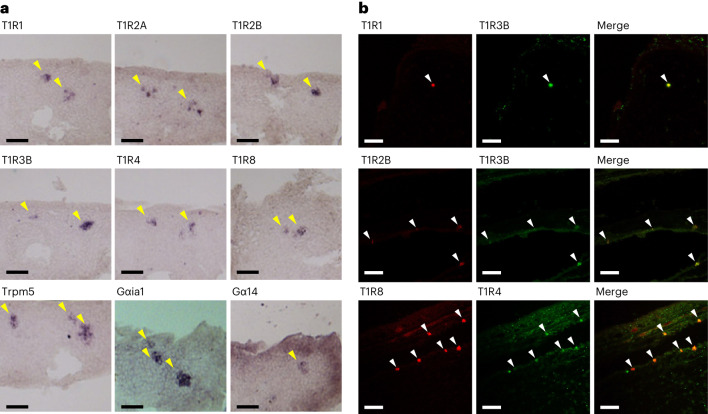
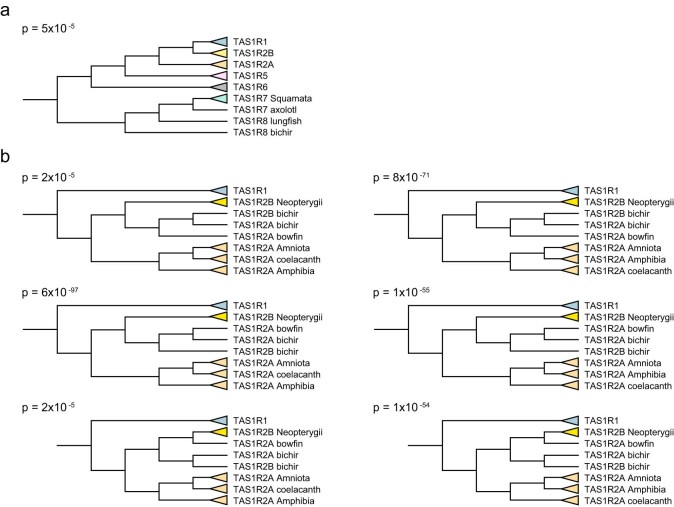
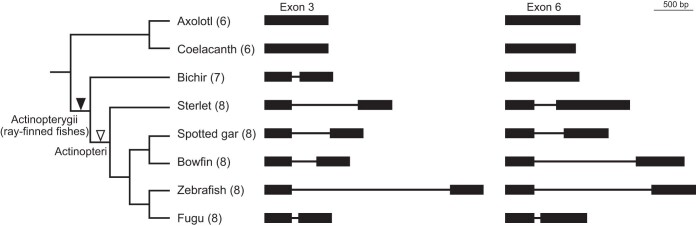
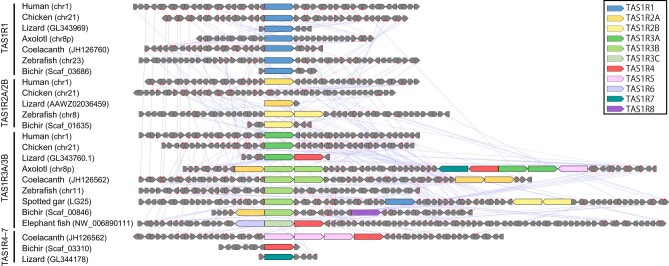
Taste is a vital chemical sense for feeding behaviour. In mammals, the umami and sweet taste receptors comprise three members of the taste receptor type 1 (T1R/TAS1R) family: T1R1, T1R2 and T1R3. Because their functional homologues exist in teleosts, only three TAS1R genes generated by gene duplication are believed to have been inherited from the common ancestor of bony vertebrates. Here, we report five previously uncharacterized TAS1R members in vertebrates, TAS1R4, TAS1R5, TAS1R6, TAS1R7 and TAS1R8, based on genome-wide survey of diverse taxa. We show that mammalian and teleost fish TAS1R2 and TAS1R3 genes are paralogues. Our phylogenetic analysis suggests that the bony vertebrate ancestor had nine TAS1Rs resulting from multiple gene duplications. Some TAS1Rs were lost independently in descendent lineages resulting in retention of only three TAS1Rs in mammals and teleosts. Combining functional assays and expression analysis of non-teleost fishes we show that the novel T1Rs form heterodimers in taste-receptor cells and recognize a broad range of ligands such as essential amino acids, including branched-chain amino acids, which have not been previously considered as T1R ligands. This study reveals diversity of taste sensations in both modern vertebrates and their ancestors, which might have enabled vertebrates to adapt to diverse habitats on Earth.
味觉是进食行为的一个重要化学感知。在哺乳动物中,鲜味和甜味受体由味觉受体类型 1(T1R/TAS1R)家族的三个成员组成:T1R1、T1R2 和 T1R3。因为它们在硬骨鱼中的功能同源物存在,所以人们认为只有从硬骨鱼祖先那里继承而来的三个 TAS1R 基因发生了基因复制。在这里,我们根据对不同分类群的全基因组调查,报道了脊椎动物中以前未被描述的五个 TAS1R 成员:TAS1R4、TAS1R5、TAS1R6、TAS1R7 和 TAS1R8。我们表明,哺乳动物和硬骨鱼的 TAS1R2 和 TAS1R3 基因是旁系同源基因。我们的系统发育分析表明,硬骨鱼祖先有九个 TAS1R,是通过多次基因复制产生的。一些 TAS1R 基因在后代谱系中独立丢失,导致哺乳动物和硬骨鱼中仅保留了三个 TAS1R。结合非硬骨鱼的功能测定和表达分析,我们表明这些新的 T1R 在味觉受体细胞中形成异二聚体,并识别广泛的配体,如必需氨基酸,包括支链氨基酸,这些以前都没有被认为是 T1R 的配体。这项研究揭示了现代脊椎动物及其祖先在味觉感知方面的多样性,这可能使脊椎动物能够适应地球上的各种栖息地。