Department of Ecology and Evolutionary Biology, University of Kansas, Lawrence, KS, 66045, USA.
Department of Biological Sciences, George Washington University, Washington, District of Columbia, USA.
Sci Rep. 2023 Dec 15;13(1):22320. doi: 10.1038/s41598-023-49815-6.
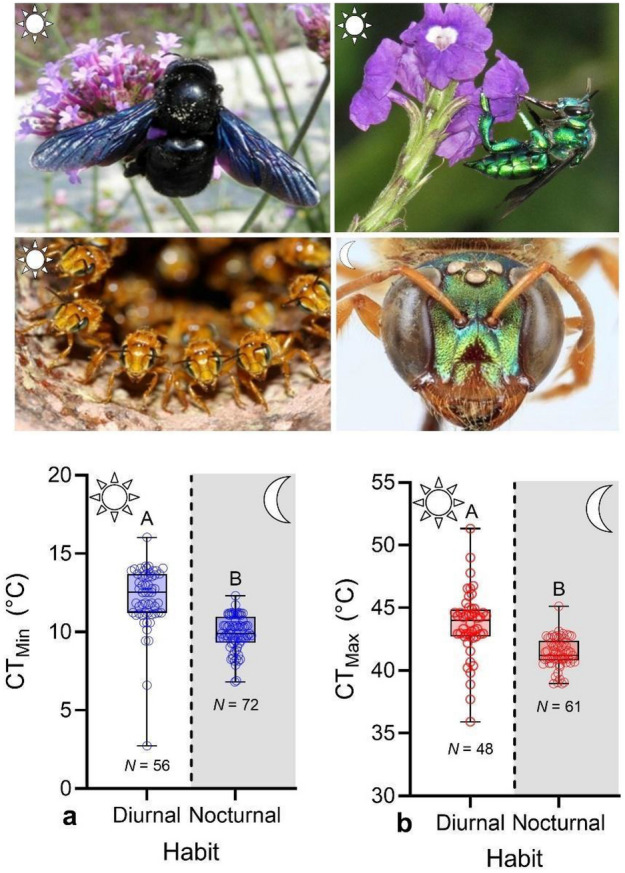
Predicting insect responses to climate change is essential for preserving ecosystem services and biodiversity. Due to high daytime temperatures and low humidity levels, nocturnal insects are expected to have lower heat and desiccation tolerance compared to diurnal species. We estimated the lower (CT) and upper (CT) thermal limits of Megalopta, a group of neotropical, forest-dwelling bees. We calculated warming tolerance (WT) as a metric to assess vulnerability to global warming and measured survival rates during simulated heatwaves and desiccation stress events. We also assessed the impact of body size and reproductive status (ovary area) on bees' thermal limits. Megalopta displayed lower CT, CT, and WTs than diurnal bees (stingless bees, orchid bees, and carpenter bees), but exhibited similar mortality during simulated heatwave and higher desiccation tolerance. CT increased with increasing body size across all bees but decreased with increasing body size and ovary area in Megalopta, suggesting a reproductive cost or differences in thermal environments. CT did not increase with increasing body size or ovary area. These results indicate a greater sensitivity of Megalopta to temperature than humidity and reinforce the idea that nocturnal insects are thermally constrained, which might threaten pollination services in nocturnal contexts during global warming.
预测昆虫对气候变化的响应对于保护生态系统服务和生物多样性至关重要。由于白天温度高、湿度低,与昼行性物种相比,夜行性昆虫的耐热性和耐旱性预计较低。我们估计了一组生活在森林中的新热带地区的巨型蜜蜂(Megalopta)的下限(CT)和上限(CT)热极限。我们计算了变暖耐受性(WT)作为评估对全球变暖脆弱性的指标,并在模拟热浪和干燥胁迫事件期间测量了生存率。我们还评估了体型和生殖状态(卵巢面积)对蜜蜂热极限的影响。与昼行性蜜蜂(无刺蜜蜂、兰花蜜蜂和木匠蜜蜂)相比,巨型蜜蜂的 CT、CT 和 WT 较低,但在模拟热浪期间死亡率相似,耐旱性更高。所有蜜蜂的 CT 均随体型增加而增加,但在巨型蜜蜂中,CT 随体型和卵巢面积增加而降低,这表明存在生殖成本或热环境的差异。CT 不随体型或卵巢面积的增加而增加。这些结果表明,巨型蜜蜂对温度的敏感性高于湿度,这进一步证实了夜行性昆虫受到热限制的观点,这可能会在全球变暖期间威胁到夜行性昆虫的授粉服务。