
基于组学科学的个性化营养计划与一般营养计划对超重和肥胖成年人的经济评估:一项基于丹麦试验数据的建模研究
Economic Evaluation of a Personalized Nutrition Plan Based on Omic Sciences Versus a General Nutrition Plan in Adults with Overweight and Obesity: A Modeling Study Based on Trial Data in Denmark.
作者信息
Galekop Milanne Maria Johanna, Uyl-de Groot Carin, Redekop William Ken
机构信息
Erasmus Universiteit Rotterdam, Erasmus School of Health Policy and Management, Rotterdam, The Netherlands.
出版信息
Pharmacoecon Open. 2024 Mar;8(2):313-331. doi: 10.1007/s41669-023-00461-8. Epub 2023 Dec 19.
BACKGROUND
Since there is no diet that is perfect for everyone, personalized nutrition approaches are gaining popularity to achieve goals such as the prevention of obesity-related diseases. However, appropriate choices about funding and encouraging personalized nutrition approaches should be based on sufficient evidence of their effectiveness and cost-effectiveness. In this study, we assessed whether a newly developed personalized plan (PP) could be cost-effective relative to a non-personalized plan in Denmark.
METHODS
Results of a 10-week randomized controlled trial were combined with a validated obesity economic model to estimate lifetime cost-effectiveness. In the trial, the intervention group (PP) received personalized home-delivered meals based on metabolic biomarkers and personalized behavioral change messages. In the control group these meals and messages were not personalized. Effects were measured in body mass index (BMI) and quality of life (EQ-5D-5L). Costs [euros (€), 2020] were considered from a societal perspective. Lifetime cost-effectiveness was assessed using a multi-state Markov model. Univariate, probabilistic sensitivity, and scenario analyses were performed.
RESULTS
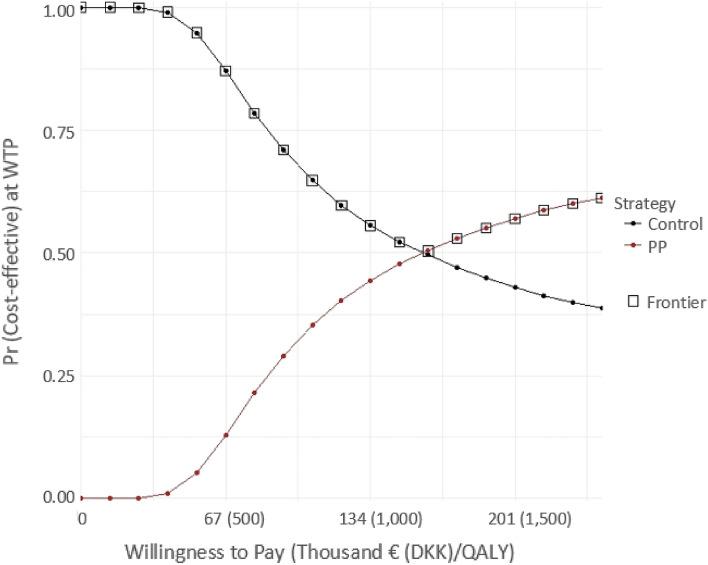
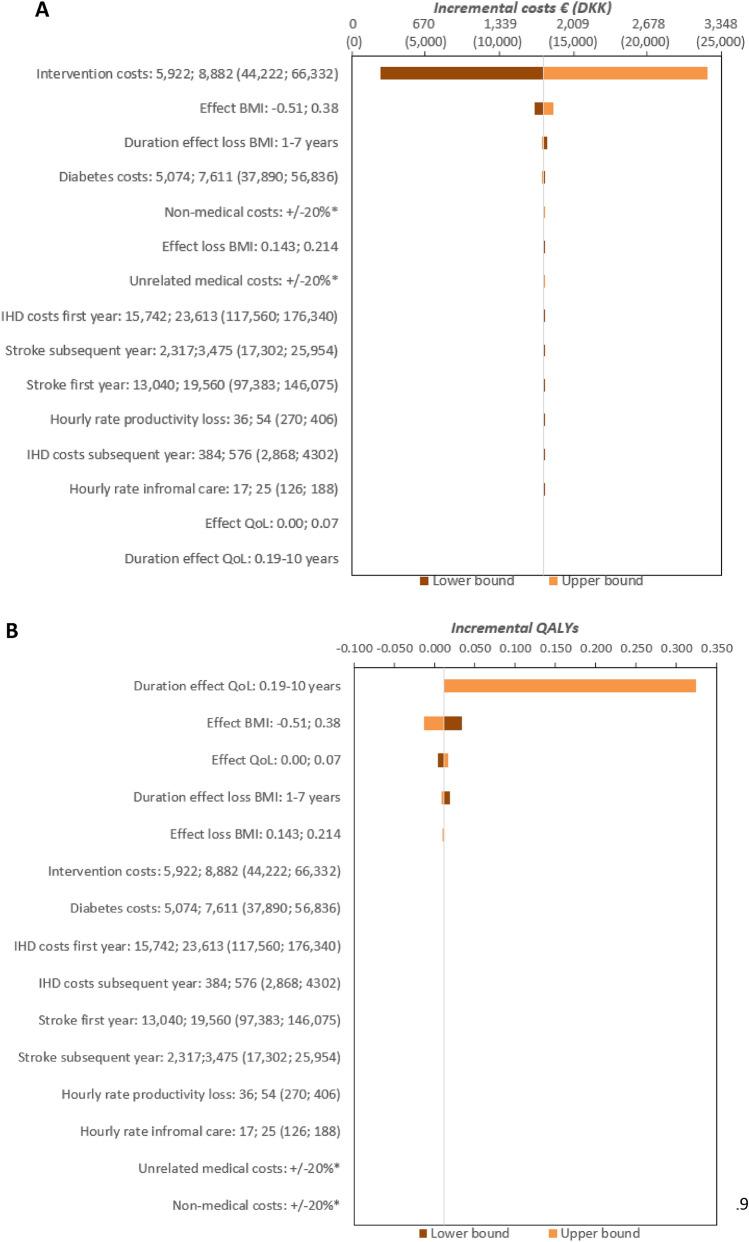
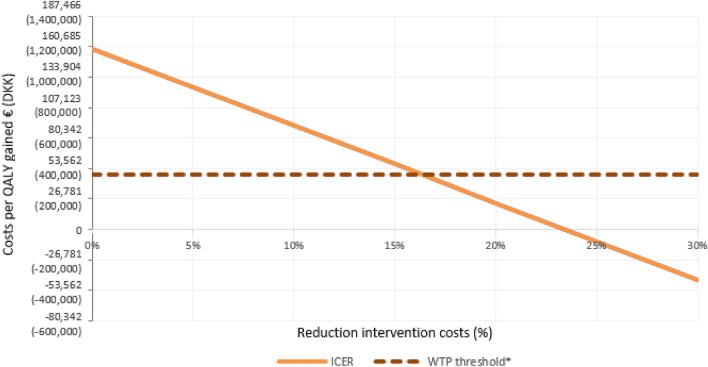
In the trial, no significant differences were found in the effectiveness of PP compared with control, but wide confidence intervals (CIs) were seen [e.g., BMI (-0.07, 95% CI -0.51, 0.38)]. Lifetime estimates showed that PP increased costs (€520,102 versus €518,366, difference: €1736) and quality-adjusted life years (QALYs) (15.117 versus 15.106, difference: 0.011); the incremental cost-utility ratio (ICUR) was therefore high (€158,798 to gain one QALY). However, a 20% decrease in intervention costs would reduce the ICUR (€23,668 per QALY gained) below an unofficial gross domestic product (GDP)-based willingness-to-pay threshold (€47,817 per QALY gained).
CONCLUSION
On the basis of the willingness-to-pay threshold and the non-significant differences in short-term effectiveness, PP may not be cost-effective. However, scaling up the intervention would reduce the intervention costs. Future studies should be larger and/or longer to reduce uncertainty about short-term effectiveness.
TRIAL REGISTRATION NUMBER
ClinicalTrials.gov registry (NCT04590989).
背景
由于不存在适合所有人的完美饮食,个性化营养方法正日益受到欢迎,以实现预防肥胖相关疾病等目标。然而,在资助和推广个性化营养方法方面做出恰当选择,应以其有效性和成本效益的充分证据为依据。在本研究中,我们评估了一种新开发的个性化计划(PP)相对于丹麦的非个性化计划是否具有成本效益。
方法
将一项为期10周的随机对照试验结果与一个经过验证的肥胖经济模型相结合,以估计终生成本效益。在该试验中,干预组(PP)基于代谢生物标志物和个性化行为改变信息接受个性化的上门送餐服务。对照组的餐食和信息则没有个性化。通过体重指数(BMI)和生活质量(EQ-5D-5L)来衡量效果。从社会角度考虑成本(欧元,2020年)。使用多状态马尔可夫模型评估终生成本效益。进行了单变量、概率敏感性和情景分析。
结果
在试验中,与对照组相比,PP的有效性未发现显著差异,但置信区间较宽(例如,BMI为-0.07,95%置信区间为-0.51,0.38)。终生估计表明,PP增加了成本(520,102欧元对518,366欧元,差值:1736欧元)和质量调整生命年(QALYs)(15.117对15.106,差值:0.011);因此,增量成本效用比(ICUR)很高(获得一个QALY需158,798欧元)。然而,干预成本降低了20%将使ICUR(每获得一个QALY为23,668欧元)降至基于国内生产总值(GDP)的非官方支付意愿阈值以下(每获得一个QALY为47,817欧元)。
结论
基于支付意愿阈值和短期有效性无显著差异,PP可能不具有成本效益。然而,扩大干预规模将降低干预成本。未来的研究应规模更大和/或时间更长,以减少短期有效性的不确定性。
试验注册号
ClinicalTrials.gov注册库(NCT04590989)。


 Zotero 插件