Section of Hygiene and Public Health, Department of Life Sciences and Public Health, Università Cattolica del Sacro Cuore, Roma, Italy.
Department of Public Health, University of Verona, Verona, Italy.
Front Public Health. 2022 Aug 11;10:787135. doi: 10.3389/fpubh.2022.787135. eCollection 2022.
Digital health interventions have significant potential to improve safety, efficacy, and quality of care, reducing waste in healthcare costs. Despite these premises, the evidence regarding cost and effectiveness of digital tools in health is scarce and limited.
The aim of this systematic review is to summarize the evidence on the cost-effectiveness of digital health interventions and to assess whether the studies meet the established quality criteria.
We queried PubMed, Scopus and Web of Science databases for articles in English published from January 1, 2016 to December 31, 2020 that performed economic evaluations of digital health technologies. The methodological rigorousness of studies was assessed with the Consolidated Health Economic Evaluation Reporting Standards (CHEERS). The review was conducted according to the Preferred Reporting Items for Systematic Reviews and Meta-Analysis (PRISMA) 2009 checklist.
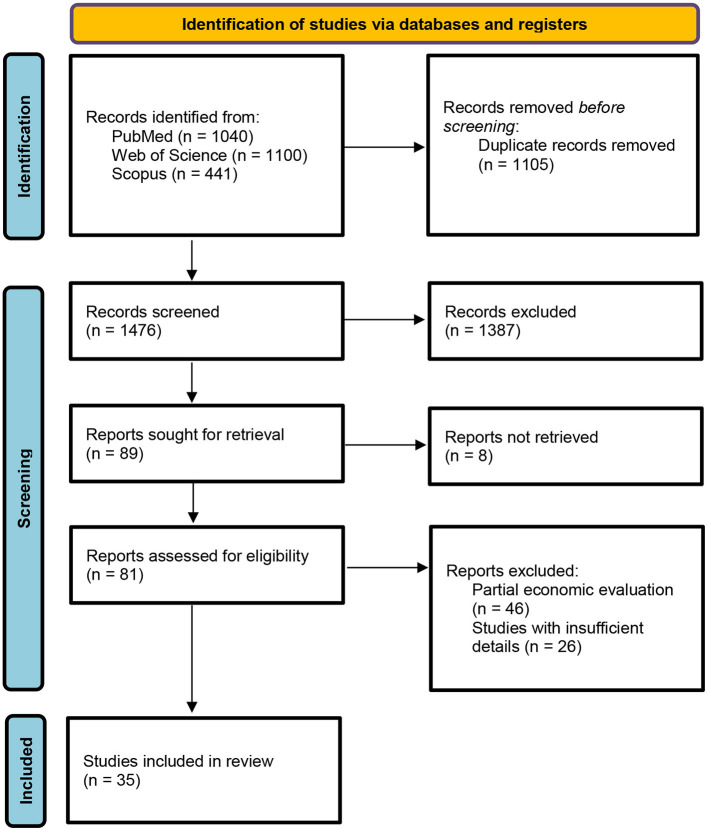
Search identified 1,476 results, 552 of which were selected for abstract and 35 were included in this review. The studies were heterogeneous by country (mostly conducted in upper and upper-middle income countries), type of eHealth intervention, method of implementation, and reporting perspectives. The qualitative analysis identified the economic and effectiveness evaluation of six different types of interventions: (1) seventeen studies on new video-monitoring service systems; (2) five studies on text messaging interventions; (3) five studies on web platforms and digital health portals; (4) two studies on telephone support; (5) three studies on new mobile phone-based systems and applications; and (6) three studies on digital technologies and innovations.
Findings on cost-effectiveness of digital interventions showed a growing body of evidence and suggested a generally favorable effect in terms of costs and health outcomes. However, due to the heterogeneity across study methods, the comparison between interventions still remains difficult. Further research based on a standardized approach is needed in order to methodically analyze incremental cost-effectiveness ratios, costs, and health benefits.
数字健康干预措施具有显著提高安全性、疗效和护理质量的潜力,同时减少医疗保健成本的浪费。尽管有这些前提,但数字工具在健康方面的成本效益证据仍然稀缺且有限。
本系统评价旨在总结数字健康干预措施的成本效益证据,并评估研究是否符合既定的质量标准。
我们在 PubMed、Scopus 和 Web of Science 数据库中查询了 2016 年 1 月 1 日至 2020 年 12 月 31 日期间发表的、评估数字健康技术经济评估的英文文章。使用统一的健康经济评估报告标准(CHEERS)评估研究的方法严谨性。该综述根据系统评价和荟萃分析的首选报告项目(PRISMA)2009 清单进行。
搜索共确定了 1476 项结果,其中 552 项被选择进行摘要评估,35 项被纳入本综述。研究在国家(主要在高收入和中上收入国家进行)、电子健康干预措施类型、实施方法和报告视角方面存在异质性。定性分析确定了六种不同类型干预措施的经济和效果评估:(1)17 项关于新视频监测服务系统的研究;(2)5 项关于短信干预的研究;(3)5 项关于网络平台和数字健康门户的研究;(4)2 项关于电话支持的研究;(5)3 项关于新的基于移动电话的系统和应用的研究;(6)3 项关于数字技术和创新的研究。
关于数字干预措施成本效益的研究结果表明,证据不断增加,并表明在成本和健康结果方面具有普遍有利的效果。然而,由于研究方法的异质性,干预措施之间的比较仍然困难。需要基于标准化方法进一步开展研究,以系统地分析增量成本效益比、成本和健康效益。