Department of Nutritional Sciences, Temerty Faculty of Medicine, University of Toronto, University of Toronto Medical Sciences Building, 5Th Floor, Room 5253A, 1 King's College Circle, Toronto, ON, M5S 1A8, Canada.
Sandy Lake First Nation, Sandy Lake, ON, P0V 1V0, Canada.
BMC Pediatr. 2023 Dec 19;23(1):641. doi: 10.1186/s12887-023-04449-5.
The Developmental Origins of Health and Disease (DOHaD) paradigm emphasizes the significance of early life factors for the prevention of chronic health conditions, like type 2 diabetes (T2DM) and obesity, which disproportionately affect First Nations communities in Canada. Despite increasing DOHaD research related to maternal health during pregnancy, early childhood growth patterns, and infant feeding practices with many populations, data from First Nations communities in Canada are limited. In partnership with Sandy Lake First Nation, the aims of this project were to characterize birthweights and growth patterns of First Nations infants/children over the first 6 years of life and to study the impact of maternal and infant social and behavioral factors on birthweight and growth trajectories.
We recruited 194 families through community announcements and clinic visits. Infant/child length/height and weight were measured at 1 and 2 weeks; 1, 2, 6, 12, and 18 months; and 2, 3, 4, 5 and 6 years. Maternal and infant/child questionnaires captured data about health, nutrition, and social support. Weight-for-Age z-score (WAZ), Height-for-Age z-score (HAZ), and BMI-for-Age z-score (BAZ) were calculated using WHO reference standards and trajectories were analyzed using generalized additive models. Generalized estimating equations and logistic regression were used to determine associations between exposures and outcomes.
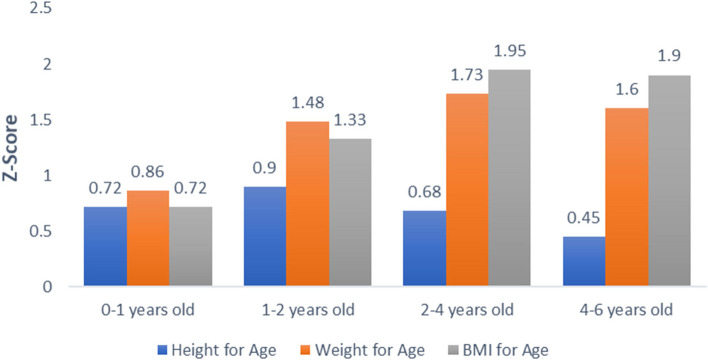
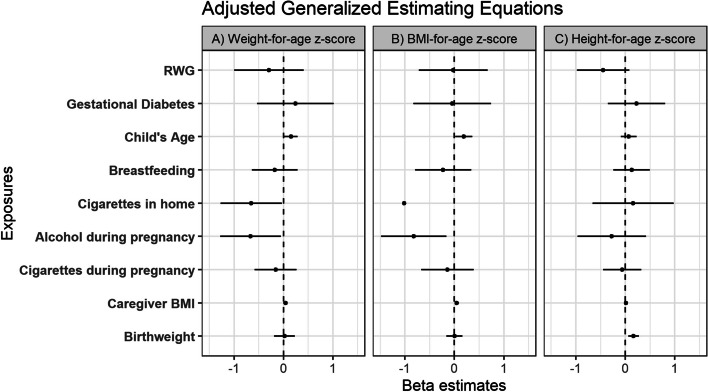
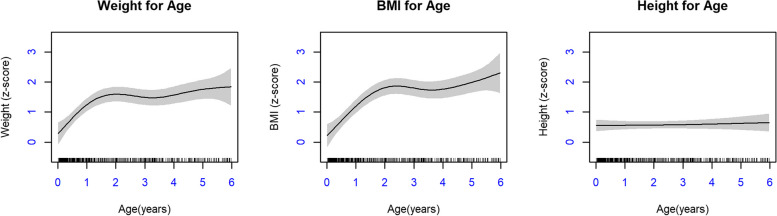
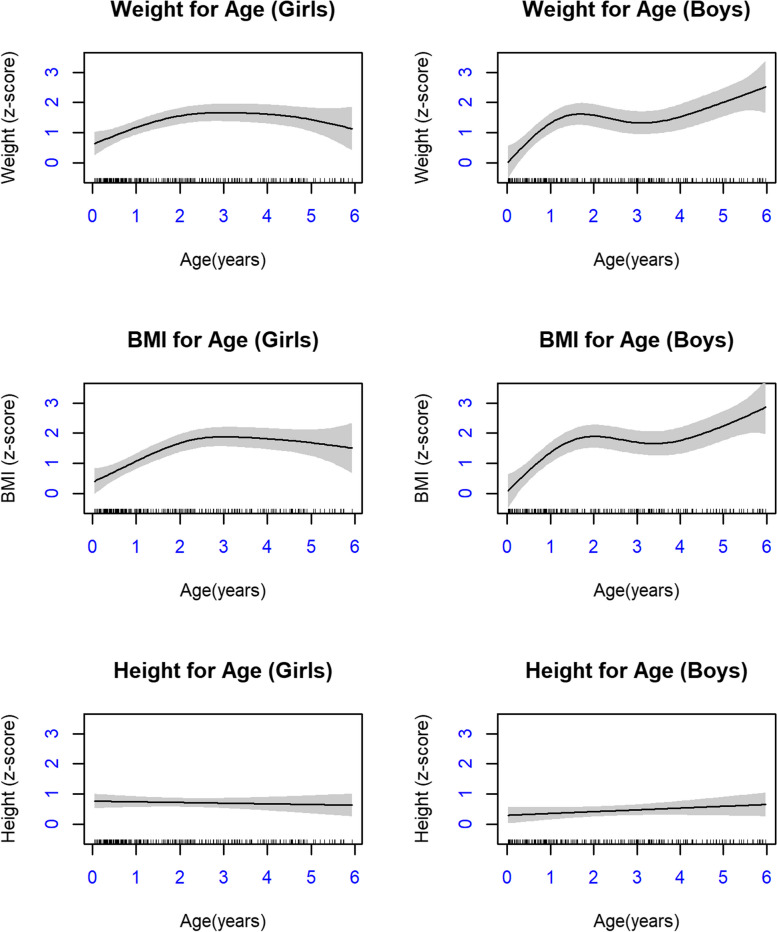
WAZ and BAZ were above the WHO mean and increased with age until age 6 years. Generalized estimating equations indicated that WAZ was positively associated with age (0.152; 95% CI 0.014, 0.29), HAZ was positively associated with birthweight (0.155; 95% CI 0.035, 0.275), and BAZ was positively associated with caregiver's BMI (0.049; 95% CI 0.004, 0.090). There was an increased odds of rapid weight gain (RWG) with exposure to gestational diabetes (OR: 7.47, 95% CI 1.68, 46.22). Almost 70% of parents initiated breastfeeding, and breastfeeding initiation was modestly associated with lower WAZ (-0.18; 95% CI -0.64, 0.28) and BAZ (-0.23; 95% CI -0.79, 0.34).
This work highlights early life factors that may contribute to T2DM etiology and can be used to support community and Indigenous-led prevention strategies.
健康与疾病的发育起源(DOHaD)范式强调了早期生活因素对预防 2 型糖尿病(T2DM)和肥胖等慢性健康状况的重要性,而这些健康状况在加拿大的第一民族社区中不成比例地存在。尽管越来越多的 DOHaD 研究关注与怀孕、幼儿生长模式和婴儿喂养实践相关的孕产妇健康,但加拿大第一民族社区的数据仍然有限。本项目与桑迪湖第一民族合作,旨在描述 6 岁以下第一民族婴儿/儿童的出生体重和生长模式,并研究母婴社会和行为因素对出生体重和生长轨迹的影响。
我们通过社区公告和诊所访问招募了 194 个家庭。婴儿/儿童的身长/身高和体重在 1 至 2 周、1、2、6、12 和 18 个月以及 2、3、4、5 和 6 岁时进行测量。母亲和婴儿/儿童的问卷收集了有关健康、营养和社会支持的数据。体重年龄 Z 评分(WAZ)、身高年龄 Z 评分(HAZ)和体重指数年龄 Z 评分(BAZ)使用世界卫生组织参考标准进行计算,使用广义加性模型分析轨迹。使用广义估计方程和逻辑回归确定暴露因素与结果之间的关联。
WAZ 和 BAZ 均高于世界卫生组织平均值,并随着年龄的增长而增加,直到 6 岁。广义估计方程表明,WAZ 与年龄呈正相关(0.152;95%置信区间 0.014,0.29),HAZ 与出生体重呈正相关(0.155;95%置信区间 0.035,0.275),BAZ 与照顾者的 BMI 呈正相关(0.049;95%置信区间 0.004,0.090)。暴露于妊娠期糖尿病会增加快速体重增加(RWG)的几率(比值比:7.47,95%置信区间 1.68,46.22)。近 70%的父母开始母乳喂养,母乳喂养的开始与较低的 WAZ(-0.18;95%置信区间 -0.64,0.28)和 BAZ(-0.23;95%置信区间 -0.79,0.34)适度相关。
这项工作强调了可能导致 2 型糖尿病发病机制的早期生活因素,并可用于支持社区和以原住民为主导的预防策略。