Department of Thoracic Surgery, Peking University Shenzhen Hospital, Shenzhen Peking University-The Hong Kong University of Science and Technology Medical Center, Shenzhen, China.
BGI Research, Hangzhou, China.
Clin Transl Med. 2023 Dec;13(12):e1515. doi: 10.1002/ctm2.1515.
Cancer-associated fibroblasts (CAFs) are potential targets for cancer therapy. Due to the heterogeneity of CAFs, the influence of CAF subpopulations on the progression of lung cancer is still unclear, which impedes the translational advances in targeting CAFs.
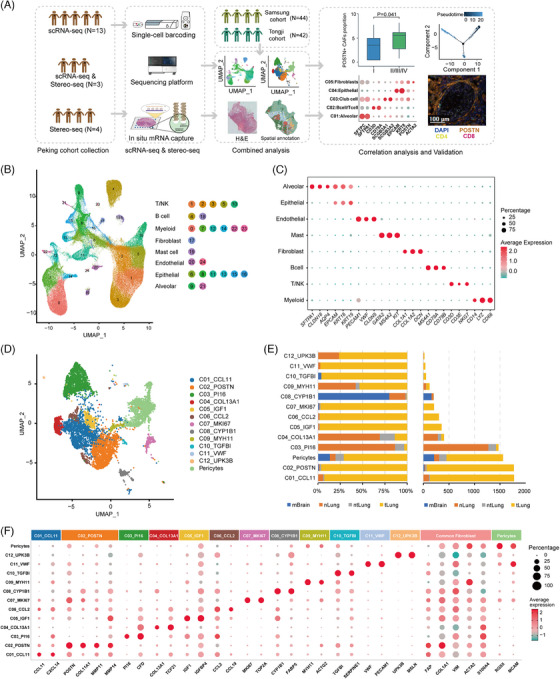
We performed single-cell RNA sequencing (scRNA-seq) on tumour, paired tumour-adjacent, and normal samples from 16 non-small cell lung cancer (NSCLC) patients. CAF subpopulations were analyzed after integration with published NSCLC scRNA-seq data. SpaTial enhanced resolution omics-sequencing (Stereo-seq) was applied in tumour and tumour-adjacent samples from seven NSCLC patients to map the architecture of major cell populations in tumour microenvironment (TME). Immunohistochemistry (IHC) and multiplexed IHC (mIHC) were used to validate marker gene expression and the association of CAFs with immune infiltration in TME.
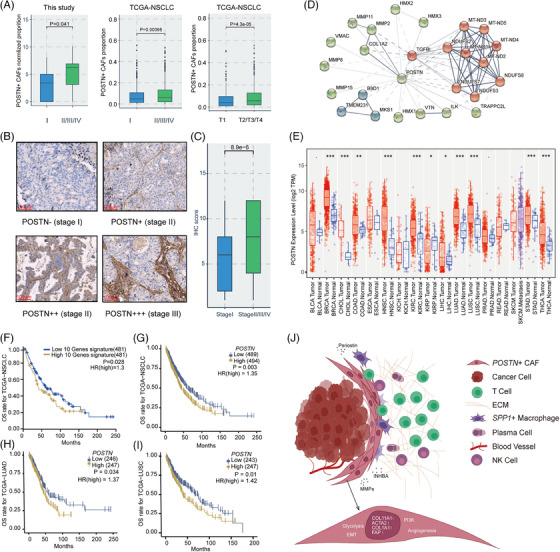
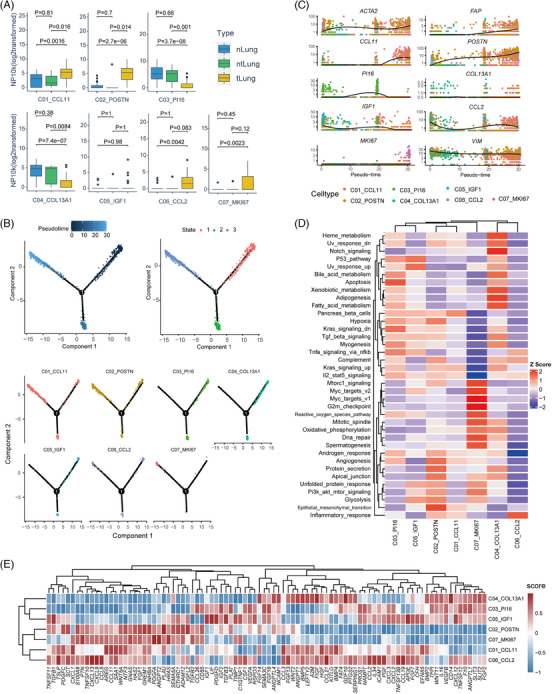
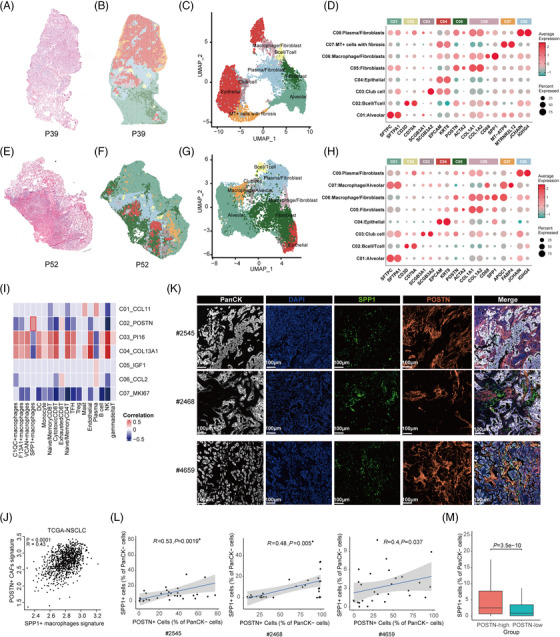
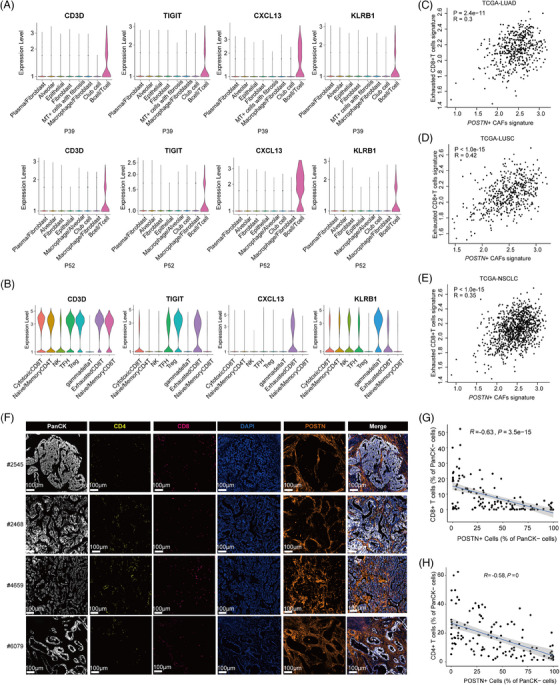
A subcluster of myofibroblastic CAFs, POSTN CAFs, were significantly enriched in advanced tumours and presented gene expression signatures related to extracellular matrix remodeling, tumour invasion pathways and immune suppression. Stereo-seq and mIHC demonstrated that POSTN CAFs were in close localization with SPP1 macrophages and were associated with the exhausted phenotype and lower infiltration of T cells. POSTN expression or the abundance of POSTN CAFs were associated with poor prognosis of NSCLC.
Our study identified a myofibroblastic CAF subpopulation, POSTN CAFs, which might associate with SPP1 macrophages to promote the formation of desmoplastic architecture and participate in immune suppression. Furthermore, we showed that POSTN CAFs associated with cancer progression and poor clinical outcomes and may provide new insights on the treatment of NSCLC.
癌症相关成纤维细胞(CAFs)是癌症治疗的潜在靶点。由于 CAFs 的异质性,CAF 亚群对肺癌进展的影响仍不清楚,这阻碍了针对 CAFs 的转化研究进展。
我们对 16 名非小细胞肺癌(NSCLC)患者的肿瘤、配对肿瘤旁和正常样本进行了单细胞 RNA 测序(scRNA-seq)。在与已发表的 NSCLC scRNA-seq 数据整合后,分析 CAF 亚群。我们在 7 名 NSCLC 患者的肿瘤和肿瘤旁样本中应用空间增强分辨率组学测序(Stereo-seq),以绘制肿瘤微环境(TME)中主要细胞群的结构。免疫组织化学(IHC)和多重免疫组化(mIHC)用于验证标记基因表达和 CAFs 与 TME 中免疫浸润的相关性。
成肌纤维 CAF 亚群中的一个亚群,即 POSTN CAFs,在晚期肿瘤中明显富集,并呈现与细胞外基质重塑、肿瘤侵袭途径和免疫抑制相关的基因表达特征。Stereo-seq 和 mIHC 表明,POSTN CAFs 与 SPP1 巨噬细胞密切定位,并与耗竭表型和 T 细胞浸润减少相关。POSTN 表达或 POSTN CAFs 的丰度与 NSCLC 的不良预后相关。
我们的研究鉴定了一个成肌纤维 CAF 亚群,即 POSTN CAFs,其可能与 SPP1 巨噬细胞相关,以促进纤维母细胞性结构的形成并参与免疫抑制。此外,我们表明 POSTN CAFs 与癌症进展和不良临床结局相关,可能为 NSCLC 的治疗提供新的见解。