Edri Tamir, Cohen Dor, Shabtai Yehuda, Fainsod Abraham
Department of Developmental Biology and Cancer Research, Institute for Medical Research Israel-Canada, Faculty of Medicine, The Hebrew University of Jerusalem, Jerusalem, Israel.
Front Cell Dev Biol. 2023 Dec 5;11:1282273. doi: 10.3389/fcell.2023.1282273. eCollection 2023.
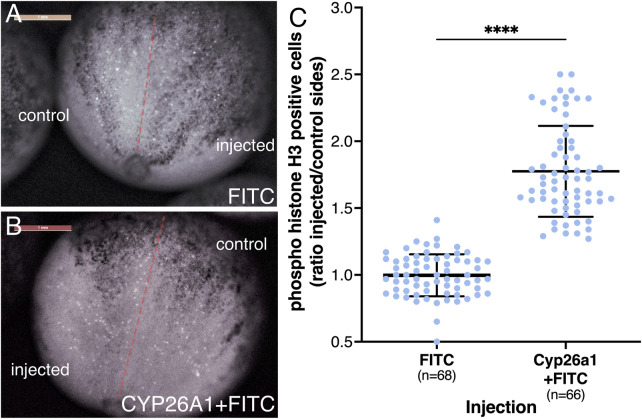
Neural tube defects (NTDs) are among the most debilitating and common developmental defects in humans. The induction of NTDs has been attributed to abnormal folic acid (vitamin B9) metabolism, Wnt and BMP signaling, excess retinoic acid (RA), dietary components, environmental factors, and many others. In the present study we show that reduced RA signaling, including alcohol exposure, induces NTDs. embryos were exposed to pharmacological RA biosynthesis inhibitors to study the induction of NTDs. Embryos were treated with DEAB, citral, or ethanol, all of which inhibit the biosynthesis of RA, or injected to overexpress Cyp26a1 to reduce RA. NTD induction was studied using neural plate and notochord markers together with morphological analysis. Expression of the neuroectodermal regulatory network and cell proliferation were analyzed to understand the morphological malformations of the neural plate. Reducing RA signaling levels using retinaldehyde dehydrogenase inhibitors (ethanol, DEAB, and citral) or Cyp26a1-driven degradation efficiently induce NTDs. These NTDs can be rescued by providing precursors of RA. We mapped this RA requirement to early gastrula stages during the induction of neural plate precursors. This reduced RA signaling results in abnormal expression of neural network genes, including the neural plate stem cell maintenance genes, , and . This abnormal expression of neural network genes results in increased proliferation of neural precursors giving rise to an expanded neural plate. We show that RA signaling is required for neural tube closure during embryogenesis. RA signaling plays a very early role in the regulation of proliferation and differentiation of the neural plate soon after the induction of neural progenitors during gastrulation. RA signaling disruption leads to the induction of NTDs through the mis regulation of the early neuroectodermal network, leading to increased proliferation resulting in the expansion of the neural plate. Ethanol exposure induces NTDs through this mechanism involving reduced RA levels.
神经管缺陷(NTDs)是人类最具致残性且常见的发育缺陷之一。NTDs的诱发归因于叶酸(维生素B9)代谢异常、Wnt和BMP信号传导、视黄酸(RA)过量、饮食成分、环境因素等诸多因素。在本研究中,我们表明包括酒精暴露在内的RA信号传导减弱会诱发NTDs。用药物性RA生物合成抑制剂处理胚胎以研究NTDs的诱发情况。用DEAB、柠檬醛或乙醇处理胚胎,所有这些都会抑制RA的生物合成,或者注射以过表达Cyp26a1来降低RA。使用神经板和脊索标记物并结合形态学分析来研究NTDs的诱发情况。分析神经外胚层调节网络的表达和细胞增殖情况以了解神经板的形态畸形。使用视黄醛脱氢酶抑制剂(乙醇、DEAB和柠檬醛)或Cyp26a1驱动的降解来降低RA信号水平可有效诱发NTDs。通过提供RA的前体可以挽救这些NTDs。我们将这种对RA的需求定位到神经板前体诱导期间的原肠胚早期阶段。这种RA信号传导减弱导致神经网络基因异常表达,包括神经板干细胞维持基因、和。神经网络基因的这种异常表达导致神经前体细胞增殖增加,从而产生扩大的神经板。我们表明RA信号传导在胚胎发生过程中神经管闭合时是必需的。RA信号传导在原肠胚形成期间神经祖细胞诱导后不久对神经板的增殖和分化调节中起着非常早期的作用。RA信号传导破坏通过早期神经外胚层网络的失调导致NTDs的诱发,导致增殖增加,从而导致神经板扩大。酒精暴露通过这种涉及RA水平降低的机制诱发NTDs。