Lee Joo-Hwan, Kim In-Young, Jung Shin, Jung Tae-Young, Moon Kyung-Sub, Kim Yeong-Jin, Park Sue-Jee, Lim Sa-Hoe
Brain Tumor Clinic & Gamma Knife Center, Department of Neurosurgery, Chonnam National University Hwasun Hospital, Hwasun, Korea
Department of Neurosurgery, Chonnam National University Medical School, Hwasun, Korea
J Korean Neurosurg Soc. 2024 Sep;67(5):560-567. doi: 10.3340/jkns.2023.0214. Epub 2023 Dec 21.
We investigated how treating large brain metastasis (LBM) using 2-day fraction Gamma Knife radiosurgery (GKRS) affects tumor control and patient survival. A prescription dose of 10.3 Gy was applied for 2 consecutive days, with a biologically effective dose equivalent to a tumor single-fraction dose of 16.05 Gy and a brain single-fraction dose of 15.12 Gy.
Between November 2017 and December 2021, 42 patients (mean age, 68.3 years; range, 50-84 years; male, 29 [69.1%]; female, 13 [30.9%]) with 44 tumors underwent 2-day fraction GKRS to treat large volume brain metastasis. The main cancer types were non-small cell lung cancer (n=16), small cell lung cancer (n=7), colorectal cancer (n=7), breast cancer (n=3), gastric cancer (n=2), and other cancers (n=7). Twenty-one patients (50.0%) had a single LBM, 19 (46.3%) had a single LBM and other metastases, and two had two (4.7%) large brain metastases. At the time of the 2-day fraction GKRS, the tumors had a mean volume of 23.1 mL (range, 12.5-67.4). On each day, radiation was administered at a dose of 10.3 Gy, mainly using a 50% isodose-line.
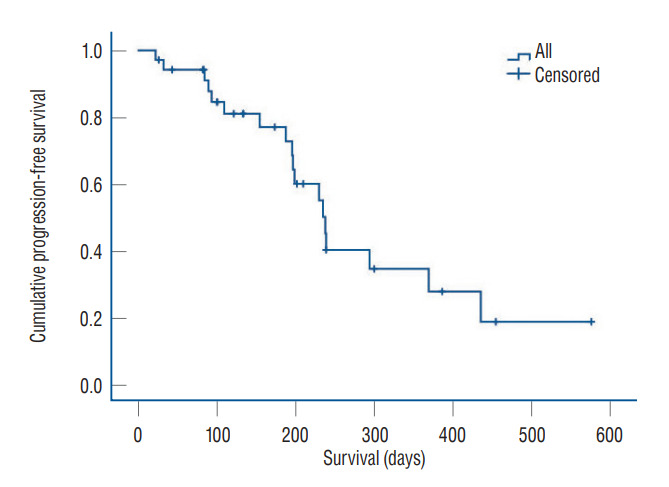
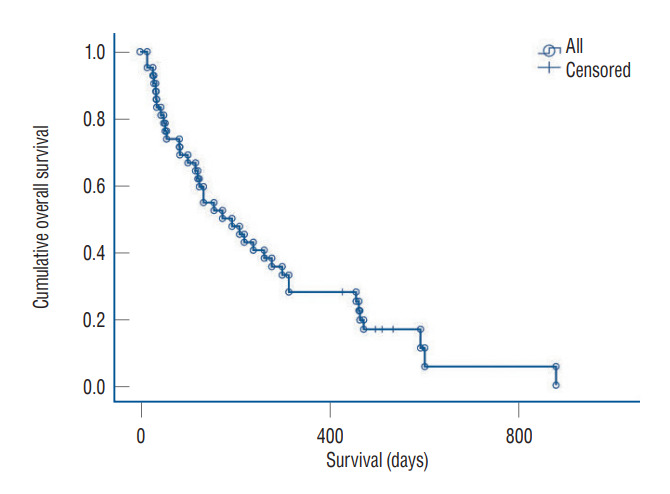
We obtained clinical and magnetic resonance imaging follow-up data for 34 patients (81%) with 35 tumors, who had undergone 2-day fraction GKRS. These patients did not experience acute or late radiation-induced complications during follow-up. The median and mean progression-free survival (PFS) periods were 188 and 194 days, respectively. The local control rates at 6, 9, and 12 months were 77%, 40%, and 34%, respectively. The prognostic factors related to PFS were prior radiotherapy (p=0.019) and lung cancer origin (p=0.041). Other factors such as tumor volumes, each isodose volumes, and peri-GKRS systemic treatment were not significantly related to PFS. The overall survival period of the 44 patients following repeat stereotactic radiosurgery (SRS) ranged from 15-878 days (median, 263±38 days; mean, 174±43 days) after the 2-day fraction GKRS. Eight patients (18.2%) were still alive.
Considering the unsatisfactory tumor control, a higher prescription dose should be needed in this procedure as a salvage management. Moreover, in the treatment for LBM with fractionated SRS, using different isodoses and prescription doses at the treatment planning for LBMs should be important. However, this report might be a basic reference with the same fraction number and prescription dose in the treatment for LBMs with frame-based SRS.
我们研究了采用为期2天分割的伽玛刀放射外科治疗(GKRS)大型脑转移瘤(LBM)对肿瘤控制和患者生存的影响。连续2天给予10.3 Gy的处方剂量,其生物等效剂量相当于肿瘤单次分割剂量16.05 Gy和脑单次分割剂量15.12 Gy。
2017年11月至2021年12月期间,42例患者(平均年龄68.3岁;范围50 - 84岁;男性29例[69.1%];女性13例[30.9%])共44个肿瘤接受了为期2天分割的GKRS治疗以处理大型脑转移瘤。主要癌症类型为非小细胞肺癌(n = 16)、小细胞肺癌(n = 7)、结直肠癌(n = 7)、乳腺癌(n = 3)、胃癌(n = 2)和其他癌症(n = 7)。21例患者(50.0%)有单个LBM,19例(46.3%)有单个LBM和其他转移灶,2例(4.7%)有两个大型脑转移瘤。在进行为期2天分割的GKRS时,肿瘤平均体积为23.1 mL(范围12.5 - 67.4)。每天以10.3 Gy的剂量进行放疗,主要使用50%等剂量线。
我们获得了34例患者(81%)共35个接受了为期2天分割GKRS治疗的肿瘤的临床和磁共振成像随访数据。这些患者在随访期间未出现急性或晚期放射性并发症。中位无进展生存期(PFS)和平均PFS分别为188天和194天。6个月、9个月和12个月时的局部控制率分别为77%、40%和34%。与PFS相关的预后因素为既往放疗(p = 0.019)和肺癌起源(p = 0.041)。其他因素如肿瘤体积、各等剂量体积和GKRS治疗期间的全身治疗与PFS无显著相关性。44例患者在重复立体定向放射外科治疗(SRS)后的总生存期在为期2天分割的GKRS后为15 - 878天(中位值,263±38天;平均值,174±43天)。8例患者(18.2%)仍存活。
考虑到肿瘤控制效果不理想,在该治疗过程中作为挽救性治疗需要更高的处方剂量。此外,在采用分割SRS治疗LBM时,在治疗计划中针对LBM使用不同的等剂量和处方剂量应很重要。然而,本报告可能是基于框架的SRS治疗LBM时具有相同分割次数和处方剂量的基本参考。