Department of Medicine, National Jewish Health, Denver, CO, United States.
Department of Medicine, Icahn School of Medicine at Mount Sinai, New York, NY, United States.
Front Immunol. 2023 Dec 6;14:1304758. doi: 10.3389/fimmu.2023.1304758. eCollection 2023.
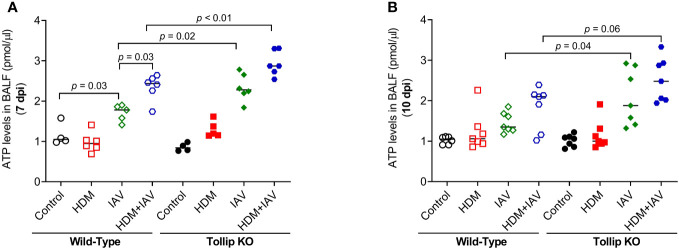
Toll-interacting protein (Tollip) is a negative regulator of the pro-inflammatory response to viruses, including influenza A virus (IAV). Genetic variation of Tollip has been associated with reduced airway epithelial Tollip expression and poor lung function in patients with asthma. Whether Tollip deficiency exaggerates type 2 inflammation (e.g., eosinophils) and viral infection in asthma remains unclear. We sought to address this critical, but unanswered question by using a Tollip deficient mouse asthma model with IAV infection. Further, we determined the underlying mechanisms by focusing on the role of the ATP/IL-33 signaling axis. Wild-type and Tollip KO mice were intranasally exposed to house dust mite (HDM) and IAV with or without inhibitors for IL-33 (i.e., soluble ST2, an IL-33 decoy receptor) and ATP signaling (i.e., an antagonist of the ATP receptor P2Y13). Tollip deficiency amplified airway type 2 inflammation (eosinophils, IL-5, IL-13 and mucins), and the release of ATP and IL-33. Blocking ATP receptor P2Y13 decreased IL-33 release during IAV infection in HDM-challenged Tollip KO mice. Furthermore, soluble ST2 attenuated airway eosinophilic inflammation in Tollip KO mice treated with HDM and IAV. HDM challenges decreased lung viral load in wild-type mice, but Tollip deficiency reduced the protective effects of HDM challenges on viral load. Our data suggests that during IAV infection, Tollip deficiency amplified type 2 inflammation and delayed viral clearance, in part by promoting ATP signaling and subsequent IL-33 release. Our findings may provide several therapeutic targets, including ATP and IL-33 signaling inhibition for attenuating excessive airway type 2 inflammation in human subjects with Tollip deficiency and IAV infection.
Toll 相互作用蛋白(Tollip)是病毒炎症反应的负调节剂,包括甲型流感病毒(IAV)。Tollip 的遗传变异与哮喘患者气道上皮 Tollip 表达减少和肺功能下降有关。Tollip 缺乏是否会加剧哮喘患者的 2 型炎症(例如嗜酸性粒细胞)和病毒感染尚不清楚。我们使用 Tollip 缺陷型小鼠哮喘模型和 IAV 感染来解决这个关键但尚未解决的问题。此外,我们通过关注 ATP/IL-33 信号轴的作用来确定潜在的机制。野生型和 Tollip KO 小鼠经鼻腔暴露于屋尘螨(HDM)和 IAV,并使用 IL-33(即可溶性 ST2,IL-33 诱饵受体)和 ATP 信号(即 ATP 受体 P2Y13 的拮抗剂)抑制剂。Tollip 缺乏会放大气道 2 型炎症(嗜酸性粒细胞、IL-5、IL-13 和粘蛋白)和 ATP 和 IL-33 的释放。阻断 ATP 受体 P2Y13 可减少 HDM 挑战的 Tollip KO 小鼠 IAV 感染期间的 IL-33 释放。此外,可溶性 ST2 可减轻 Tollip KO 小鼠用 HDM 和 IAV 治疗后的气道嗜酸性粒细胞炎症。HDM 挑战降低了野生型小鼠肺部的病毒载量,但 Tollip 缺乏降低了 HDM 挑战对病毒载量的保护作用。我们的数据表明,在 IAV 感染期间,Tollip 缺乏会放大 2 型炎症并延迟病毒清除,部分原因是促进了 ATP 信号的传递,随后促进了 IL-33 的释放。我们的发现可能为 Tollip 缺乏和 IAV 感染的人类患者提供几种治疗靶点,包括 ATP 和 IL-33 信号抑制,以减轻过度的气道 2 型炎症。