Division of Cardiology, Department of Systems Medicine, Tor Vergata University, 00133 Rome, Italy.
Division of Cardiology, Mount Sinai Hospital, Icahn School of Medicine at Mount Sinai, 1 Gustave L. Levy Place, New York, NY 10029, USA.
Biomolecules. 2023 Nov 23;13(12):1695. doi: 10.3390/biom13121695.
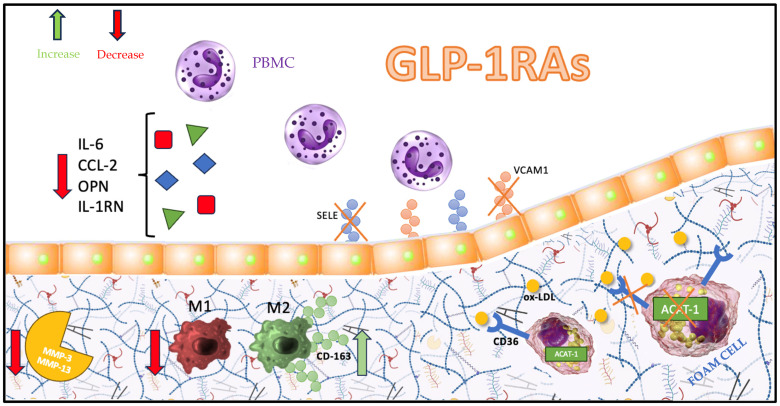
Atherosclerosis is a chronic inflammatory disease characterized by lipid and inflammatory cell deposits in the inner layer of large- and medium-sized elastic and muscular arteries. Diabetes mellitus (DM) significantly increases the risk of cardiovascular diseases and the overall and cardiovascular mortality, and it is a pro-atherogenic factor that induces atherosclerosis development and/or accelerates its progression through a multifactorial process. Glucagon-like peptide-1 receptor agonists (GLP-1RAs) are a new class of drugs, belonging to the armamentarium to fight type 2 DM, that have shown robust reductions in atherosclerotic events and all-cause mortality in all studies. Preclinical studies have shown that GLP-1RAs play a role in the immunomodulation of atherosclerosis, affecting multiple pathways involved in plaque development and progression. In this review, we wanted to explore the translational power of such preclinical studies by analyzing the most recent clinical trials investigating the atheroprotective effect of GLP-1RAs.
动脉粥样硬化是一种慢性炎症性疾病,其特征是在大中弹性和肌肉动脉的内层有脂质和炎症细胞沉积。糖尿病(DM)显著增加了心血管疾病和全因及心血管死亡率的风险,它是一种促动脉粥样硬化的因素,通过多因素过程诱导动脉粥样硬化的发展和/或加速其进展。胰高血糖素样肽-1 受体激动剂(GLP-1RAs)是一类新的药物,属于治疗 2 型糖尿病的武器库,所有研究均显示在动脉粥样硬化事件和全因死亡率方面有显著降低。临床前研究表明,GLP-1RAs 在动脉粥样硬化的免疫调节中发挥作用,影响斑块发展和进展涉及的多个途径。在这篇综述中,我们通过分析最近研究 GLP-1RAs 的抗动脉粥样硬化作用的临床试验,探讨了这些临床前研究的转化潜力。