Department of Inorganic and Organic Chemistry, Biochemistry and Catalysis, Faculty of Chemistry, University of Bucharest, 90-92 Panduri Str., District 5, 050663 Bucharest, Romania.
Department of Physics of Nanostructured Systems, National Institute for Research and Development of Isotopic and Molecular Technologies, 67-103 Donat Str., 400293 Cluj-Napoca, Romania.
Int J Mol Sci. 2023 Dec 5;24(24):17137. doi: 10.3390/ijms242417137.
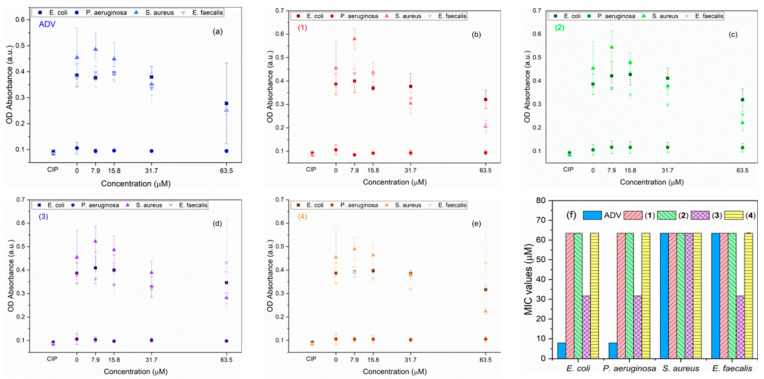
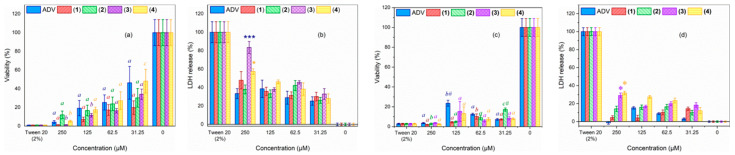
To obtain biologically active species, a series of decavanadates (Hpbg)[HVO]·6HO () (Htbg)[HVO]·6HO; () (Hgnd)(Hgnu)[VO]; () (Hgnu)[VO]·2HO; and () (pbg = 1-phenyl biguanide, tbg = 1-(-tolyl)biguanide, gnd = guanidine, and gnu = guanylurea) were synthesized and characterized by several spectroscopic techniques (IR, UV-Vis, and EPR) as well as by single crystal X-ray diffraction. Compound () crystallizes in space group -1 while () and () adopt the same centrosymmetric space group 21/n. The unusual signal identified by EPR spectroscopy was assigned to a charge-transfer π(O)→d(V) process. Both stability in solution and reactivity towards reactive oxygen species (O and OH·) were screened through EPR signal modification. All compounds inhibited the development of , , , and bacterial strains in a planktonic state at a micromolar level, the most active being compound (). However, the experiments conducted at a minimal inhibitory concentration (MIC) indicated that the compounds do not disrupt the biofilm produced by these bacterial strains. The cytotoxicity assayed against A375 human melanoma cells and BJ human fibroblasts by testing the viability, lactate dehydrogenase, and nitric oxide levels indicated compound () as the most active in tumor cells.
为了获得具有生物活性的物种,我们合成并通过多种光谱技术(IR、UV-Vis 和 EPR)以及单晶 X 射线衍射对一系列十钒酸盐(Hpbg)[HVO]·6HO () (Htbg)[HVO]·6HO; () (Hgnd)(Hgnu)[VO]; () (Hgnu)[VO]·2HO; 和 ()(pbg = 1- 苯胍,tbg = 1-(- 甲苯)胍,gnd = 胍,gnu = 胍脲)进行了表征。化合物 () 结晶于空间群 -1 中,而 () 和 () 采用相同的中心对称空间群 21/n。通过 EPR 光谱鉴定出的异常信号被分配给电荷转移 π(O)→d(V) 过程。通过 EPR 信号修饰筛选了它们在溶液中的稳定性和对活性氧物种 (O 和 OH·) 的反应性。所有化合物在浮游状态下以微摩尔水平抑制了 、 、 和 细菌菌株的发育,其中最活跃的是化合物 ()。然而,在最低抑菌浓度 (MIC) 下进行的实验表明,这些化合物不会破坏这些细菌菌株产生的生物膜。通过测试细胞活力、乳酸脱氢酶和一氧化氮水平对 A375 人黑色素瘤细胞和 BJ 人成纤维细胞进行的细胞毒性测定表明,化合物 () 对肿瘤细胞最活跃。