Division of Life Science, Incheon National University, 119 Academy-Ro, Yeonsu-Gu, Incheon, 22012, South Korea.
Space and Environment Laboratory, Chungnam Institute, 73-26 Institute Road, Gongju, South Chungcheong Province, 32589, South Korea.
Sci Rep. 2023 Dec 27;13(1):23008. doi: 10.1038/s41598-023-50149-6.
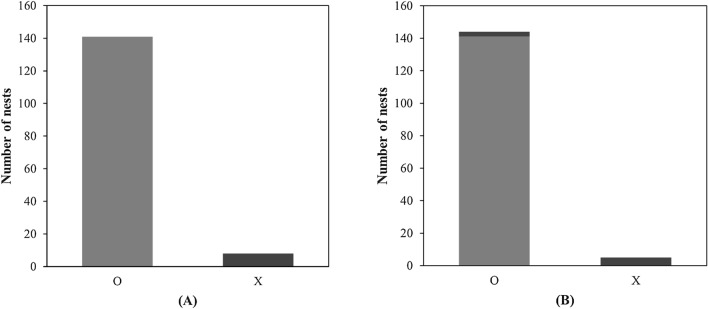
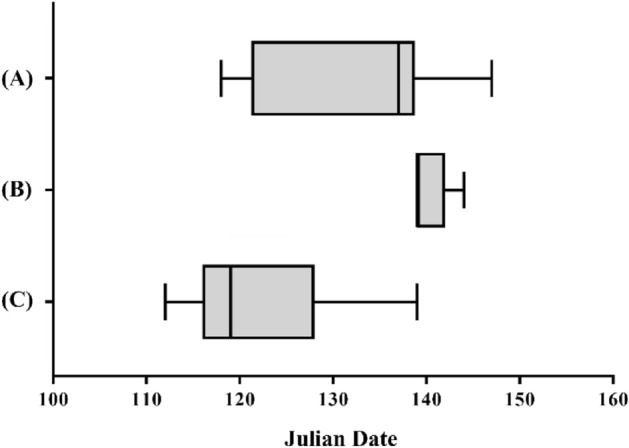
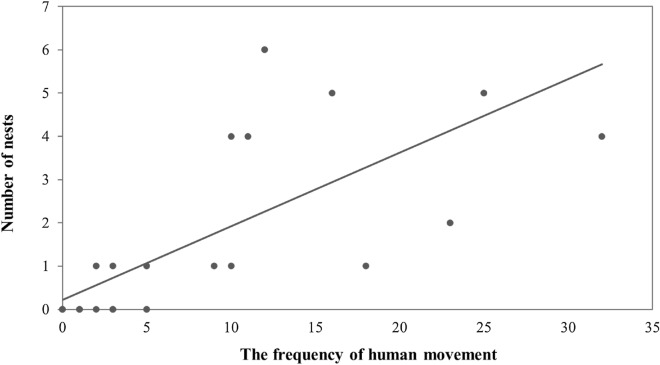
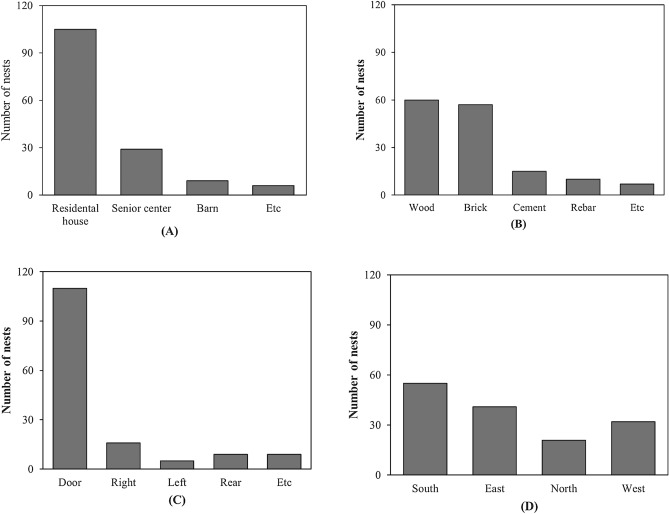
We found that barn swallow (Hirundo rustica) breeding occurs within close proximity to humans. An evaluation of barn swallow breeding frequency and the breeding success rate of swallows at research sites, which were buildings inhabited by humans and buildings where humans had previously resided, was conducted in order to establish a relationship between the location of barn swallow nests and human habitation and activity frequency. The results demonstrated that barn swallows often breed in human-inhabited buildings. No significant relationship was observed between the wall material and the direction of the wall and the type of building, whereas a much higher proportion of the nests were located near doors with a high level of human movement. In addition, no significant correlation was observed between the location of the nest and the distance from potential resources (food, water etc.), however, a statistically significant relationship was observed between the frequency of human activity measured through the video camera and the number of nests located at a certain distance. The average number of offspring and the reproductive success rate were higher in nests located within close proximity to human activity compared to nests not located within close proximity to human activity, suggesting that the presence of humans had a positive effect on reproduction. This study show that barn swallow nesting occurs in locations where there is a human influence and humans provide implicit protection of swallows from predation, which has a significant impact on breeding.
我们发现,家燕的繁殖与人类活动密切相关。为了确定家燕巢与人类居住和活动频率之间的关系,我们评估了研究地点的家燕繁殖频率和繁殖成功率,这些研究地点包括人类居住的建筑物和人类曾经居住过的建筑物。研究结果表明,家燕经常在人类居住的建筑物中繁殖。家燕巢的位置与墙壁材料、墙壁方向和建筑物类型之间没有显著关系,但在人类活动频繁的门口附近,家燕巢的比例要高得多。此外,巢的位置与潜在资源(食物、水等)的距离之间没有显著相关性,但通过摄像机测量的人类活动频率与一定距离内的巢数量之间存在显著的统计学关系。与远离人类活动的巢相比,靠近人类活动的巢中生息的后代数量和繁殖成功率更高,这表明人类的存在对繁殖有积极影响。本研究表明,家燕在人类活动影响的地方筑巢,人类为家燕提供了免受捕食的隐性保护,这对繁殖有重大影响。