Centeno Maria Virginia, Alam Md Suhail, Haldar Kasturi, Apkarian Apkar Vania
Center for Translational Pain Research, Northwestern University Feinberg School of Medicine, Chicago, Illinois 60611.
Department of Neuroscience, Northwestern University Feinberg School of Medicine, Chicago, Illinois 60611.
bioRxiv. 2023 Dec 14:2023.12.13.571583. doi: 10.1101/2023.12.13.571583.
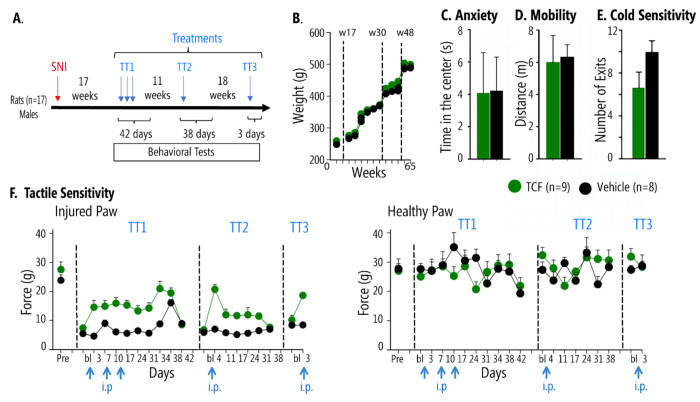
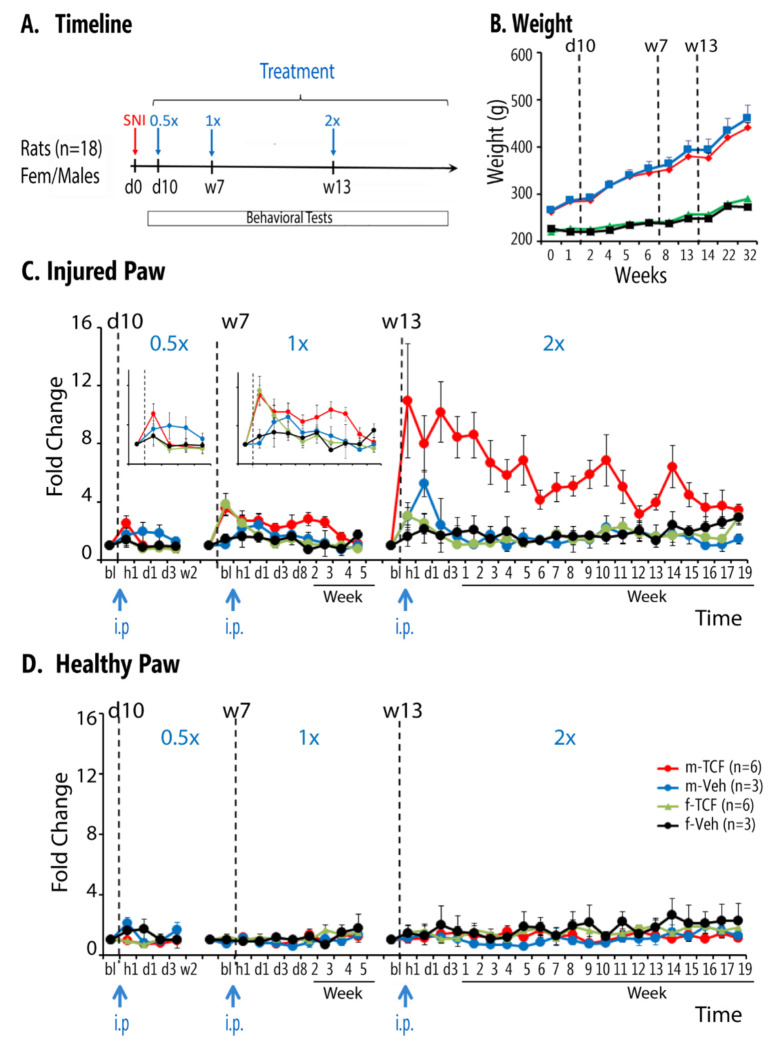
Histone deacetylase inhibitors (HDACi) that modulate epigenetic regulation and are approved for treating rare cancers have, in disease models, also been shown to mitigate neurological conditions, including chronic pain. They are of interest as non-opioid treatments, but achieving long-term efficacy with limited dosing has remained elusive. Here we utilize a triple combination formulation (TCF) comprised of a pan-HDACi vorinostat (Vo at its FDA-approved daily dose of 50mg/Kg), the caging agent 2-hydroxypropyl-β-cyclodextrin (HPBCD) and polyethylene glycol (PEG) known to boost plasma and brain exposure and efficacy of Vo in mice and rats, of various ages, spared nerve injury (SNI) model of chronic neuropathic pain. Administration of the TCF (but not HPBCD and PEG) decreased mechanical allodynia for 4 weeks without antagonizing weight, anxiety, or mobility. This was achieved at less than 1% of the total dose of Vo approved for 4 weeks of tumor treatment and associated with decreased levels of major inflammatory markers and microglia in ipsilateral (but not contralateral) spinal cord regions. A single TCF injection was sufficient for 3-4 weeks of efficacy: this was mirrored in repeat injections, specific for the injured paw and not seen on sham treatment. Pharmacodynamics in an SNI mouse model suggested pain relief was sustained for days to weeks after Vo elimination. Doubling Vo in a single TCF injection proved effectiveness was limited to male rats, where the response amplitude tripled and remained effective for > 2 months, an efficacy that outperforms all currently available chronic pain pharmacotherapies. Together, these data suggest that through pharmacological modulation of Vo, the TCF enables single-dose effectiveness with extended action, reduces long-term HDACi dosage, and presents excellent potential to develop as a non-opioid treatment option for chronic pain.
组蛋白去乙酰化酶抑制剂(HDACi)可调节表观遗传调控,已被批准用于治疗罕见癌症,在疾病模型中也显示可减轻包括慢性疼痛在内的神经系统疾病。它们作为非阿片类药物治疗备受关注,但在有限剂量下实现长期疗效一直难以捉摸。在此,我们利用一种三联组合制剂(TCF),其由泛HDACi伏立诺他(Vo,以其FDA批准的每日剂量50mg/Kg)、笼形剂2-羟丙基-β-环糊精(HPBCD)和聚乙二醇(PEG)组成,已知后者可提高不同年龄小鼠和大鼠血浆及脑内药物暴露量以及Vo的疗效,该制剂用于慢性神经性疼痛的 spared nerve injury(SNI)模型。给予TCF(而非HPBCD和PEG)可使机械性异常性疼痛减轻4周,且不影响体重、焦虑或活动能力。这是在肿瘤治疗4周批准的Vo总剂量不到1%的情况下实现的,并且与同侧(而非对侧)脊髓区域主要炎症标志物和小胶质细胞水平降低有关。单次注射TCF足以产生3 - 4周的疗效:重复注射也得到了类似结果,且该疗效对受伤爪子具有特异性,假手术治疗未见此效果。SNI小鼠模型中的药效学表明,Vo消除后疼痛缓解可持续数天至数周。在单次TCF注射中使Vo剂量加倍证明有效性仅限于雄性大鼠,其反应幅度增加两倍且在>2个月内仍有效,该疗效优于所有目前可用的慢性疼痛药物疗法。总之,这些数据表明,通过对Vo进行药理学调节,TCF可实现单剂量有效性且作用持久,降低HDACi长期剂量,并具有作为慢性疼痛非阿片类治疗选择开发的巨大潜力。