
地方环境空气质量标准的制定:以中国海南省为例
The development of local ambient air quality standards: A case study of Hainan Province, China.
作者信息
Song Qian, Zhang Nannan, Zhang Yanning, Yin Dejia, Hao Jiming, Wang Shuxiao, Li Shengyue, Xu Wenshuai, Yan Weijun, Meng Xinxin, Xu Xinghong, Wu Xiaochen, Xie Donghai, Zhu Yun, Qu Qipeng, Hou Xuan, Jiang Yueqi, Dong Zhaoxin, Zheng Haotian, Sun Yisheng, Li Zeqi, Zhao Bin
机构信息
State Key Joint Laboratory of Environmental Simulation and Pollution Control, School of Environment, Tsinghua University, Beijing 100084, China.
State Environmental Protection Key Laboratory of Sources and Control of Air Pollution Complex, Beijing 100084, China.
出版信息
Eco Environ Health. 2023 Oct 28;3(1):11-20. doi: 10.1016/j.eehl.2023.10.002. eCollection 2024 Mar.
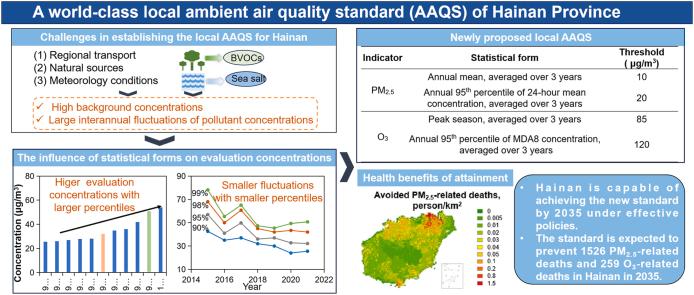
The ambient air quality standard (AAQS) is a vital policy instrument for protecting the environment and human health. Hainan Province is at the forefront of China's efforts to protect its ecological environment, with an official goal to achieve world-leading air quality by 2035. However, neither the national AAQS nor the World Health Organization guideline offers sufficient guidance for improving air quality in Hainan because Hainan has well met the former while the latter is excessively stringent. Consequently, the establishment of Hainan's local AAQS becomes imperative. Nonetheless, research regarding the development of local AAQS is scarce, especially in comparatively more polluted countries such as China. The relatively high background values and significant interannual fluctuations in air pollutant concentrations in Hainan present challenges in the development of local AAQS. Our research proposes a world-class local AAQS of Hainan Province by reviewing the AAQS in major countries or regions worldwide, analyzing the influence of different statistical forms, and carefully evaluating the attainability of the standard. In the proposed AAQS, the annual mean concentration limit for PM, the annual 95th percentile of daily maximum 8-h mean (MDA8) concentration limit for O, and the peak season concentration limit for O are set at 10, 120, and 85 μg/m, respectively. Our study indicates that, with effective control policies, Hainan is projected to achieve compliance with the new standard by 2035. The implementation of the local AAQS is estimated to avoid 1,526 (1,253-1,789) and 259 (132-501) premature deaths attributable to long-term exposure to PM and O in Hainan in 2035, respectively.
环境空气质量标准(AAQS)是保护环境和人类健康的重要政策工具。海南省在中国保护生态环境的努力中处于前沿位置,其官方目标是到2035年实现世界领先的空气质量。然而,国家AAQS和世界卫生组织指南都没有为改善海南的空气质量提供足够的指导,因为海南已经很好地达到了前者的标准,而后者又过于严格。因此,制定海南的地方AAQS变得势在必行。尽管如此,关于地方AAQS制定的研究却很少,尤其是在像中国这样污染相对较重的国家。海南空气污染物浓度相对较高的背景值和显著的年际波动给地方AAQS的制定带来了挑战。我们的研究通过回顾全球主要国家或地区的AAQS、分析不同统计形式的影响以及仔细评估标准的可实现性,提出了海南省世界级的地方AAQS。在所提出的AAQS中,PM的年平均浓度限值、O₃的日最大8小时平均浓度(MDA8)的年第95百分位数限值以及O₃的旺季浓度限值分别设定为10、120和85μg/m³。我们的研究表明,通过有效的控制政策,预计海南到2035年将符合新标准。预计实施地方AAQS将分别避免2035年海南因长期接触PM₂.₅和O₃导致的1526例(1253 - 1789例)和259例(132 - 501例)过早死亡。



 Zotero 插件