Parmar Mihirkumar P, Kaleem Safa, Samuganathan Periyaiyadever, Ishfaq Lyluma, Anne Tejawi, Patel Yashaswi, Bollu Sashank, Vempati Roopeessh
Internal Medicine, Gujarat Medical Education and Research Society, Vadnagar, IND.
Internal Medicine, Shadan Institute of Medical Sciences, Hyderabad, IND.
Cureus. 2023 Dec 3;15(12):e49883. doi: 10.7759/cureus.49883. eCollection 2023 Dec.
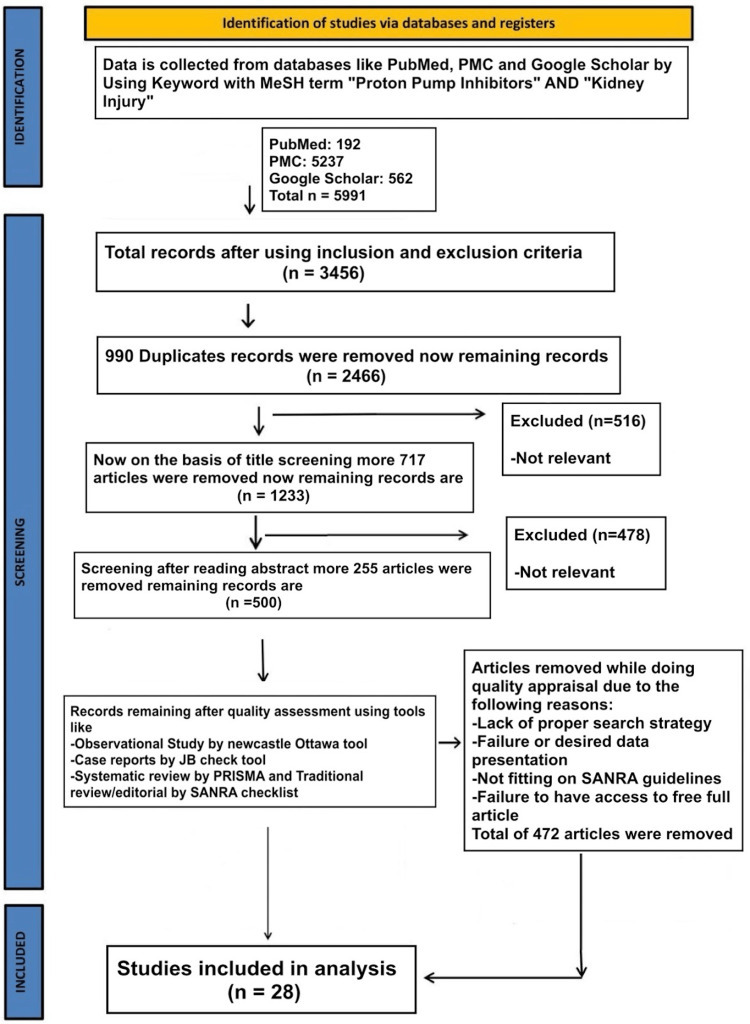
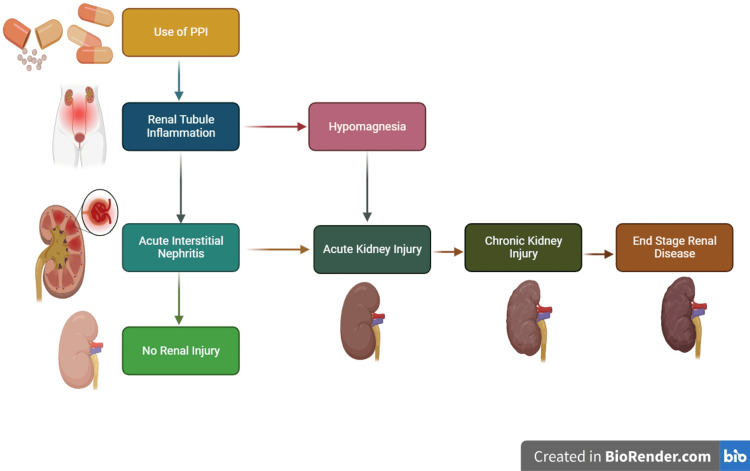
Proton pump inhibitors (PPIs) are widely prescribed medications for the management of various gastrointestinal disorders, primarily gastroesophageal reflux disease (GERD) and peptic ulcers. However, recent concerns have emerged regarding their potential adverse effects on kidney function and their role in the progression of chronic kidney disease (CKD). This systematic review aims to comprehensively analyze the existing literature to assess the impact of PPI use on kidney function and CKD progression. We took information from PubMed, PubMed Central (PMC), and Google Scholar articles from the last 10 years, from 2013 to 2023, and looked for links between PPI use and a number of kidney-related outcomes. These included acute kidney injury, a drop in the estimated glomerular filtration rate (eGFR), and new cases of CKD. The findings of this systematic review highlight the need for a thorough evaluation of the benefits and risks associated with PPI use, particularly in patients with pre-existing kidney conditions, in order to inform clinical decision-making and improve were taken out and looked at to see if there were any links between PPI use and different kidney-related events, such as acute kidney injury, a drop in the estimated eGFR, and the development of CKD. The review also explores potential mechanisms underlying PPI-induced nephrotoxicity. The findings of this systematic review highlight the need for a thorough evaluation of the benefits and risks associated with PPI use, particularly in patients with pre-existing kidney conditions, in order to inform clinical decision-making and improve patient care. Further research is warranted to better understand the complex interplay between PPIs, kidney function, and CKD progression.
质子泵抑制剂(PPIs)是广泛用于治疗各种胃肠道疾病的药物,主要用于治疗胃食管反流病(GERD)和消化性溃疡。然而,最近人们对其对肾功能的潜在不良影响以及在慢性肾脏病(CKD)进展中的作用表示担忧。本系统评价旨在全面分析现有文献,以评估使用PPIs对肾功能和CKD进展的影响。我们从2013年至2023年的过去10年中,从PubMed、PubMed Central(PMC)和谷歌学术文章中获取信息,并寻找使用PPIs与一些肾脏相关结局之间的联系。这些结局包括急性肾损伤、估计肾小球滤过率(eGFR)下降以及CKD新病例。本系统评价的结果强调,需要对使用PPIs的益处和风险进行全面评估,特别是对于已有肾脏疾病的患者,以便为临床决策提供依据并改善患者护理。研究还探讨了PPIs诱导肾毒性的潜在机制。本系统评价的结果强调,需要对使用PPIs的益处和风险进行全面评估,特别是对于已有肾脏疾病的患者,以便为临床决策提供依据并改善患者护理。有必要进行进一步的研究,以更好地理解PPIs、肾功能和CKD进展之间的复杂相互作用。