Marine Sciences Department, National Authority for Remote Sensing and Space Sciences, Cairo, Egypt.
Geology Department, National Authority for Remote Sensing and Space Sciences, Cairo, Egypt.
Environ Sci Pollut Res Int. 2024 Jan;31(5):8118-8133. doi: 10.1007/s11356-023-31625-y. Epub 2024 Jan 4.
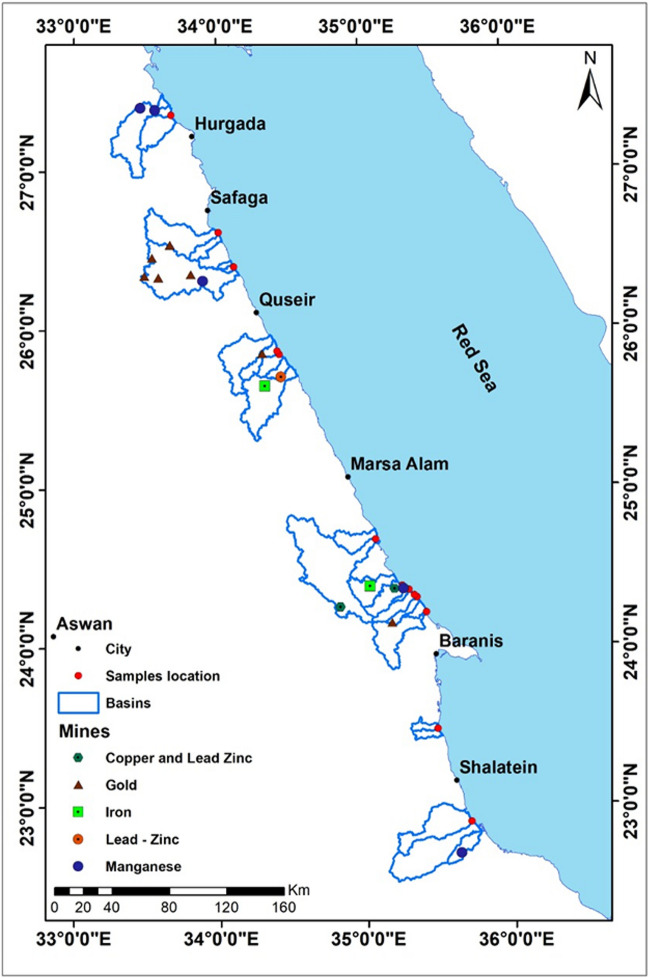
Mangrove areas are considered the most retention zone for heavy metal pollution as it work as an edge that aggregates land and sea sediments. This study aims to examine if the heavy metals' existence in the mangrove sediment is related to contamination or natural resources. In addition, it gives an interpretation of the origin of these metals along the Egyptian Red Sea coast. Twenty-two samples of mangrove sediments were collected and then, analyzed for metals (Mn, Ni, Cu, Fe, Cd, Ag, and Pb) using inductively coupled plasma mass spectroscopy (ICP-MS). Integration between the in-situ data, contamination indices, and remote sensing and geographical information science (GIS), and multivariate statistical analysis techniques (PCA) were analyzed to assess and clarify the spatial origin of heavy metals in sediment at a regional scale. The average concentration of heavy metals from mangrove sediments were shown to be substantially lower than the referenced value, ranging from moderate to significant except the levels of Ag were very high. The heavy metals concentrations were expected to be naturally origin rather than anthropogenic and that be confirmed by mapping of Red Sea alteration zones spots. These alteration zones are parallel to mangrove sites and rich by several mineralization types including heavy metals that are carried by flooding to the coastline. Remote sensing and GIS techniques successfully contributed to interpreting the pattern of the origin of heavy metals and discharging systems that control the heavy metals concentration along the Red Sea coast.
红树林地区被认为是重金属污染的最主要滞留区,因为它作为一个边缘,聚集了陆地和海洋沉积物。本研究旨在检验红树林沉积物中重金属的存在是与污染有关还是与自然资源有关。此外,它还解释了这些金属在埃及红海沿岸的来源。采集了 22 个红树林沉积物样本,然后使用电感耦合等离子体质谱法(ICP-MS)分析了这些样本中的金属(Mn、Ni、Cu、Fe、Cd、Ag 和 Pb)。对原位数据、污染指数以及遥感和地理信息科学(GIS)进行了整合,并采用多元统计分析技术(PCA),以评估和阐明重金属在区域尺度上沉积物中的空间来源。红树林沉积物中重金属的平均浓度明显低于参考值,除 Ag 水平非常高外,从中等至高显著不等。重金属浓度可能是自然来源,而不是人为来源,这一点通过红海蚀变带斑点的映射得到了证实。这些蚀变带与红树林地区平行,富含多种包括重金属在内的矿化类型,这些重金属是由洪水带到海岸线上的。遥感和 GIS 技术成功地有助于解释重金属的来源模式和控制红海沿岸重金属浓度的排放系统。