
年龄相关性白内障患者植入散光双焦点或三焦点人工晶状体后动态视力的比较:一项随机对照试验
Comparison of dynamic visual acuity after implantation of toric bifocal or trifocal intraocular lens in age-related cataract patients: a randomized controlled trial.
作者信息
Li Yuanting, Li Xiaodan, Jiang Xiaodan, Wang Yuexin, Wu Tingyi, Xia Huaqin, Li Xuemin
机构信息
Department of Ophthalmology, Peking University Third Hospital, Beijing, China.
Beijing Key Laboratory of Restoration of Damaged Ocular Nerves, Beijing, China.
出版信息
Front Neurosci. 2023 Dec 21;17:1287626. doi: 10.3389/fnins.2023.1287626. eCollection 2023.
PURPOSE
To investigate the dynamic visual acuity (DVA) after implantation of toric bifocal or trifocal intraocular lens in age-related cataract patients.
METHODS
This was a prospective randomized controlled trial. Of one hundred and twenty-four patients enrolled and randomized to receive unilateral phacoemulsification and toric trifocal (939 M/MP, Carl Zeiss Meditec AG, Jena, Germany) or toric bifocal (909 M, Carl Zeiss Meditec AG, Jena, Germany) intraocular lenses (IOL) implantation, ninety-nine patients completed the follow-up and were included in final analysis. Postoperatively, uncorrected and corrected distance (UDVA and CDVA), intermediate (UIVA and DCIVA) and near (UNVA and DCNVA) static visual acuity, manifest refraction and uncorrected and corrected distance DVA (UDDVA and CDDVA) at 20, 40 and 80 degrees per second (dps) were evaluated at one week, one month and three months.
RESULTS
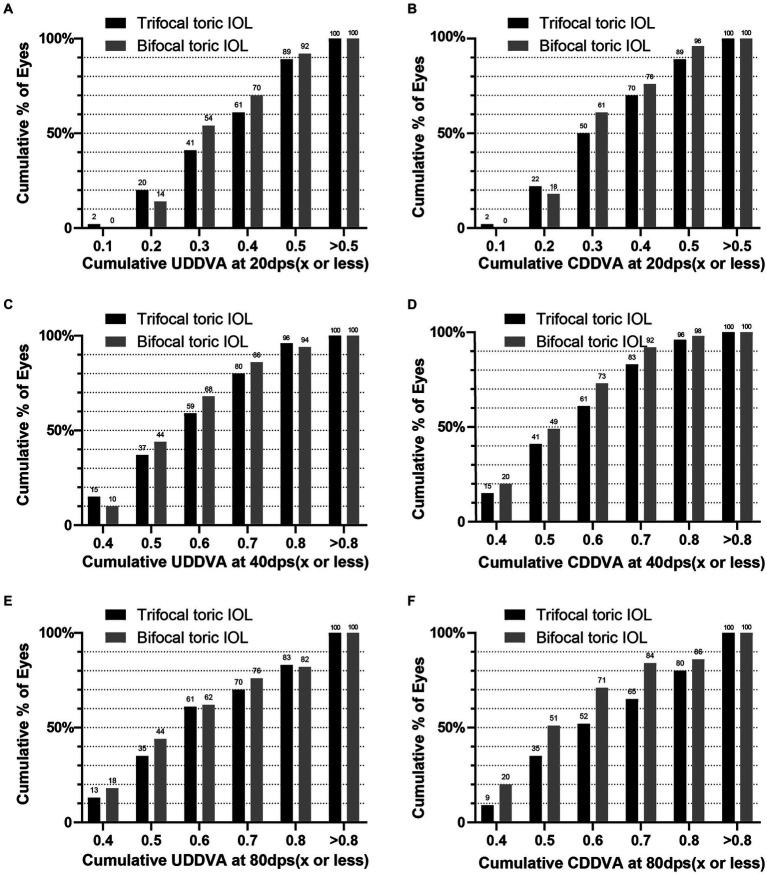
Three months postoperatively, the UDVA were 0.13 ± 0.11 and 0.14 ± 0.13 in the toric trifocal and bifocal IOL group, respectively. Significant better UIVA (trifocal, 0.17 ± 0.13 vs. bifocal, 0.23 ± 0.13, = 0.037) and DCIVA (trifocal, 0.16 ± 0.11 vs. bifocal, 0.20 ± 0.12, = 0.048) were observed in patients implanting toric trifocal than bifocal IOL at three months postoperatively. Patients implanted with toric bifocal IOL obtained better CDDVA at 80 dps (0.5607 ± 0.2032) than the trifocal group (0.6573 ± 0.2450, = 0.039) at three months. Postoperative UDDVA and CDDVA at 20, 40 and 80 dps were significantly associated with age ( < 0.05, respectively) and postoperative static visual acuity ( < 0.05, respectively).
CONCLUSION
Toric trifocal IOL provides better static intermediate visual acuity, and toric bifocal IOL implantation provides better distance dynamic visual acuity at high speed.
目的
研究年龄相关性白内障患者植入散光双焦点或三焦点人工晶状体后的动态视力(DVA)。
方法
这是一项前瞻性随机对照试验。124例患者入组并随机接受单侧超声乳化联合散光三焦点(939 M/MP,德国耶拿卡尔蔡司医疗技术公司)或散光双焦点(909 M,德国耶拿卡尔蔡司医疗技术公司)人工晶状体(IOL)植入术,99例患者完成随访并纳入最终分析。术后,在1周、1个月和3个月时评估未矫正和矫正的远视力(UDVA和CDVA)、中视力(UIVA和DCIVA)和近视力(UNVA和DCNVA),以及每秒20、40和80度(dps)时的未矫正和矫正远DVA(UDDVA和CDDVA)、验光和视力。
结果
术后3个月,散光三焦点和双焦点IOL组的UDVA分别为0.13±0.11和0.14±0.13。术后3个月,植入散光三焦点IOL的患者的UIVA(三焦点组为0.17±0.13,双焦点组为0.23±0.13,P = 0.037)和DCIVA(三焦点组为0.16±0.11,双焦点组为0.20±0.12,P = 0.048)明显优于植入散光双焦点IOL的患者。术后3个月,植入散光双焦点IOL的患者在80 dps时的CDDVA(0.5607±0.2032)优于三焦点组(0.6573±0.2450,P = 0.039)。术后在20、40和80 dps时的UDDVA和CDDVA与年龄(P均<0.05)和术后静态视力(P均<0.05)显著相关。
结论
散光三焦点IOL提供更好的静态中视力,而植入散光双焦点IOL在高速时提供更好的远动态视力。

 Zotero 插件