Section of Clinical Genetics and Metabolism, Department of Pediatrics, School of Medicine, University of Colorado Anschutz Medical Campus and Children's Hospital Colorado, Aurora, Colorado, USA.
Department of Pathology and Laboratory Medicine, Children's Hospital Colorado, Aurora, Colorado, USA.
Hepatol Commun. 2024 Jan 5;8(1). doi: 10.1097/HC9.0000000000000361. eCollection 2024 Jan 1.
Mitochondrial hepatopathies (MHs) are primary mitochondrial genetic disorders that can present as childhood liver disease. No recognized biomarkers discriminate MH from other childhood liver diseases. The protein biomarkers growth differentiation factor 15 (GDF15) and fibroblast growth factor 21 (FGF21) differentiate mitochondrial myopathies from other myopathies. We evaluated these biomarkers to determine if they discriminate MH from other liver diseases in children.
Serum biomarkers were measured in 36 children with MH (17 had a genetic diagnosis); 38 each with biliary atresia, α1-antitrypsin deficiency, and Alagille syndrome; 20 with NASH; and 186 controls.
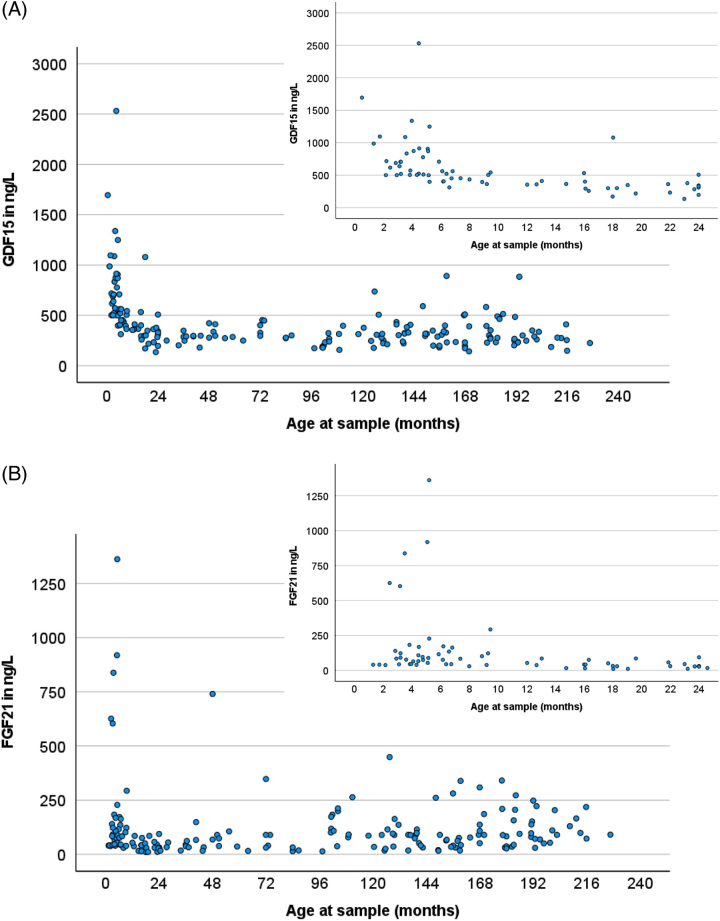
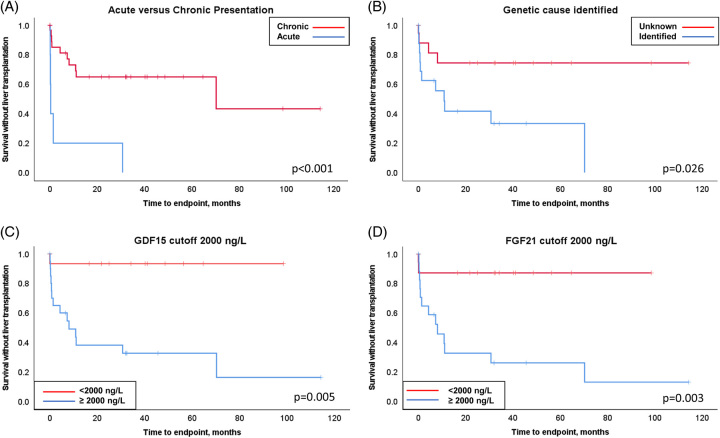
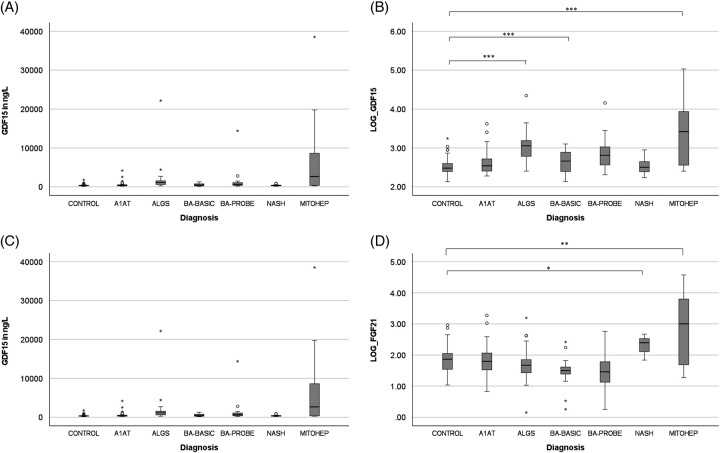
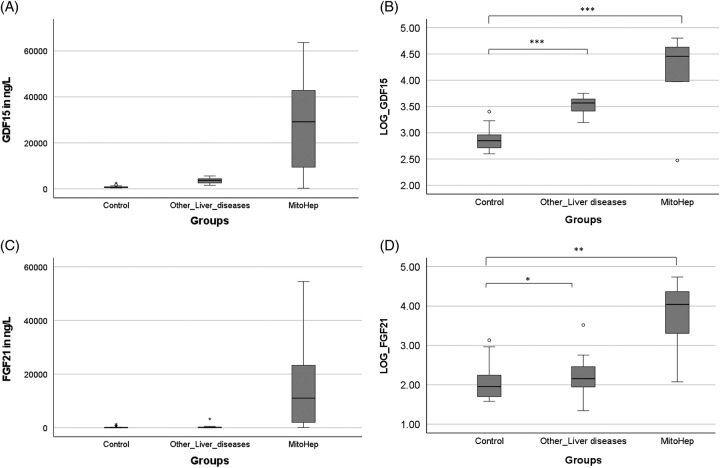
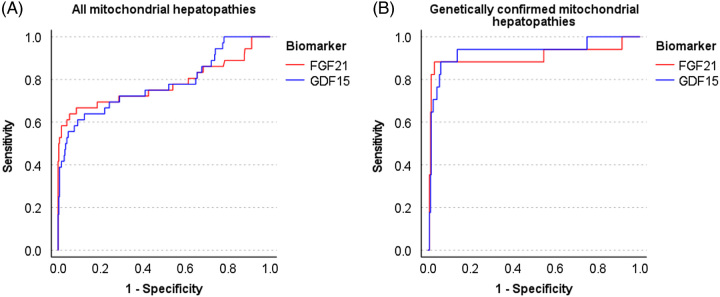
GDF15 levels compared to controls were mildly elevated in patients with α1-antitrypsin deficiency, Alagille syndrome, and biliary atresia-young subgroup, but markedly elevated in MH (p<0.001). FGF21 levels were mildly elevated in NASH and markedly elevated in MH (p<0.001). Both biomarkers were higher in patients with MH with a known genetic cause but were similar in acute and chronic presentations. Both markers had a strong performance to identify MH with a molecular diagnosis with the AUC for GDF15 0.93±0.04 and for FGF21 0.90±0.06. Simultaneous elevation of both markers >98th percentile of controls identified genetically confirmed MH with a sensitivity of 88% and specificity of 96%. In MH, independent predictors of survival without requiring liver transplantation were international normalized ratio and either GDF15 or FGF21 levels, with levels <2000 ng/L predicting survival without liver transplantation (p<0.01).
GDF15 and FGF21 are significantly higher in children with MH compared to other childhood liver diseases and controls and, when combined, were predictive of MH and had prognostic implications.
线粒体肝病变(MHs)是一种原发性线粒体遗传疾病,可表现为儿童期肝病。目前尚无公认的生物标志物可将 MH 与其他儿童期肝病区分开来。生长分化因子 15(GDF15)和成纤维细胞生长因子 21(FGF21)等蛋白生物标志物可将线粒体肌病与其他肌病区分开来。我们评估了这些生物标志物,以确定它们是否可将 MH 与儿童期的其他肝病区分开来。
共检测了 36 例 MH 患儿(17 例有遗传诊断)、38 例胆道闭锁、α1-抗胰蛋白酶缺乏症和 Alagille 综合征患儿、20 例非酒精性脂肪性肝炎(NASH)患儿和 186 例对照者的血清生物标志物。
与对照组相比,α1-抗胰蛋白酶缺乏症、Alagille 综合征和胆道闭锁-年轻亚组患儿的 GDF15 水平轻度升高,但 MH 患儿的 GDF15 水平明显升高(p<0.001)。FGF21 水平在 NASH 患儿中轻度升高,在 MH 患儿中明显升高(p<0.001)。有明确遗传病因的 MH 患儿的两种生物标志物均升高,但急性和慢性表现的两种生物标志物相似。两种标志物对具有分子诊断的 MH 均具有较强的识别能力,GDF15 的 AUC 为 0.93±0.04,FGF21 的 AUC 为 0.90±0.06。同时升高两种标志物超过对照组 98 百分位值可识别出经基因证实的 MH,其灵敏度为 88%,特异性为 96%。在 MH 中,国际标准化比值和 GDF15 或 FGF21 水平是独立的无肝移植生存预测因子,水平<2000ng/L 可预测无肝移植的生存(p<0.01)。
与其他儿童期肝病和对照组相比,MH 患儿的 GDF15 和 FGF21 水平显著升高,两者联合可预测 MH,并具有预后意义。