Dean Kimberlie, Laursen Thomas Munk, Marr Carey, Pedersen Carsten B, Webb Roger T, Agerbo Esben
Discipline of Psychiatry and Mental Health, School of Clinical Medicine, Faculty of Medicine and Health, University of New South Wales, Australia.
Justice Health and Forensic Mental Health Network, NSW, Australia.
Lancet Reg Health Eur. 2023 Nov 22;36:100781. doi: 10.1016/j.lanepe.2023.100781. eCollection 2024 Jan.
Previous research has suggested that people with severe mental illness are at elevated risk of both violence perpetration and violent victimisation, with risk of the latter being perhaps greater than the former. However, few studies have examined risk across both outcomes.
Using a total population approach, the absolute and relative risks of victimisation and perpetration were estimated for young men and women across the full psychiatric diagnostic spectrum. Information on mental disorder status was extracted from national registers and information on violent victimisation and perpetration outcomes from police records. The follow-up was from age 15 to a maximum of 31 years, with most of the person-time at risk pertaining to cohort members aged in their early twenties. Both absolute risk (at 1 and 5 years from onset of illness) and relative risk were estimated.
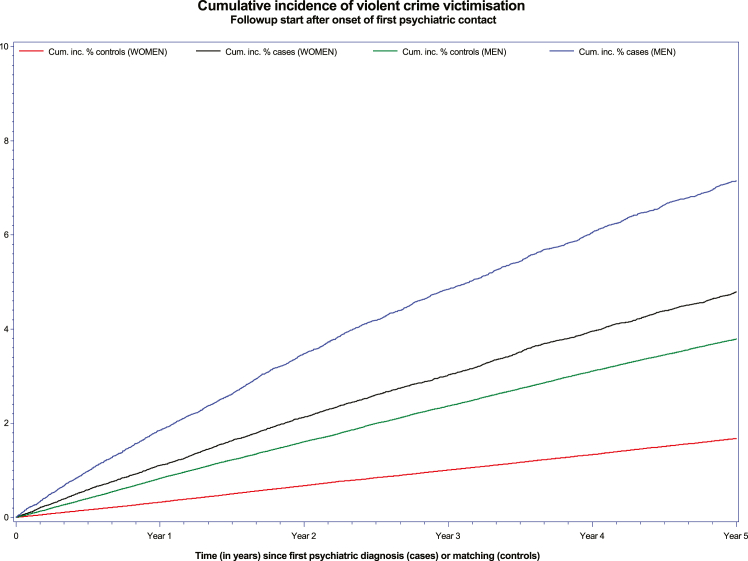
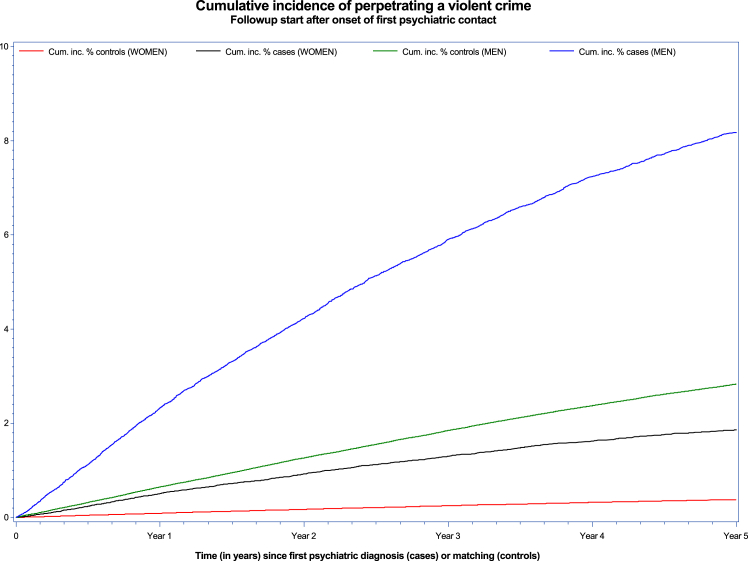
Both types of violent outcome occurred more frequently amongst those with mental illness than the general population. However, whether risk of one was greater than the other depended on a range of factors, including sex and diagnosis. Men with a mental disorder had higher absolute risks of both outcomes than women [victimisation: = 7.15 (6.88-7.42) versus = 4.79 (4.61-4.99); perpetration: = 8.17 (7.90-8.46) versus = 1.86 (1.75-1.98)], as was the case with persons in the general population without a recorded mental illness diagnosis. Women with mental illness had higher absolute risk of victimisation than perpetration, which was also true for men and women without mental illness. However, the opposite was true for men with mental illness. Men and women with diagnoses of personality disorders, substance use disorders, and schizophrenia-spectrum disorders were at highest risk of victimisation and perpetration.
Strategies developed to prevent violent victimisation and violence perpetration may need to be tailored for young adults with mental disorders. There may also be a benefit in taking a sex-specific approach to prevention in this group.
This study was supported by an Australian National Health and Medical Research Council Investigator Grant awarded to the first author.
先前的研究表明,患有严重精神疾病的人实施暴力和成为暴力受害者的风险都有所增加,且后者的风险可能大于前者。然而,很少有研究同时考察这两种结果的风险。
采用全人群研究方法,估计了整个精神疾病诊断范围内年轻男性和女性成为受害者和实施暴力的绝对风险和相对风险。精神障碍状况信息取自国家登记册,暴力受害和实施暴力结果的信息取自警方记录。随访时间从15岁至最长31岁,大部分风险暴露时间涉及20岁出头的队列成员。同时估计了绝对风险(发病后1年和5年)和相对风险。
患有精神疾病的人群中,这两种暴力结果的发生频率均高于普通人群。然而,一种结果的风险是否大于另一种结果取决于一系列因素,包括性别和诊断。患有精神障碍的男性在这两种结果上的绝对风险均高于女性[受害:=7.15(6.88 - 7.42)对=4.79(4.61 - 4.99);实施暴力:=8.17(7.90 - 8.46)对=1.86(1.75 - 1.98)],普通人群中未记录有精神疾病诊断的人也是如此。患有精神疾病的女性成为受害者的绝对风险高于实施暴力的风险,无精神疾病的男性和女性也是如此。然而,患有精神疾病的男性情况则相反。被诊断患有精神人格障碍、物质使用障碍和精神分裂症谱系障碍的男性和女性成为受害者和实施暴力的风险最高。
为预防暴力受害和暴力实施而制定的策略可能需要针对患有精神障碍的年轻人进行调整。针对该群体采取针对性别的预防方法可能也有益处。
本研究得到了澳大利亚国家卫生与医学研究委员会授予第一作者的一项研究员资助。