From St. John's Research Institute (P.D., R.F.), St. John's Medical College (T.T., J.M.R., A.V.K.), and Bruhat Bengaluru Mahanagara Palike (N.B., R.S.) - all in Bangalore, India; the Africa Academy for Public Health (A.M., S.M.K., M.M.S.), Muhimbili University of Health and Allied Sciences (M.B., A.B.P.), Dar es Salaam Regional Medical Office of Health (N.O.S.), and Ifakara Health Institute (H.M.M.) - all in Dar es Salaam, Tanzania; the Harvard T.H. Chan School of Public Health (C.R.S., M.W., N.P., C.P.D., W.W.F.), Harvard Medical School (M.W., C.P.D.), and Boston Children's Hospital (C.P.D.) - all in Boston; Columbia University Medical Center, New York (B.J.W.); and the University of South Carolina, Columbia (N.P.).
N Engl J Med. 2024 Jan 11;390(2):143-153. doi: 10.1056/NEJMoa2307212.
The World Health Organization recommends 1500 to 2000 mg of calcium daily as supplementation, divided into three doses, for pregnant persons in populations with low dietary calcium intake in order to reduce the risk of preeclampsia. The complexity of the dosing scheme, however, has led to implementation barriers.
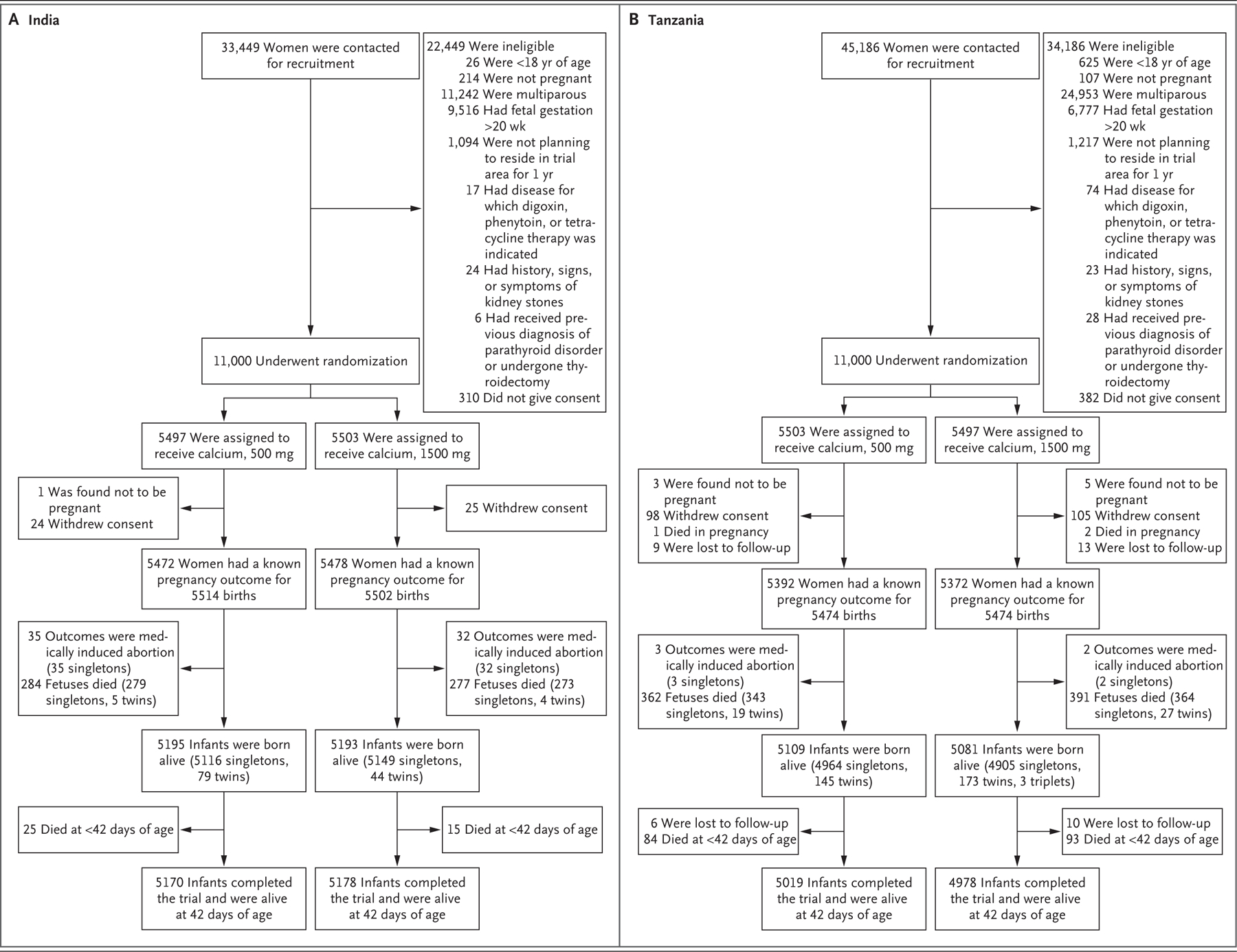
We conducted two independent randomized trials of calcium supplementation, in India and Tanzania, to assess the noninferiority of a 500-mg daily dose to a 1500-mg daily dose of calcium supplementation. In each trial, the two primary outcomes were preeclampsia and preterm birth, and the noninferiority margins for the relative risks were 1.54 and 1.16, respectively.
A total of 11,000 nulliparous pregnant women were included in each trial. The cumulative incidence of preeclampsia was 3.0% in the 500-mg group and 3.6% in the 1500-mg group in the India trial (relative risk, 0.84; 95% confidence interval [CI], 0.68 to 1.03) and 3.0% and 2.7%, respectively, in the Tanzania trial (relative risk, 1.10; 95% CI, 0.88 to 1.36) - findings consistent with the noninferiority of the lower dose in both trials. The percentage of live births that were preterm was 11.4% in the 500-mg group and 12.8% in the 1500-mg group in the India trial (relative risk, 0.89; 95% CI, 0.80 to 0.98), which was within the noninferiority margin of 1.16; in the Tanzania trial, the respective percentages were 10.4% and 9.7% (relative risk, 1.07; 95% CI, 0.95 to 1.21), which exceeded the noninferiority margin.
In these two trials, low-dose calcium supplementation was noninferior to high-dose calcium supplementation with respect to the risk of preeclampsia. It was noninferior with respect to the risk of preterm live birth in the trial in India but not in the trial in Tanzania. (Funded by the Bill and Melinda Gates Foundation and others; ClinicalTrials.gov number, NCT03350516; Clinical Trials Registry-India number, CTRI/2018/02/012119; and Tanzania Medicines and Medical Devices Authority Trials Registry number, TFDA0018/CTR/0010/5).
世界卫生组织建议每日摄入 1500 至 2000 毫克的钙作为补充,分为三剂,以降低子痫前期的风险,适用于低膳食钙摄入量人群中的孕妇。然而,由于剂量方案的复杂性,导致实施存在障碍。
我们在印度和坦桑尼亚进行了两项独立的钙补充随机试验,以评估每日 500 毫克剂量与每日 1500 毫克钙补充剂的非劣效性。在每项试验中,主要结局是子痫前期和早产,相对风险的非劣效性边界分别为 1.54 和 1.16。
两项试验共纳入 11000 名初产妇。在印度试验中,500 毫克组的子痫前期累积发生率为 3.0%,1500 毫克组为 3.6%(相对风险,0.84;95%置信区间[CI],0.68 至 1.03),在坦桑尼亚试验中,分别为 3.0%和 2.7%(相对风险,1.10;95%CI,0.88 至 1.36),这两项试验的结果均与较低剂量的非劣效性一致。500 毫克组的活产早产儿百分比为 11.4%,1500 毫克组为 12.8%(相对风险,0.89;95%CI,0.80 至 0.98),这在 1.16 的非劣效性边界内;在坦桑尼亚试验中,相应的百分比为 10.4%和 9.7%(相对风险,1.07;95%CI,0.95 至 1.21),超过了非劣效性边界。
在这两项试验中,低剂量钙补充与高剂量钙补充相比,子痫前期的风险无差异。在印度的试验中,低剂量钙补充与早产的风险无差异,但在坦桑尼亚的试验中则不然。(由比尔及梅琳达·盖茨基金会等资助;临床试验.gov 编号,NCT03350516;印度临床试验注册中心编号, CTRI/2018/02/012119;以及坦桑尼亚药品和医疗器械管理局试验注册中心编号,TFDA0018/CTR/0010/5)。