Yamada Yosuke, Iwane Kosuke, Nakanishi Yuki, Haga Hironori
Department of Diagnostic Pathology, Kyoto University Hospital, Kyoto 606-8507, Japan.
Department of Gastroenterology and Hepatology, Kyoto University Graduate School of Medicine, Kyoto 606-8507, Japan.
Cancers (Basel). 2023 Dec 25;16(1):115. doi: 10.3390/cancers16010115.
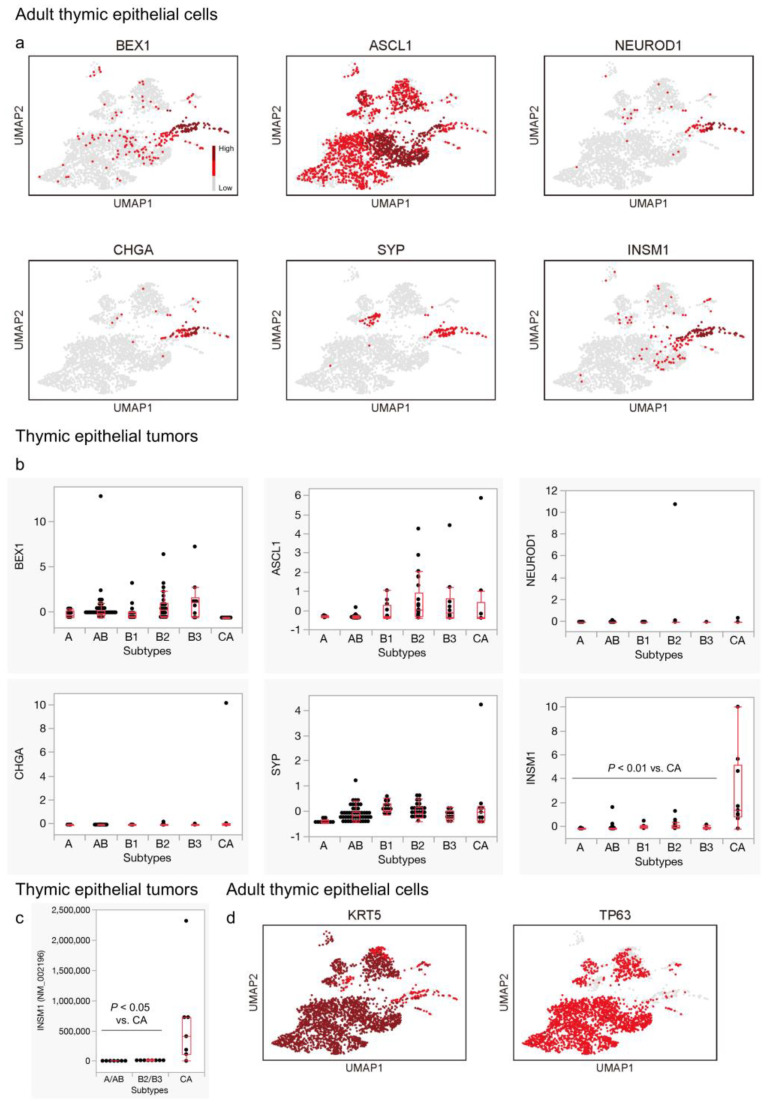
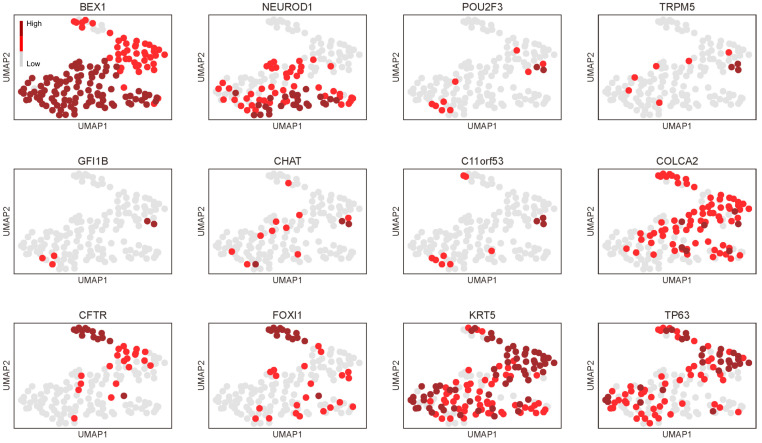
The histogenesis of thymic epithelial tumors (TETs) has been a subject of debate. Recent technological advancements have revealed that thymic carcinomas often exhibit a phenotype akin to tuft cells, which is a subset of medullary TECs. Here, we further explored the gene expression signatures of thymic carcinomas in relation to tuft cells and their kinships-ionocytes and neuroendocrine cells (neuroendocrine group).
We analyzed a single-cell RNA sequencing dataset from the normal human thymus. Concurrently, we examined publicly available datasets on the mRNA expression and methylation status of TECs and lung cancers. Real-time quantitative PCR was also conducted with our tissue samples.
Thymic carcinomas displayed a neuroendocrine phenotype biased toward tuft cells and ionocytes. When exploring the possible regulators of this phenotype, we discovered that and were characteristically expressed in the neuroendocrine group in adult TECs and thymic carcinomas. Additionally, the pan-thymic epithelium markers, exemplified by and , were significantly suppressed in thymic carcinomas.
Thymic carcinomas might be characterized by unique neuroendocrine differentiation and loss of identity as thymic epithelial cells. Future studies investigating the role of HDAC9 and NFATC1 in thymic epithelium are warranted to explore their potential as therapeutic targets in TETs.
胸腺上皮肿瘤(TETs)的组织发生一直是一个有争议的话题。最近的技术进步表明,胸腺癌通常表现出类似于簇状细胞的表型,簇状细胞是髓质胸腺上皮细胞(mTECs)的一个子集。在此,我们进一步探讨了胸腺癌与簇状细胞及其亲属——离子细胞和神经内分泌细胞(神经内分泌组)相关的基因表达特征。
我们分析了来自正常人胸腺的单细胞RNA测序数据集。同时,我们研究了关于胸腺上皮细胞(TECs)和肺癌的mRNA表达及甲基化状态的公开可用数据集。我们还对组织样本进行了实时定量PCR。
胸腺癌表现出偏向簇状细胞和离子细胞的神经内分泌表型。在探索这种表型的可能调节因子时,我们发现HDAC9和NFATC1在成年TECs和胸腺癌的神经内分泌组中特异性表达。此外,以FOXN1和AIRE为例的全胸腺上皮标志物在胸腺癌中显著下调。
胸腺癌可能具有独特的神经内分泌分化特征,并丧失胸腺上皮细胞的特征。未来有必要研究HDAC9和NFATC1在胸腺上皮中的作用,以探索它们作为TETs治疗靶点的潜力。