Tan A Katherine, Henry Aurelie, Goffart Nicolas, van Logtestijn Sofie, Bours Vincent, Hol Elly M, Robe Pierre A
Department of Translational Neuroscience, University Medical Center Utrecht (UMCU) Brain Center, Utrecht University, 3584 CX Utrecht, The Netherlands.
Department of Human Genetics, University of Liège, 4000 Liège, Belgium.
Cancers (Basel). 2023 Dec 30;16(1):193. doi: 10.3390/cancers16010193.
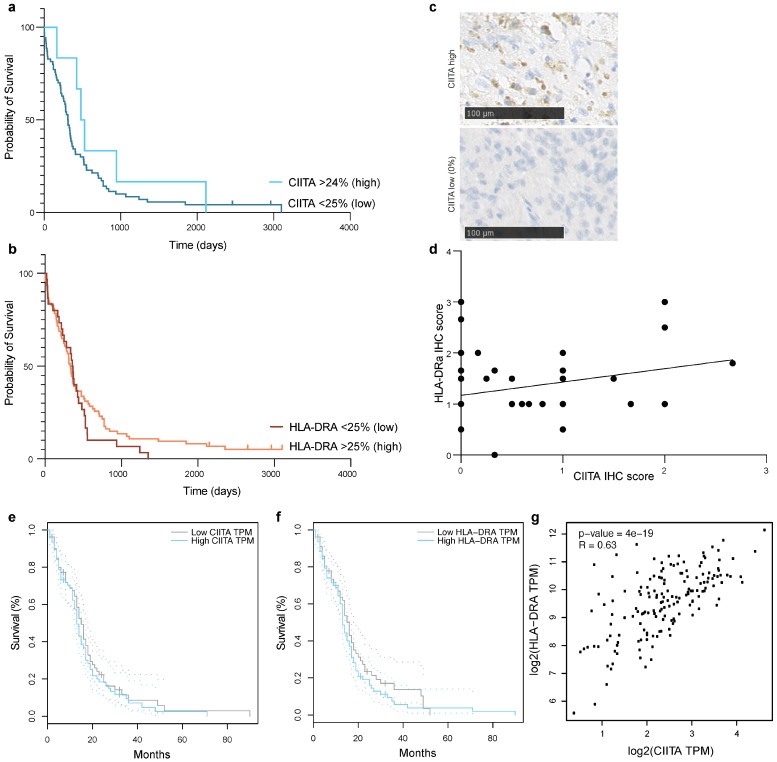
The major histocompatibility complex type II is downregulated in glioblastoma (GB) due to the silencing of the major transcriptional regulator class II transactivator (CIITA). We investigated the pro-immunogenic potential of CIITA overexpression in mouse and human GB.
The intracerebral growth of wildtype GL261-WT cells was assessed following contralateral injection of GL261-CIITA cells or flank injections with GL261-WT or GL261-CIITA cells. Splenocytes obtained from mice implanted intracerebrally with GL261-WT, GL261-CIITA cells or phosphate buffered saline (PBS) were transferred to other mice and subsequently implanted intracerebrally with GL261-WT. Human GB cells and (syngeneic) GB-infiltrating immune cells were isolated from surgical samples and co-cultured with GB cells expressing CIITA or not, followed by RT-qPCR assessment of the expression of key immune regulators.
Intracerebral vaccination of GL261-CIITA significantly reduced the subsequent growth of GL261-WT cells implanted contralaterally. Vaccination with GL261-WT or -CIITA subcutaneously, however, equivalently retarded the intracerebral growth of GL261 cells. Adoptive cell transfer experiments showed a similar antitumor potential of lymphocytes harvested from mice implanted intracerebrally with GL261-WT or -CIITA. Human GB-infiltrating myeloid cells and lymphocytes were not activated when cultured with CIITA-expressing GB cells. Tumor-infiltrating NK cells remained mostly inactivated when in co-culture with GB cells, regardless of CIITA.
these results question the therapeutic potential of CIITA-mediated immunotherapy in glioblastoma.
由于主要转录调节因子II类反式激活因子(CIITA)的沉默,胶质母细胞瘤(GB)中II类主要组织相容性复合体表达下调。我们研究了CIITA过表达在小鼠和人类GB中的促免疫原性潜力。
在对侧注射GL261-CIITA细胞后评估野生型GL261-WT细胞的脑内生长情况,或在侧腹注射GL261-WT或GL261-CIITA细胞。将从脑内植入GL261-WT、GL261-CIITA细胞或磷酸盐缓冲盐水(PBS)的小鼠中获得的脾细胞转移到其他小鼠中,随后脑内植入GL261-WT。从手术样本中分离出人GB细胞和(同基因的)GB浸润免疫细胞,并与表达或不表达CIITA的GB细胞共培养,随后通过RT-qPCR评估关键免疫调节因子的表达。
脑内接种GL261-CIITA显著降低了对侧植入的GL261-WT细胞的后续生长。然而,皮下接种GL261-WT或-CIITA等效地延缓了GL261细胞的脑内生长。过继性细胞转移实验表明,从脑内植入GL261-WT或-CIITA的小鼠中收获的淋巴细胞具有相似的抗肿瘤潜力。当与人GB浸润的髓样细胞和淋巴细胞与表达CIITA的GB细胞共培养时,它们未被激活。与GB细胞共培养时,肿瘤浸润性NK细胞大多仍处于未激活状态,无论是否存在CIITA。
这些结果对CIITA介导的免疫疗法在胶质母细胞瘤中的治疗潜力提出了质疑。