
瑜伽干预对创伤后下肢截肢者行为及生活质量的影响:一项随机对照试验
Impact of Yoga Intervention in Lower Limb Amputees following Trauma in Relation to Behavior and Quality of Life: A Randomized Controlled Trial.
作者信息
Mir Nida, Sen Mahadev Singh, Mani Kalaivani, Sagar Rajesh, Arulselvi S, Kumar Subodh, Gupta Amit, Sagar Sushma
机构信息
Division of Trauma Surgery and Critical Care, JPNATC, AIIMS, New Delhi, India.
Institute of Human Behaviour and Allied Sciences, New Delhi, India.
出版信息
Int J Yoga. 2023 May-Aug;16(2):106-115. doi: 10.4103/ijoy.ijoy_156_23. Epub 2023 Nov 21.
BACKGROUND
Yoga is an emerging intervention causing improvement in physical, mental, and spiritual well-being. Its role in improving outcomes in patients with amputation was investigated.
METHODOLOGY
Patients with traumatic lower limb amputation ( = 50) were enrolled and randomized to the Yoga group ( = 26) against control ( = 24). Sociodemographic details, quality of life (QOL) (World Health Organization QOL-BREF), Depression anxiety stress scale (DASS), Rosenberg self-esteem scale, and amputee body image score were applied at baseline, 6,-18 weeks of amputation.
RESULTS
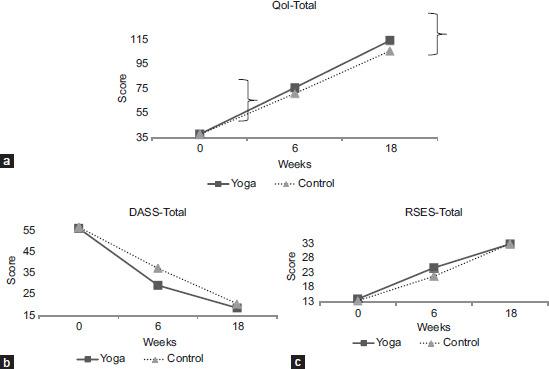
Sociodemographic and clinical variables were comparable between groups. At 18 weeks, the Yoga group had better QOL ( = 0.005) than the control group. Symptoms of depression (0.02) and anxiety (<0.001) reduced, and self-image ( = 0.015) improved significantly at 6 weeks, while stress ( = 0.003) reduced at 18 weeks in the yoga group. Despite comparable body image scores, the prosthesis usage (hours/day) was more ( = 0.005) in the Yoga (6.9 ± 3.2) group against the control (12 ± 2.7).
CONCLUSION
Yoga improves QOL and self-esteem and reduces depression, anxiety, and stress symptoms in patients with traumatic amputation.
背景
瑜伽是一种新兴的干预方式,可改善身体、心理和精神健康。本研究调查了瑜伽在改善截肢患者预后方面的作用。
方法
纳入50例创伤性下肢截肢患者,随机分为瑜伽组(26例)和对照组(24例)。在截肢后的基线、6周和18周时,应用社会人口统计学细节、生活质量(世界卫生组织生活质量简表)、抑郁焦虑压力量表、罗森伯格自尊量表和截肢者身体形象评分。
结果
两组间社会人口统计学和临床变量具有可比性。在18周时,瑜伽组的生活质量(P = 0.005)优于对照组。在6周时,瑜伽组的抑郁症状(P = 0.02)和焦虑症状(P < 0.001)减轻,自我形象(P = 0.015)显著改善;在18周时,压力(P = 0.003)减轻。尽管身体形象评分相当,但瑜伽组(6.9 ± 3.2)的假肢使用时间(小时/天)比对照组(12 ± 2.7)更长(P = 0.005)。
结论
瑜伽可改善创伤性截肢患者的生活质量和自尊,减轻抑郁、焦虑和压力症状。


 Zotero 插件