Duus Louise Aarup, Junker Theresa, Rasmussen Benjamin Schnack Brandt, Vilstrup Mie Holm, Lund Lars, Pedersen Michael, Graumann Ole
Department of Radiology, Odense University Hospital, Odense, Denmark.
Department of Nuclear Medicine, Odense University Hospital, Odense, Denmark.
J Clin Imaging Sci. 2023 Dec 15;13:37. doi: 10.25259/JCIS_66_2023. eCollection 2023.
The objective of this study was to investigate renal function after robot-assisted partial nephrectomy (RAPN) and percutaneous cryoablation (PCA) in clinical stage T1 (cT1) renal cell carcinoma (RCC) and evaluate the relationship between baseline renal function and renal functional outcome.
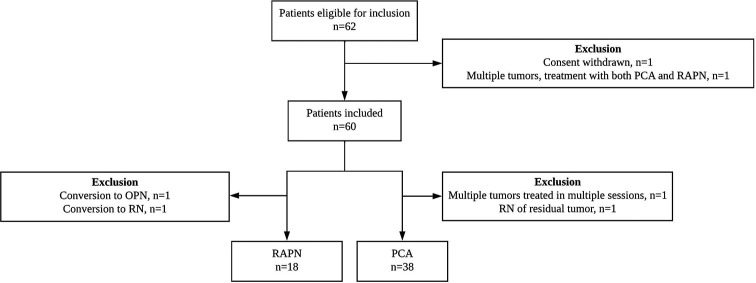
Patients with cT1 RCC treated with RAPN or PCA were prospectively enrolled between June 2019 and January 2021. Renal function was evaluated using estimated glomerular filtration rate, Tc-99m diethylenetriamine-pentaacetate plasma clearance, Tc-99m mercaptoacetyltriglycine renography, and renal volume at baseline and 6 months after treatment.
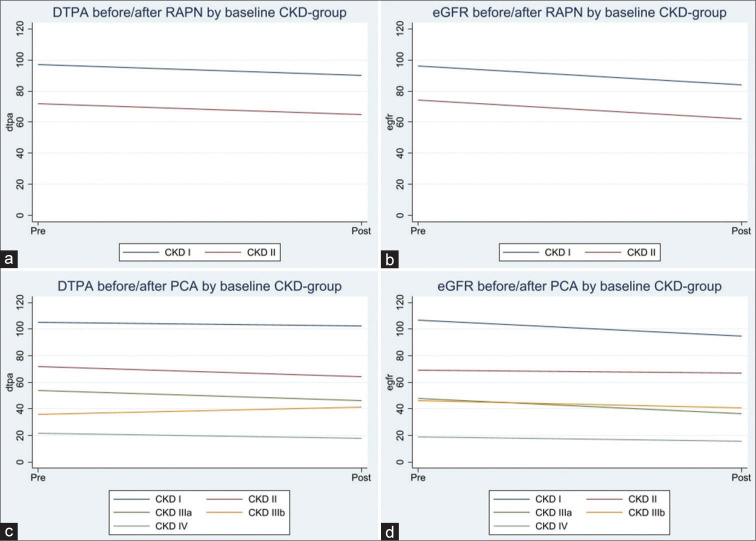
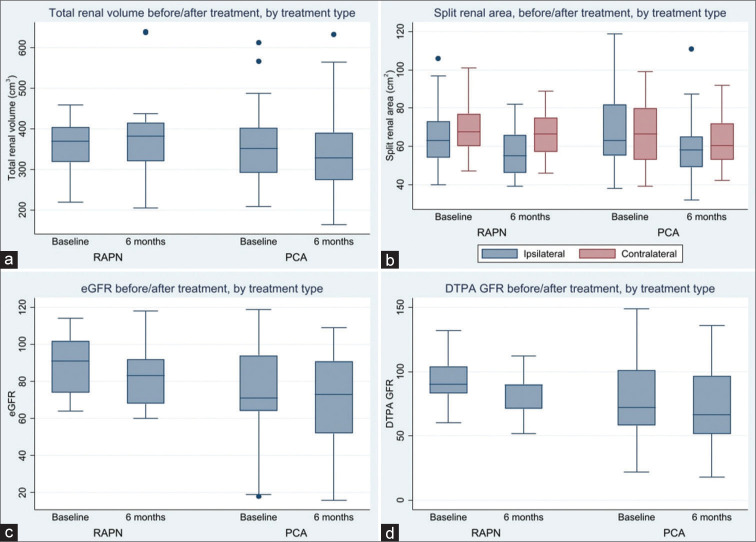
Fifty-six patients were included (18 RAPN, 38 PCA). PCA patients had a significantly higher age (68.5 years; = 0.019) and Charlson comorbidity index (3.0; = 0.007). Tumor characteristics did not differ significantly between RAPN and PCA. Total renal volume decreased significantly after PCA (-18.2 cm; = 0.001). Baseline chronic disease stage IIIb-IV leads to a greater reduction in renal volume (-31.8 cm; = 0.003) but not other renal function measures. Renal function declined significantly after either treatment without significant differences between RAPN and PCA.
This study found a small, similar decrease in renal function 6 months after RAPN or PCA, despite significant differences in baseline patient characteristics. Reduced renal function at baseline did not lead to a worse renal functional outcome.
本研究的目的是调查临床分期为T1(cT1)的肾细胞癌(RCC)患者在接受机器人辅助部分肾切除术(RAPN)和经皮冷冻消融术(PCA)后的肾功能,并评估基线肾功能与肾功能结局之间的关系。
2019年6月至2021年1月期间前瞻性纳入接受RAPN或PCA治疗的cT1 RCC患者。在基线和治疗后6个月,使用估计肾小球滤过率、Tc-99m二乙三胺五乙酸血浆清除率、Tc-99m巯基乙酰三甘氨酸肾图和肾体积评估肾功能。
共纳入56例患者(18例行RAPN,38例行PCA)。PCA组患者年龄显著更高(68.5岁;P = 0.019),查尔森合并症指数更高(3.0;P = 0.007)。RAPN组和PCA组的肿瘤特征无显著差异。PCA术后总肾体积显著减小(-18.2 cm;P = 0.001)。基线慢性疾病IIIb-IV期导致肾体积减小幅度更大(-31.8 cm;P = 0.003),但其他肾功能指标无此情况。两种治疗后肾功能均显著下降,RAPN组和PCA组之间无显著差异。
本研究发现,尽管基线患者特征存在显著差异,但RAPN或PCA术后6个月肾功能均有小幅且相似的下降。基线肾功能降低并未导致更差的肾功能结局。