Center for Anesthesia Research Excellence (CARE), Beth Israel Deaconess Medical Center, Harvard Medical School, Boston, MA.
Department of Internal Medicine, King Hussein Cancer Center (KHCC), Amman, Jordan.
JCO Glob Oncol. 2024 Jan;10:e2300349. doi: 10.1200/GO.23.00349.
Clinical trials are valuable evidence for managing urologic malignancies. Early termination of clinical trials is associated with a waste of resources and may substantially affect patient care. We sought to study the termination rate of urologic cancer clinical trials and identify factors associated with trial termination.
A cross-sectional search of ClinicalTrials.gov identified completed and terminated kidney, prostate, and bladder cancer clinical trials started. Trials were assessed for reasons for termination. Multivariable analyses were conducted to determine the significant factors associated with the termination.
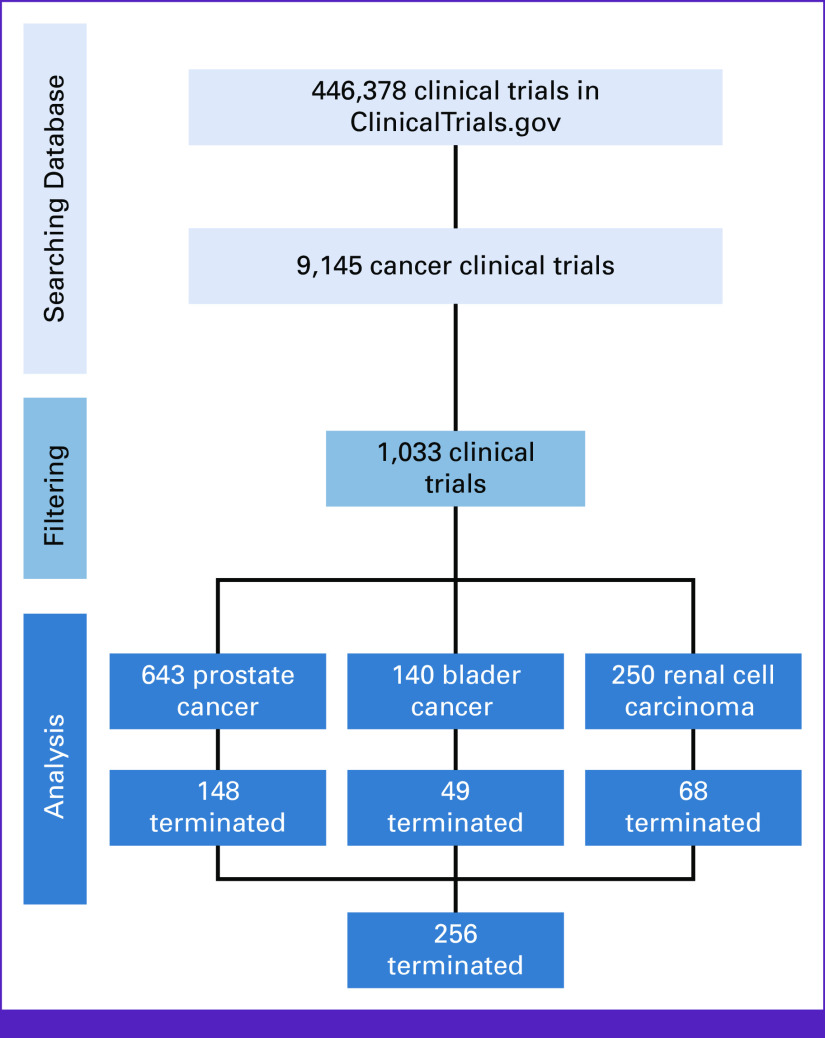
Between 2000 and 2020, 9,145 oncology clinical trials were conducted, of which 11.30% (n = 1,033) were urologic cancer clinical trials. Of the urologic cancer clinical trials, 25.38% (n = 265) were terminated, with low patient accrual being the most common reason for termination, 52.9% (n = 127). Multivariable analysis showed that only the university funding source odds ratio (OR) of 2.20 (95% CI, 1.45 to 3.32), single-center studies OR of 2.11 (95% CI, 1.59 to 2.81), and sample size of <50 were significant predictors of clinical trial termination OR of 5.26 (95% CI, 3.85 to 7.69); all values are <.001.
The termination rate of urologic cancer clinical trials was 25%, with low accrual being the most frequently reported reason. Trials funded by a university, single-center trials, and small trials (sample size <50) were associated with early termination. A better understanding of these factors might help researchers, funding agencies, and other stakeholders prioritize resource allocations for multicenter trials that aim to recruit a sufficient number of patients.
临床试验是管理泌尿系统恶性肿瘤的有价值的证据。临床试验的提前终止与资源浪费有关,并可能对患者的治疗产生重大影响。我们试图研究泌尿系统癌症临床试验的终止率,并确定与试验终止相关的因素。
对 ClinicalTrials.gov 进行了横断面检索,以确定已完成和已终止的肾、前列腺和膀胱癌临床试验。对试验终止的原因进行评估。进行多变量分析以确定与终止相关的显著因素。
在 2000 年至 2020 年期间,进行了 9145 项肿瘤学临床试验,其中 11.30%(n=1033)为泌尿系统癌症临床试验。在泌尿系统癌症临床试验中,有 25.38%(n=265)被终止,其中低患者入组是终止的最常见原因,占 52.9%(n=127)。多变量分析显示,只有大学资助来源的比值比(OR)为 2.20(95%可信区间,1.45 至 3.32)、单中心研究的 OR 为 2.11(95%可信区间,1.59 至 2.81)和<50 的样本量是临床试验终止的显著预测因素,OR 为 5.26(95%可信区间,3.85 至 7.69);所有 P 值均<.001。
泌尿系统癌症临床试验的终止率为 25%,低入组是最常报告的原因。由大学资助、单中心试验和小型试验(样本量<50)与提前终止相关。更好地了解这些因素可能有助于研究人员、资助机构和其他利益相关者为旨在招募足够数量患者的多中心试验分配资源。