Institut de Biotecnologia i de Biomedicina, Universitat Autònoma de Barcelona, 08193, Bellaterra, Barcelona, Spain.
Institut de Ciència de Materials de Barcelona, ICMAB-CSIC, Campus UAB, 08193, Bellaterra, Spain.
Appl Microbiol Biotechnol. 2024 Dec;108(1):98. doi: 10.1007/s00253-024-13003-x. Epub 2024 Jan 11.
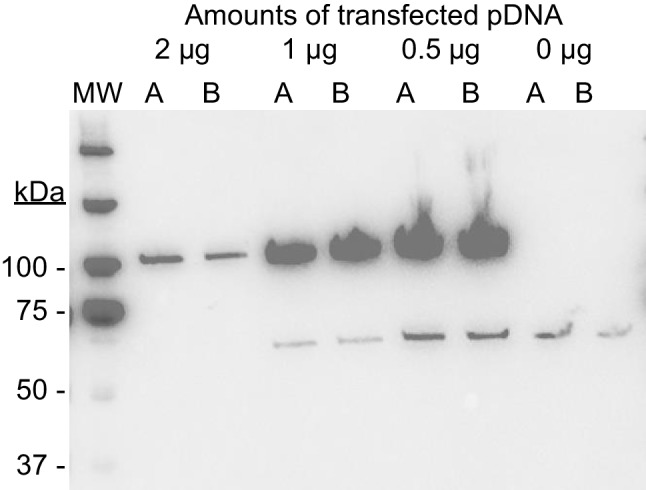
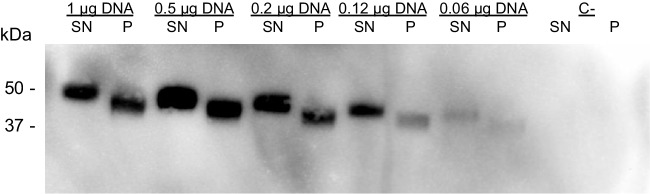
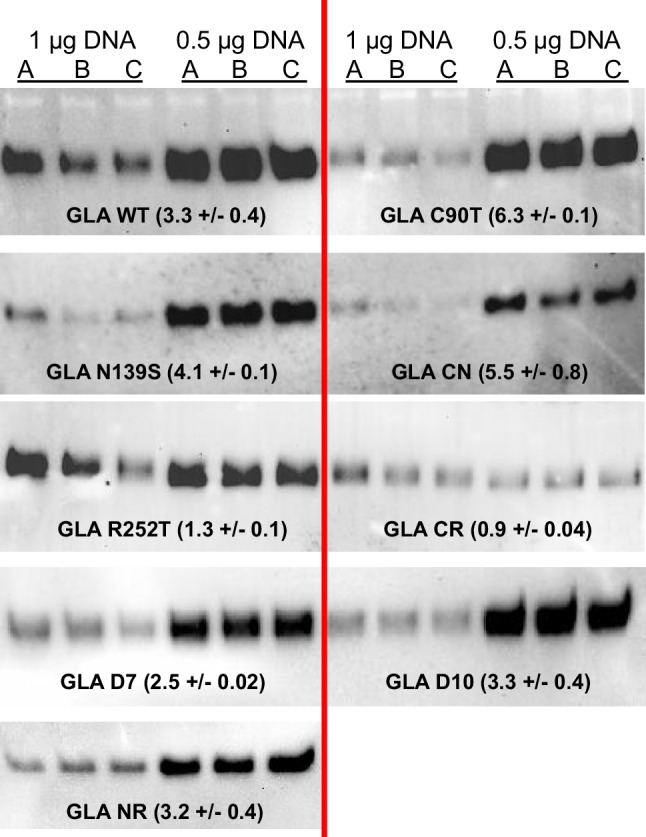
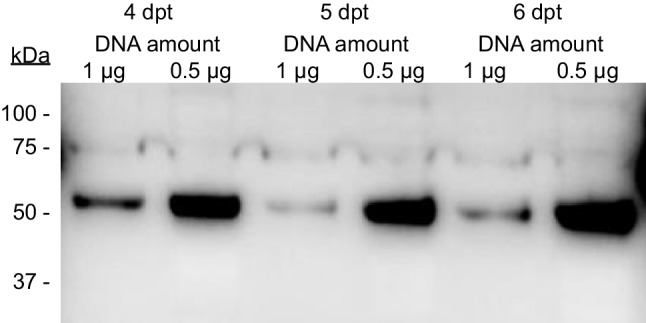
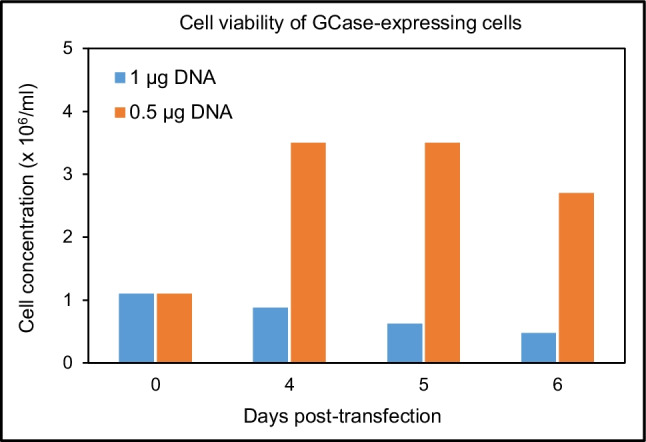
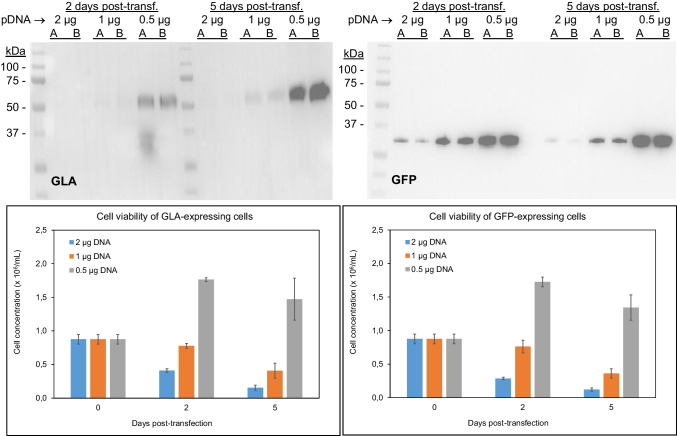
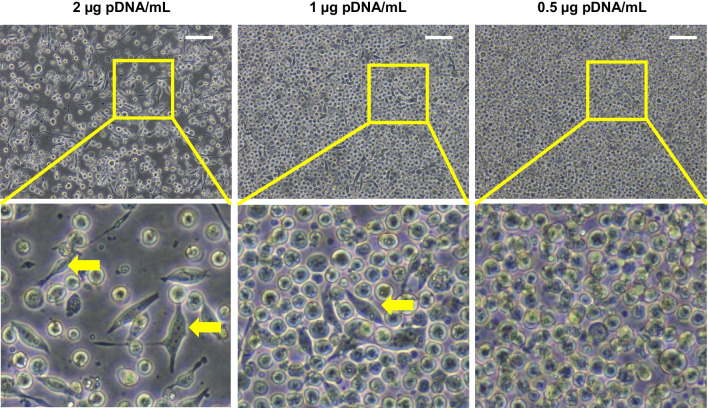
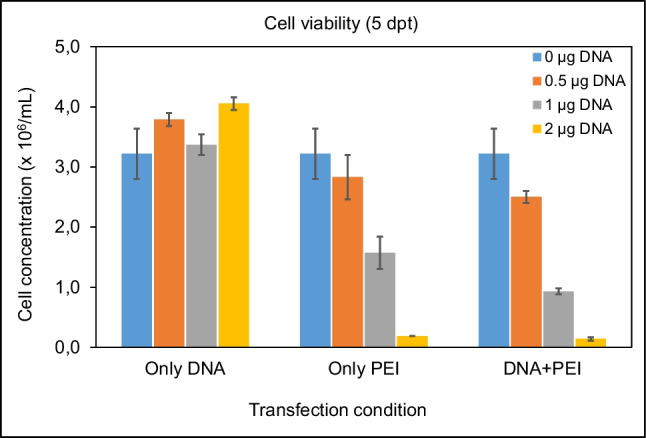
Transient gene expression (TGE) in mammalian cells is a well-known approach to the fast expression of recombinant proteins. The human cell line HEK (human embryonic kidney) 293F is widely used in this field, due to its adaptability to grow in suspension to high cell densities in serum-free media, amenability to transfection, and production of recombinant proteins in satisfactory quantities for functional and structural analysis. Amounts of plasmid DNA (pDNA) required in transfections for TGE remain high (usually 1 µg pDNA/mL, or even higher), representing a noticeable proportion of the overall cost. Thus, there is an economic need to reduce amounts of coding pDNA in TGE processes. In this work, amounts of both pDNA and transfecting agent used for TGE in HEK 293F cells have been explored in order to reduce them without compromising (or even improving) the productivity of the process in terms of protein yield. In our hands, minimal polyethyleneimine (PEI) cytotoxicity and optimum protein yields were obtained when transfecting at 0.5 µg pDNA/mL (equal to 0.5 µg pDNA/million cells) and a DNA-to-PEI ratio of 1:3, a trend confirmed for several unrelated recombinant proteins. Thus, carefully tuning pDNA and transfecting agent amounts not only reduces the economic costs but also results in higher recombinant protein yields. These results surely have a direct application and interest for the biopharmaceutical industry, always concerned in increasing productivity while decreasing economic costs. KEY POINTS: • Mammalian cells are widely used to produce recombinant proteins in short times. • Tuning DNA and transfecting agent are of great interest to optimize economic costs. • Reducing DNA and transfecting agent amounts result in higher protein yields.
瞬时基因表达(TGE)在哺乳动物细胞中是一种快速表达重组蛋白的常用方法。人胚肾 293F(HEK 293F)细胞系因其能够在无血清培养基中悬浮培养至高细胞密度、易于转染以及能够以令人满意的数量生产用于功能和结构分析的重组蛋白而被广泛应用于该领域。TGE 中转染所需的质粒 DNA(pDNA)量仍然很高(通常为 1μg pDNA/mL,甚至更高),这代表了总成本的一个显著部分。因此,在 TGE 过程中减少编码 pDNA 的数量具有经济意义。在这项工作中,为了降低 TGE 过程中的 pDNA 和转染试剂的用量,而不影响(甚至提高)该过程的蛋白质产量,我们探索了 HEK 293F 细胞中转染 pDNA 和转染试剂的用量。在我们的实验中,当以 0.5μg pDNA/mL(相当于 0.5μg pDNA/百万个细胞)和 DNA 与 PEI 的比例为 1:3 进行转染时,最小的聚乙烯亚胺(PEI)细胞毒性和最佳的蛋白质产量得到了实现,对于几种不相关的重组蛋白也得到了同样的趋势。因此,仔细调整 pDNA 和转染试剂的用量不仅降低了经济成本,而且还提高了重组蛋白的产量。这些结果无疑对生物制药行业具有直接的应用和意义,因为它们一直关注在降低经济成本的同时提高生产力。要点:• 哺乳动物细胞被广泛用于在短时间内生产重组蛋白。• 调整 DNA 和转染试剂对于优化经济成本具有重要意义。• 减少 DNA 和转染试剂的用量可提高蛋白产量。