See Claudia, Wheelock Kevin M, Caraballo César, Khera Rohan, Annapureddy Amarnath, Mahajan Shiwani, Lu Yuan, Krumholz Harlan M, Murugiah Karthik
Section of Cardiovascular Medicine, Department of Internal Medicine, Yale School of Medicine, New Haven, Conn.
Department of Internal Medicine, Yale School of Medicine, New Haven, Conn.
Am J Med Open. 2023 Dec;10. doi: 10.1016/j.ajmo.2023.100048. Epub 2023 Jun 24.
Studies show that digoxin use is declining but is still prevalent. Recent data on digoxin prescription and characteristics of digoxin prescribers are unknown, which can help understand its contemporary use.
Using Medicare Part D data from 2013 to 2019, we studied the change in number and proportion of digoxin prescriptions and digoxin prescribers, overall and by specialty. Using logistic regression, we identified prescriber characteristics associated with digoxin prescription.
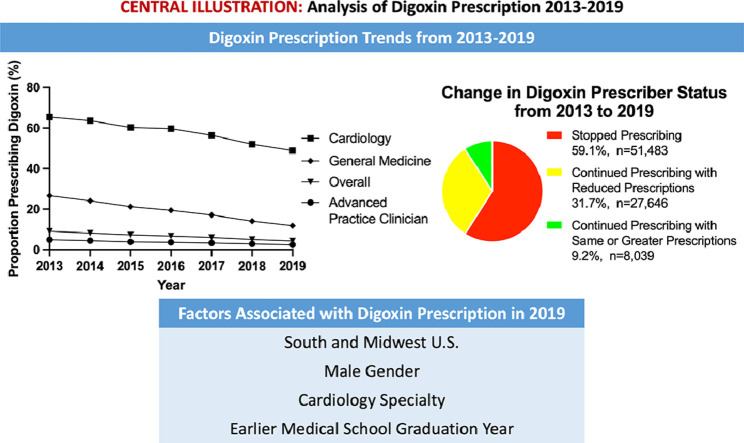
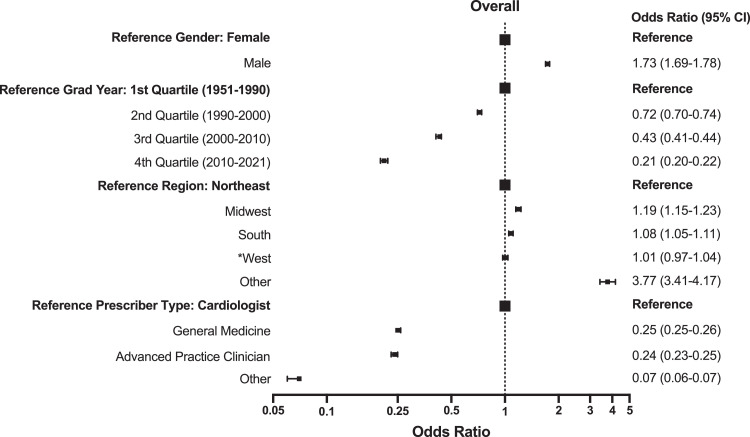
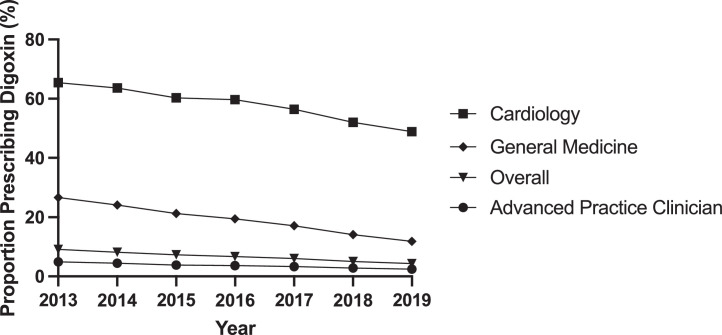
From 2013 to 2019, total digoxin prescriptions (4.6 to 1.8 million) and proportion of digoxin prescribers decreased (9.1% to 4.3% overall; 26.6% to 11.8% among General Medicine prescribers and 65.4% to 48.9% among Cardiology). Of digoxin prescribers from 2013 practicing in 2019 (91.2% remained active), 59.1% did not prescribe digoxin at all, 31.7% reduced, and 9.2% maintained or increased prescriptions. The proportion of all digoxin prescriptions that were prescribed by General Medicine prescribers declined from 59.7% to 48.2% and increased for Cardiology (29% to 38.5%). Among new prescribers in 2019 ( = 85,508), only 1.9% prescribed digoxin. Digoxin prescribers when compared to non-digoxin prescribers were more likely male, graduated from medical school earlier, were located in the Midwest or South, and belonged to Cardiology (all < .001).
Digoxin prescriptions continue to decline with over half of 2013 prescribers no longer prescribing digoxin in 2019. This may be a result of the increasing availability of newer heart failure therapies. The decline in digoxin prescription was greater among general medicine physicians than cardiologists, suggesting a change in digoxin use to a medication prescribed increasingly by specialists.
研究表明地高辛的使用正在减少,但仍然很普遍。目前关于地高辛处方及地高辛处方医生特征的最新数据尚不清楚,而这些数据有助于了解其当前的使用情况。
利用2013年至2019年医疗保险D部分的数据,我们研究了地高辛处方数量和比例以及地高辛处方医生的总体变化情况,并按专业进行了分析。我们使用逻辑回归分析确定与地高辛处方相关的医生特征。
从2013年到2019年,地高辛处方总数(从460万降至180万)和地高辛处方医生的比例下降(总体从9.1%降至4.3%;普通内科处方医生中从26.6%降至11.8%,心脏病学领域从65.4%降至48.9%)。2013年开具地高辛处方且在2019年仍在执业的医生(91.2%仍活跃)中,59.1%根本不再开具地高辛处方,31.7%减少了开具量,9.2%维持或增加了处方量。普通内科处方医生开具的所有地高辛处方比例从59.7%降至48.2%,心脏病学领域的比例则从29%升至38.5%。在2019年的新处方医生中(n = 85508),只有1.9%开具地高辛。与非地高辛处方医生相比,地高辛处方医生更可能为男性,更早从医学院毕业,位于中西部或南部,且属于心脏病学领域(所有P <.001)。
地高辛处方持续减少,2013年开具地高辛处方的医生中超过一半在2019年不再开具。这可能是由于新型心力衰竭治疗方法的可及性增加所致。普通内科医生中地高辛处方的减少幅度大于心脏病专家,这表明地高辛的使用正在发生变化,越来越多地由专科医生开具。