Department of Cognitive and Motor Rehabilitation and Neuroimaging, Santa Lucia Foundation (IRCCS Fondazione Santa Lucia), Rome, Italy.
Department of Psychology, Sapienza University, Rome, Italy.
Hum Brain Mapp. 2024 Jan;45(1):e26571. doi: 10.1002/hbm.26571.
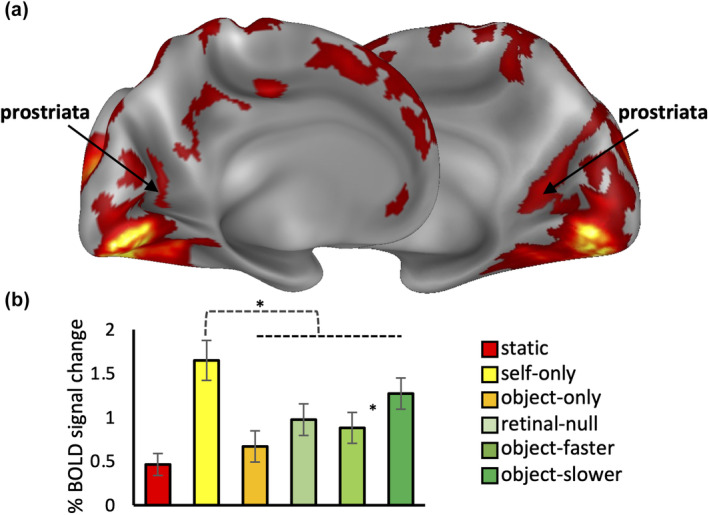
The ability to detect and assess world-relative object-motion is a critical computation performed by the visual system. This computation, however, is greatly complicated by the observer's movements, which generate a global pattern of motion on the observer's retina. How the visual system implements this computation is poorly understood. Since we are potentially able to detect a moving object if its motion differs in velocity (or direction) from the expected optic flow generated by our own motion, here we manipulated the relative motion velocity between the observer and the object within a stationary scene as a strategy to test how the brain accomplishes object-motion detection. Specifically, we tested the neural sensitivity of brain regions that are known to respond to egomotion-compatible visual motion (i.e., egomotion areas: cingulate sulcus visual area, posterior cingulate sulcus area, posterior insular cortex [PIC], V6+, V3A, IPSmot/VIP, and MT+) to a combination of different velocities of visually induced translational self- and object-motion within a virtual scene while participants were instructed to detect object-motion. To this aim, we combined individual surface-based brain mapping, task-evoked activity by functional magnetic resonance imaging, and parametric and representational similarity analyses. We found that all the egomotion regions (except area PIC) responded to all the possible combinations of self- and object-motion and were modulated by the self-motion velocity. Interestingly, we found that, among all the egomotion areas, only MT+, V6+, and V3A were further modulated by object-motion velocities, hence reflecting their possible role in discriminating between distinct velocities of self- and object-motion. We suggest that these egomotion regions may be involved in the complex computation required for detecting scene-relative object-motion during self-motion.
检测和评估世界相对物体运动的能力是视觉系统执行的一项关键计算。然而,观察者的运动极大地复杂化了这一计算,因为观察者的运动会在其视网膜上产生全局运动模式。视觉系统如何执行这一计算还不太清楚。由于我们如果感觉到移动的物体的运动速度(或方向)与我们自身运动产生的预期光流不同,就有可能检测到它,因此我们在这里操纵了观察者和物体在静止场景中的相对运动速度,以此作为测试大脑如何完成物体运动检测的策略。具体来说,我们测试了已知对与自身运动相符的视觉运动有反应的大脑区域(即,与自身运动相符的区域:扣带沟视觉区、后扣带沟区、后岛叶皮质、V6+、V3A、IPSmot/VIP 和 MT+)对虚拟场景中不同速度的视觉诱导平移自身和物体运动的组合的神经敏感性,同时要求参与者检测物体运动。为此,我们结合了个体表面脑图、功能磁共振成像的任务诱发活动,以及参数和表示相似性分析。我们发现,所有的自身运动区域(除了 PIC 区)都对自身和物体运动的所有可能组合做出反应,并受到自身运动速度的调节。有趣的是,我们发现,在所有的自身运动区域中,只有 MT+、V6+和 V3A 进一步受到物体运动速度的调节,因此反映了它们在区分自身和物体运动的不同速度方面的可能作用。我们认为,这些自身运动区域可能参与了在自身运动期间检测场景相对物体运动所需的复杂计算。