Department of Dermatology, Hospital Universitari de Bellvitge, IDIBELL, Universitat de Barcelona, Barcelona, Spain.
Department of Plastic Surgery, Hospital Universitari de Bellvitge, IDIBELL, Universitat de Barcelona, Barcelona, Spain.
Dermatology. 2024;240(3):487-493. doi: 10.1159/000536172. Epub 2024 Jan 16.
Dermatofibrosarcoma protuberans (DFSP) is the most common sarcoma of the skin. Although distant metastases are infrequent, DFSP is highly aggressive locally with frequent local recurrences. It has been reported that the presence within the tumour of areas histopathologically mimicking fibrosarcoma may increase the risk of recurrence.
The objective of this study was to review the clinical features of our patients with DFSP and the factors associated with recurrence of the tumour, focussing on the presence of fibrosarcomatous areas.
Retrospective study of patients with DFSP diagnosed in 1990-2021 in a tertiary university hospital. The medical records were reviewed to obtain the following data: age, sex, tumour location, diameter, evolution time, presence of fibrosarcomatous areas, development of recurrence, and follow-up. Factors possibly associated with disease-free survival were analysed with Kaplan-Meier method and multivariate Cox regression.
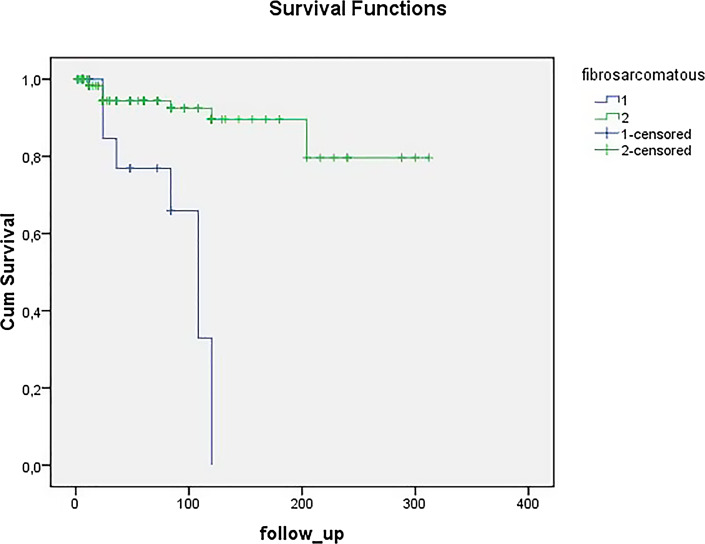
148 patients (74 women/74 men, mean age 46.28 years, SD 14.431) were included in the study. Tumours involved the head and neck in 15 cases, thorax in 31, abdomen in 16, upper back in 43, lower back in 10, upper extremities in 10, and lower extremities in 23. Fibrosarcoma-like areas were observed in 16 tumours (10.81%). In 17 patients (11.49%), recurrences were observed (13 local recurrences, 3 lung metastasis, and 1 local recurrence with lung metastasis). Fibrosarcomatous DFSP recurred more frequently than classic DFSP (50% vs. 6.82%, respectively), and its disease-free survival was significantly lower (p < 0.001). In multivariate Cox regression, the presence of fibrosarcomatous areas was the only factor influencing disease-free survival.
It is important to identify the fibrosarcomatous variant since it recurs more frequently and has lower recurrence-free survival. Distant metastases, mainly in the lung, are also more frequent in fibrosarcomatous DFSP.
隆突性皮肤纤维肉瘤(DFSP)是最常见的皮肤肉瘤。虽然远处转移很少见,但 DFSP 在局部具有高度侵袭性,常发生局部复发。据报道,肿瘤内存在组织病理学上类似于纤维肉瘤的区域可能会增加复发的风险。
本研究旨在回顾我们的 DFSP 患者的临床特征以及与肿瘤复发相关的因素,重点关注纤维肉瘤样区域的存在。
回顾性分析 1990 年至 2021 年在一家三级大学医院诊断的 DFSP 患者的病历,以获取以下数据:年龄、性别、肿瘤位置、直径、演变时间、纤维肉瘤样区域的存在、复发的发展以及随访情况。使用 Kaplan-Meier 法和多变量 Cox 回归分析可能与无病生存相关的因素。
研究共纳入 148 例患者(74 例女性/74 例男性,平均年龄 46.28 岁,标准差 14.431)。肿瘤发生于头部和颈部 15 例,胸部 31 例,腹部 16 例,上背部 43 例,下背部 10 例,上肢 10 例,下肢 23 例。16 例肿瘤中观察到纤维肉瘤样区域(10.81%)。17 例患者(11.49%)出现复发(13 例局部复发,3 例肺转移,1 例局部复发伴肺转移)。纤维肉瘤样 DFSP 比经典 DFSP 更频繁地复发(分别为 50%和 6.82%),其无病生存率显著降低(p < 0.001)。多变量 Cox 回归分析显示,纤维肉瘤样区域的存在是唯一影响无病生存率的因素。
识别纤维肉瘤样变异体很重要,因为它更频繁地复发,且无复发生存率更低。纤维肉瘤样 DFSP 也更容易发生远处转移,主要是在肺部。